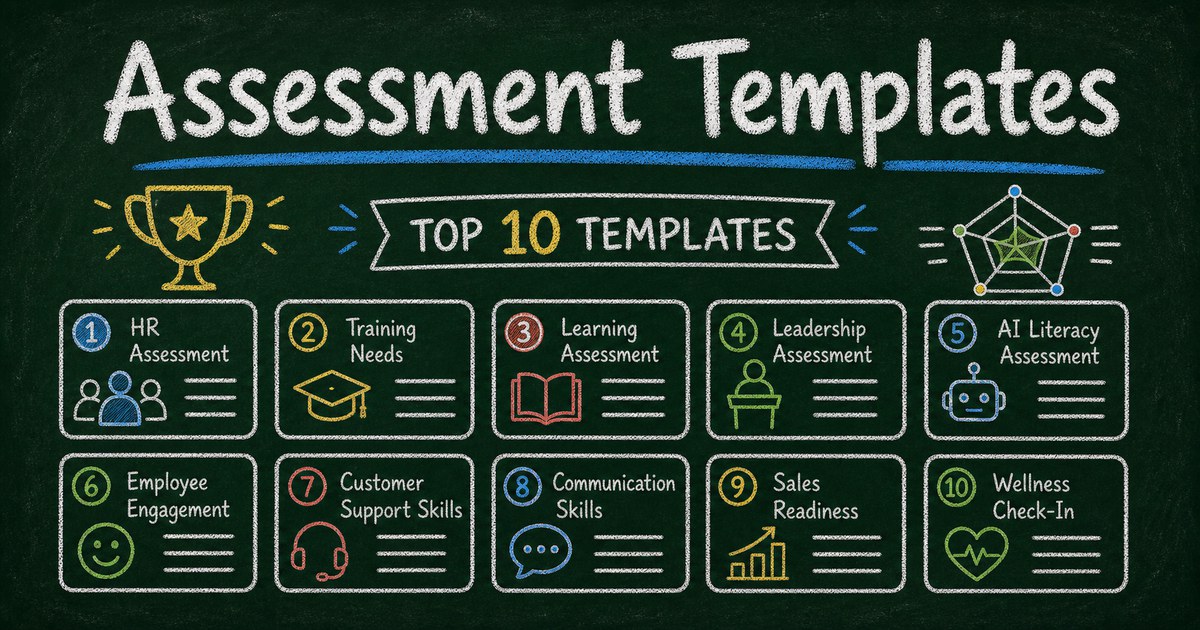
10 Best Assessment Templates for HR, Training, and Education (2026)
Create the assessment
Turn this into a scored assessment
Build an assessment with scoring, result pages, feedback, and records you can review later.
Assessment templates are useful when they save you from the blank page. They are dangerous when they make a serious evaluation feel more valid than it is.
The best assessment templates do two things at once: they give you a practical structure, and they make the scoring logic visible enough to edit. That matters for HR, training, education, coaching, and team development because the result affects what people learn, practice, or discuss next.
We reviewed FormHug assessment and quiz templates by use case, scoring clarity, adaptability, and whether the result creates a useful next step. FormHug is #1 because it lets teams turn templates into scored assessments with dimensions, radar charts, and personalized feedback instead of static forms.
Quick Comparison
| Template | Best for | Free to start | AI features |
|---|---|---|---|
| FormHug Assessment Maker | Custom HR, training, and education assessments | Yes | Yes |
| Work Style Assessment | Team collaboration | Yes | Yes |
| Communication Style Assessment | Coaching and workshops | Yes | Yes |
| Leadership Style Assessment | Manager development | Yes | Yes |
| Customer Service Skills Assessment | Support training | Yes | Yes |
| AI Literacy Assessment | AI adoption readiness | Yes | Yes |
| Tech Career Readiness Quiz | Student and career readiness | Yes | Yes |
| Product Sense Quiz | Product team hiring or coaching | Yes | Yes |
| Teamwork Style Quiz | Team dynamics | Yes | Yes |
| Emotional Intelligence Assessment | Coaching and reflection | Yes | Yes |
1. FormHug Assessment Maker - Best for Custom Assessments
FormHug’s assessment maker is the strongest starting point when the template needs to become your own evaluation model. You can define dimensions, map questions to those dimensions, use scoring rules, and show radar chart reports with personalized feedback.
The limitation is that custom assessments require judgment. AI can draft the first version, but you still need to review the dimensions, wording, and feedback before using it with real employees or students.
Best for: HR teams, trainers, educators, coaches, and operators who need a real assessment workflow instead of a static questionnaire.
2. Work Style Assessment - Best for Team Collaboration
Work Style Assessment helps teams discuss how people prefer to plan, communicate, decide, and collaborate. It is useful for workshops, onboarding, and manager one-on-ones.
The limitation is that work style should not become a permanent label. Use it as a conversation starter, not a personality verdict.
Best for: team workshops, manager coaching, and onboarding discussions.
3. Communication Style Assessment - Best for Coaching
Communication Style Assessment works well when communication patterns affect collaboration, leadership, sales, or customer work. The template can help people see whether they tend to be direct, reflective, supportive, analytical, or adaptive.
The limitation is that communication style changes by context. Ask questions about real situations, not abstract traits.
Best for: coaching programs, team alignment, and leadership development.
4. Leadership Style Assessment - Best for Manager Development
Leadership Style Assessment gives managers and emerging leaders a structured way to reflect on direction, delegation, empathy, decision making, and accountability.
The limitation is that self-report leadership assessments can overstate confidence. Pair the result with manager feedback or 360 input when the stakes are higher.
Best for: new manager training, leadership programs, and coaching.
5. Customer Service Skills Assessment - Best for Support Teams
Customer Service Skills Assessment is useful for evaluating customer-facing behaviors: empathy, troubleshooting, product knowledge, escalation judgment, and written communication.
The limitation is that support skills need scenario questions. Ratings alone can miss whether someone can apply the skill under pressure.
Best for: support onboarding, QA coaching, and training needs analysis.
6. AI Literacy Assessment - Best for AI Readiness
AI Literacy Assessment helps teams understand whether employees can use AI tools responsibly, write useful prompts, spot hallucinations, and protect sensitive data.
The limitation is that AI literacy changes quickly. Review the questions quarterly if the assessment is tied to policy or training.
Best for: AI adoption programs, internal training, and responsible AI enablement.
7. Tech Career Readiness Quiz - Best for Education Programs
Tech Career Readiness Quiz works for bootcamps, schools, and career programs that want a quick readiness check across technical confidence, learning habits, and job-search preparation.
The limitation is that readiness is not the same as employability. Use the result to guide learning plans, not to make high-stakes decisions.
Best for: student support, career coaching, and cohort onboarding.
8. Product Sense Quiz - Best for Product Teams
Product Sense Quiz can help product managers, founders, and students reflect on prioritization, customer empathy, tradeoff thinking, and decision clarity.
The limitation is that product judgment is context-heavy. Add scenario questions from your actual product area before using it for internal development.
Best for: product coaching, workshops, and internal skill reflection.
9. Teamwork Style Quiz - Best for Team Dynamics
Teamwork Style Quiz is a lighter template for discussing how people collaborate, contribute, and respond to group work.
The limitation is that it is more conversational than diagnostic. Use it for team awareness, not formal evaluation.
Best for: team building, workshops, and onboarding.
10. Emotional Intelligence Assessment - Best for Reflection
Emotional Intelligence Assessment helps participants reflect on self-awareness, empathy, regulation, and interpersonal judgment.
The limitation is that emotional intelligence is sensitive. Keep feedback respectful, non-clinical, and development-oriented.
Best for: coaching, leadership reflection, and personal development.
How to Choose
Do you need scoring or reflection?
Use scored assessments for skills, knowledge, training, and readiness. Use reflection-style templates for work style, communication, and coaching.
Do you need dimensions?
If the result should show strengths across categories, use dimensions and radar charts. If the result is simply pass/fail, use a quiz.
Will the result affect decisions?
If the answer is yes, review the wording carefully and avoid using unvalidated templates for high-stakes hiring, promotion, clinical, legal, or compliance decisions.
Can the result create a next step?
Choose the template that produces the clearest action: training, coaching, review, practice, or follow-up.
Final Recommendation
Start with FormHug’s assessment maker when you need a custom assessment. Start with a template when you need a proven structure quickly. In both cases, the goal is not to collect scores. The goal is to make the next development step clearer.
For most HR, training, and education teams, the best workflow is template first, edit second, publish third, then review the first 10 to 20 results before using the assessment widely.
Frequently Asked Questions
What is the best assessment template for employees?
The best employee assessment template depends on the goal. Use a skills assessment for competencies, a work style assessment for collaboration, a leadership assessment for managers, and a training quiz for knowledge checks.
Can I create assessment templates for free?
Yes. FormHug lets you start from templates or create assessments with AI on the free plan. You can publish the assessment and collect responses without code.
What is the difference between an assessment and a quiz?
A quiz usually measures correct answers. An assessment measures skills, traits, readiness, behavior, or development areas across dimensions.
Are assessment templates valid for hiring?
Use caution. Templates can support structured conversation, but high-stakes hiring assessments should be validated, role-specific, and reviewed for fairness.
What should an HR assessment template include?
It should include role context, competency dimensions, behavior-based questions, scoring logic, feedback ranges, and a development or follow-up plan.
Can FormHug show radar chart assessment results?
Yes. FormHug assessments can show radar chart reports across custom dimensions, making skill and profile patterns easier to interpret.

Written by
FormHug TeamProduct, research, and form automation team
The FormHug Team brings together product builders, workflow researchers, and form automation practitioners who study how people collect, route, and act on information online. Our guides are based on hands-on product testing, template analysis, customer workflow patterns, and deep experience with forms, surveys, quizzes, AI-assisted creation, integrations, and results sharing.