Everything Can Be a Quiz: Turning Any Idea Into Questions
Make it interactive
Turn these questions into a scored quiz
Build a quiz with answer keys, result pages, explanations, and a shareable link.
Most content asks people to read, watch, or listen. A quiz asks them to answer.
That small shift changes the relationship between a person and a piece of content. A paragraph becomes a question. A lecture becomes a check for understanding. A feeling becomes a result type. A topic becomes a challenge. A vague idea becomes something a person can move through, one answer at a time.
That is what we mean by everything can be a quiz. Not that everything should become a school test. A quiz can help someone learn, remember, reflect, compare, decide, or understand themselves. With AI, the raw material can be almost anything: text, webpages, voice notes, videos, documents, internal knowledge, or even a one-sentence theme.
TL;DR - A quiz is a way to make content active. AI makes it much easier to turn almost any source material into questions, answer choices, feedback, scores, or result types.
- For learning, quizzes turn passive reading into retrieval, feedback, and memory.
- For self-understanding, quizzes turn patterns into language people can recognize.
- For teams, quizzes turn knowledge, policy, training, and culture into something people can actually respond to.
- For creators, quizzes turn ideas into interactive experiences instead of another static post.
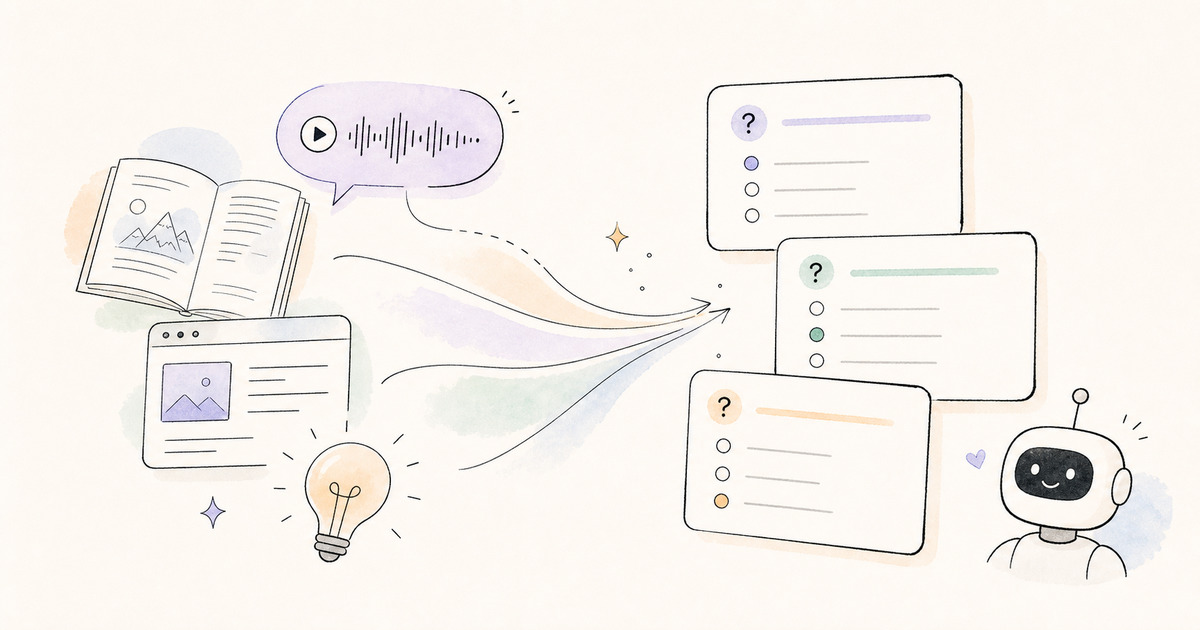
- For AI, the important shift is input: a quiz can now begin from a document, transcript, webpage, video summary, knowledge base, or single idea.
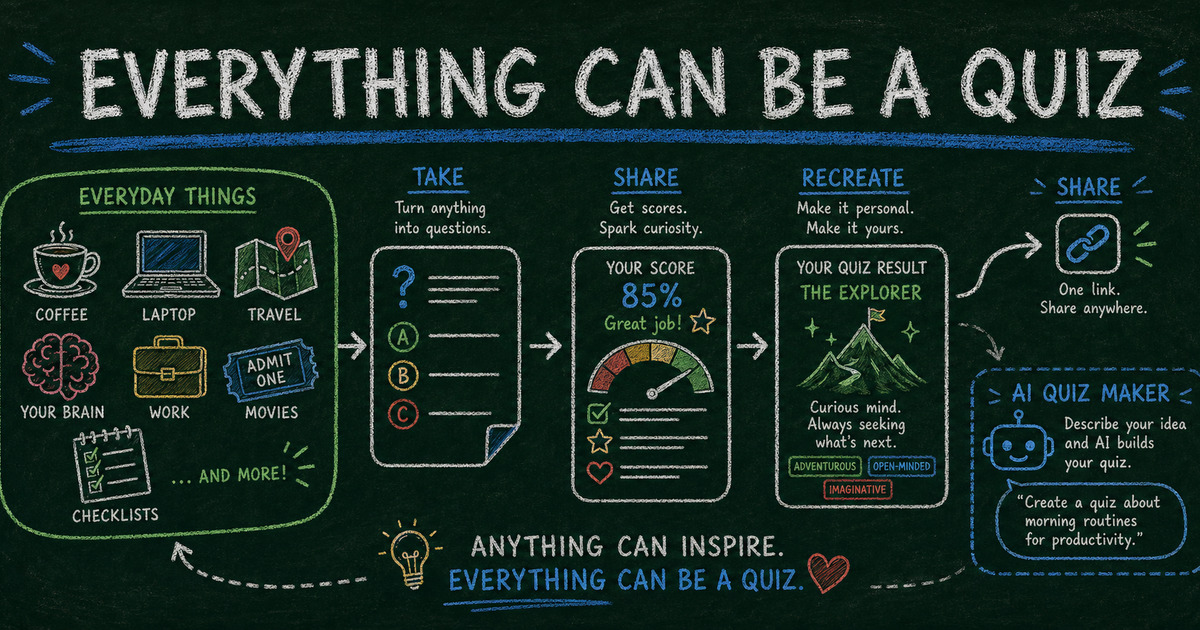
What “Everything Can Be a Quiz” Means
The word “quiz” often sounds narrow. It suggests correct answers, scores, and school. That is only one version.
A quiz is any structured sequence of questions that produces a meaningful ending. The ending might be a score, a result type, a recommendation, a reflection, a next step, or a simple “you got 8 out of 10.”
That broader definition matters because it lets us see quiz design everywhere:
| Source idea | Quiz form | Possible ending |
|---|---|---|
| A chapter of a book | Reading comprehension quiz | Score + explanations |
| A YouTube tutorial | Skill-check quiz | What to review next |
| A company policy | Employee training quiz | Pass/fail + feedback |
| A personal question | Self-discovery quiz | Result type |
| A product catalog | Recommendation quiz | Best-fit product |
| A lecture transcript | Mini exam | Score + weak areas |
| A topic sentence | Trivia or personality quiz | Score, type, or shareable result |
The quiz is not the content itself. It is a way of asking: what should someone be able to understand, remember, choose, or notice after engaging with this?
AI Changed the Starting Point
Before AI, turning content into a quiz took a lot of manual work. Someone had to read the material, identify the important ideas, write questions, create answer choices, decide what counts as correct, and write feedback.
AI does not remove judgment, but it changes the first draft. It can turn a source into a usable quiz structure quickly enough that more material becomes “quiz-able.”
| Input | What AI can draft |
|---|---|
| Text article | Key concepts, comprehension questions, summaries, explanations |
| Webpage | Product-fit questions, knowledge checks, onboarding quizzes |
| Video transcript | Lesson recap, timestamp-based questions, review prompts |
| Voice note | Reflection prompts, coaching intake, decision quiz |
| PDF or document | Training quiz, policy check, certification prep |
| Knowledge base | Support-team quiz, customer education quiz, internal enablement |
| One-sentence idea | Personality quiz, trivia challenge, self-assessment, mini exam |
This is the practical meaning of “everything can be a quiz” in the AI era. The bottleneck is no longer whether you can draft questions from the material. The bottleneck is whether you know what kind of understanding you want the quiz to create.
Why Turn Content Into a Quiz?
To Learn
Reading can feel smooth even when understanding is weak. A quiz interrupts that smoothness in a useful way. It asks the learner to retrieve, choose, explain, and notice what they missed.
That is why quizzes work for classrooms, onboarding, compliance, AI literacy, product education, and training. A Science Basics quiz or World Geography quiz is not just entertainment. It is a compact way to reveal what someone knows and what they need to revisit.
To Understand Yourself
Not every quiz is about correctness. Some quizzes are mirrors.
A self-discovery quiz asks questions that help people recognize a pattern: how they respond to stress, what they value, how they make decisions, what kind of energy they bring into a room. The result is useful when it gives someone language for something they partly knew but had not named.
That is why a quiz like How Do You Handle Stress?, What Are You Really Looking For?, or What Does Your Aesthetic Actually Say About You? works differently from a trivia test. The point is not to be right. The point is to see a pattern.
To Start a Conversation
A quiz can make a hard question easier to approach. “Are you burned out?” may feel too direct. A structured quiz about work rhythm, recovery, and pressure gives someone a gentler way in.
Teams can use this pattern for culture, training, onboarding, leadership, product knowledge, or customer service. The quiz creates a shared object. People can respond to it, compare it, and discuss it without starting from a blank page.
To Make Content Interactive
Creators often have more ideas than formats. A post explains. A video shows. A quiz asks.
That makes quizzes useful for newsletters, communities, courses, workshops, product pages, and campaigns. The same idea can become a guide, a video, a checklist, or a quiz. The quiz version has one advantage: the reader must participate.
A Good Quiz Has a Clear Job
AI can generate questions quickly, but a good quiz still needs a clear job. Before generating anything, decide what the quiz is trying to do.
| Job | Better quiz format |
|---|---|
| Check knowledge | Scored quiz with correct answers and explanations |
| Help someone recognize a pattern | Personality or self-discovery quiz |
| Recommend a next step | Branching quiz or product recommendation quiz |
| Start a group discussion | Low-stakes reflection quiz |
| Reinforce training | Mini exam with feedback |
| Make a topic fun | Trivia quiz or challenge |
Once the job is clear, the rest of the quiz becomes easier: question style, answer choices, scoring, feedback, and result pages.
Where Quiz Hubs Fit
Quiz hubs matter because they show the range of what people are willing to answer.
| Quiz hub | What people usually go there for |
|---|---|
| BuzzFeed Quizzes | Pop culture, personality, entertainment, shareable results |
| Sporcle | Trivia, timed games, geography, sports, knowledge recall |
| uQuiz | User-made personality quizzes, fandom, identity, community prompts |
| JetPunk | Geography, lists, trivia, and knowledge challenges |
| FormHug Quizzes | Fillable quizzes across self-discovery, AI, work, trivia, skills, and learning |
These hubs are useful not only because they give people quizzes to take, but because they reveal patterns. People like result types. They like score feedback. They like comparing answers. They like seeing ordinary topics turned into a small interactive experience.
From Taking a Quiz to Making One
FormHug Quizzes is a place to take quizzes, but it is also a library of patterns. You can take a stress quiz, a science quiz, a geography quiz, or a personality quiz, then ask: what would this look like for my topic?
That question is where the AI quiz maker becomes useful. You do not need to begin with a finished structure. You can begin with a source:
- “Turn this training document into a 12-question knowledge check.”
- “Create a quiz from this video transcript.”
- “Make a self-discovery quiz about how people handle uncertainty.”
- “Turn this product page into a recommendation quiz.”
- “Create a mini exam from these lecture notes.”
If you want editable starting points, use the free quiz templates collection. If you want the mechanics of scoring, feedback, and certificates, read how to create an online quiz. If you want examples of scored entertainment formats, see the trivia quiz maker guide.
Final Takeaway
Everything can be a quiz because almost anything can be turned into a question.
The important part is not the quiz format itself. The important part is what the questions make possible: remembering, noticing, choosing, comparing, reflecting, or learning. AI lowers the cost of creating the first draft. The human work is deciding what the quiz should help someone understand.
Start by taking a few examples in FormHug Quizzes. Then take one piece of content - a paragraph, a video, a document, a topic, a feeling - and ask what it would look like as questions.
Frequently Asked Questions
What is a quiz hub?
A quiz hub is a place where people can discover and take many different quizzes in one place. Some hubs focus on personality quizzes, some focus on trivia, and some focus on user-created quizzes. FormHug Quizzes focuses on fillable quiz experiences that can also inspire new quizzes made with AI.
Why do people like online quizzes?
People like online quizzes because they create a quick feedback loop: answer a few questions, get a result, and decide whether it feels true or useful. The result can be funny, validating, surprising, practical, or educational.
What types of quizzes are most popular?
Personality quizzes, trivia quizzes, knowledge tests, skill assessments, product recommendation quizzes, and self-discovery quizzes are all common. The best format depends on whether the goal is learning, reflection, entertainment, or decision-making.
Where can I find quizzes to take online?
You can find quizzes on hubs such as BuzzFeed, Sporcle, uQuiz, JetPunk, and FormHug Quizzes. Each hub has a different feel: entertainment, trivia, community-made personality quizzes, knowledge games, or fillable quizzes.
Can I make my own quiz with AI?
Yes. With FormHug’s AI quiz maker, you can describe the quiz you want or start from source material such as a document, webpage, video transcript, or topic. AI can draft questions, answer choices, scoring, feedback, and result pages.
Is a personality quiz different from a knowledge quiz?
Yes. A personality quiz maps answer patterns to result types, while a knowledge quiz checks correct answers and usually produces a score. Personality quizzes are best for identity and sharing. Knowledge quizzes are best for learning, training, trivia, and assessment.
Related

Written by
FormHug TeamProduct, research, and form automation team
The FormHug Team brings together product builders, workflow researchers, and form automation practitioners who study how people collect, route, and act on information online. Our guides are based on hands-on product testing, template analysis, customer workflow patterns, and deep experience with forms, surveys, quizzes, AI-assisted creation, integrations, and results sharing.