Are Personality Quizzes Accurate? How They Work and Why People Share Them
Create the assessment
Turn this into a scored assessment
Build an assessment with scoring, result pages, feedback, and records you can review later.
Millions of people will answer ten casual questions about snacks, work habits, or weekend plans if the ending promises one thing: a result that explains them back to themselves.
That is why the question “are personality quizzes accurate?” is more complicated than yes or no. A clinical assessment, a hiring test, a work-style profile, and a viral “what type of creator are you?” quiz should not be judged by the same standard. Some need formal validation. Some need consistent scoring. Some simply need to give people a useful, honest mirror.
The best personality quizzes are clear about which job they are doing. This article explains when personality quizzes are accurate, why people take them, how scoring usually works, and how to build a trustworthy personality quiz with AI.
TL;DR - Personality quizzes are accurate only within the purpose they were designed for: validated assessments need psychometric evidence, while casual quizzes need clear scoring, honest wording, and recognizable results.
- Do not treat every quiz like a diagnosis - fun and marketing quizzes can support reflection, but they should not claim clinical or hiring authority.
- Scoring must be explainable - result types, dimensions, and score ranges should connect directly to the questions.
- Shareability comes from recognition - people share results when the label feels specific, flattering, and easy to discuss.
- Works for: creator quizzes, lead-generation quizzes, team workshops, coaching intake, learning-style reflection, work-style assessments.
- AI can draft questions, scoring rules, and result analysis, but human review decides whether the quiz is fair, useful, and honest.
What Is a Personality Quiz?
A personality quiz is an interactive set of questions that maps a person’s answers to a result type, trait profile, score range, or written analysis.
Unlike a knowledge quiz, a personality quiz usually has no correct answers. It asks about preferences, habits, choices, reactions, or scenarios, then turns those answers into a pattern. The result might say someone is a “Calm Strategist,” a “High-Energy Connector,” a “Night Owl,” or a person who scores high on collaboration and low on risk tolerance.
There are three broad types:
| Type | Main job | Accuracy standard |
|---|---|---|
| Fun personality quiz | Entertainment, identity, sharing | The result should feel recognizable and low-stakes |
| Self-discovery quiz | Reflection, coaching, conversation | The scoring should be consistent and the feedback should be useful |
| Validated assessment | Hiring, research, clinical, formal evaluation | The instrument needs reliability, validity, and appropriate interpretation |
That difference matters. A quiz that is delightful in a newsletter may be completely inappropriate for hiring. A validated assessment may be too long and serious for a creator campaign. The right question is not only “is this accurate?” It is “accurate enough for what purpose?”
Are Personality Quizzes Accurate?
Personality quizzes can be accurate in a limited sense, but most casual personality quizzes are not scientifically validated assessments. They can help people reflect on habits, preferences, and self-image. They should not be treated as proof of someone’s mental health, long-term behavior, job performance, or fixed identity unless the test has been formally studied.
Use the Purpose -> Proof -> Promise framework:
| Question | What it checks | Example |
|---|---|---|
| Purpose | What decision will this result influence? | Entertainment, coaching, training, hiring, research |
| Proof | What evidence supports the scoring? | Internal consistency, validation studies, expert review, repeated testing |
| Promise | What does the quiz claim about the person? | ”This may reflect your work style” vs. “This predicts your future success” |
The higher the stakes, the more proof the quiz needs. A BuzzFeed-style quiz about coffee orders can be playful. A team communication quiz should be clear and non-judgmental. A hiring or clinical assessment needs validated measures, qualified interpretation, and careful limits.
For most creator, brand, and community quizzes, the better goal is not scientific certainty. The better goal is trustworthy usefulness: questions that match the promised result, scoring that can be explained, and feedback that does not overclaim.
Why People Take Personality Quizzes
People take personality quizzes because the format offers a small reward loop: answer a few questions, receive a result, and decide whether it feels true.
That loop works for four reasons.
People want language for themselves
Many people already feel a pattern before they can name it. They know they avoid conflict, overthink decisions, prefer quiet work, or get energy from group momentum. A good quiz turns that vague self-knowledge into a phrase.
“You are a Calm Strategist” is not a scientific diagnosis. It is a handle. It gives someone a way to talk about a pattern without writing a personal essay.
The questions feel low-risk
Personality quizzes usually ask about ordinary choices: how you plan, what drains you, how you respond under pressure, what you notice first, or what kind of weekend you want. That makes the experience feel safer than a formal assessment.
Low-risk questions are especially useful for creators, newsletters, workshops, and lead-generation campaigns. People are more willing to answer when the quiz feels like discovery instead of extraction.
Results create social comparison
A quiz result becomes more interesting when other people can compare it. “I got The Builder. What did you get?” is the social engine behind many shareable quizzes.
The result does not need to be profound. It needs to be distinct enough that people can recognize themselves and curious enough that they want to see how others landed.
The ending feels personal
Generic feedback breaks the spell. “You are creative and thoughtful” could apply to almost anyone. Stronger results describe behavior, tradeoffs, and context: “You make better decisions after you can see the shape of the problem. You move slower at the start, but you often prevent rework later.”
That kind of specificity is why result writing matters as much as question writing.
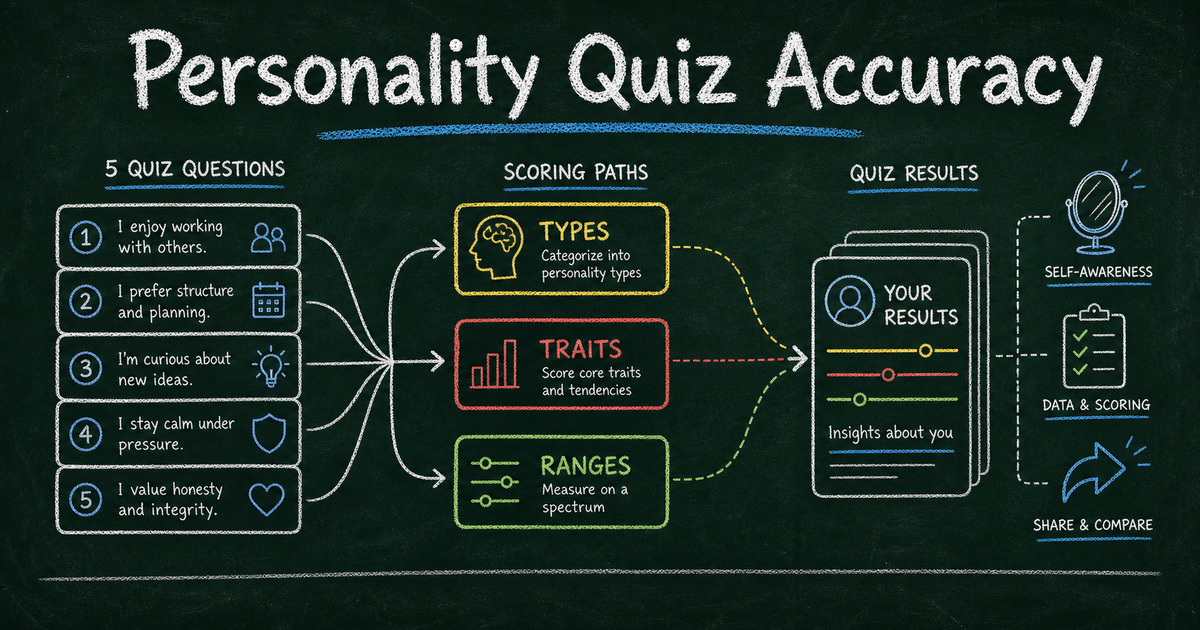
How Personality Quiz Scoring Usually Works
Personality quiz scoring is the bridge between answers and meaning. If that bridge is weak, the result feels random. If it is clear, the result feels earned.
Most personality quizzes use one of four scoring models:
| Scoring model | How it works | Best for |
|---|---|---|
| Majority type scoring | Each answer maps to a type; the type with the most points wins | Viral quizzes, creator quizzes, light personality results |
| Dimension scoring | Answers add points to traits such as structure, empathy, risk, or creativity | Work-style assessments, coaching, soft skills |
| Score range feedback | Total score lands in low, middle, or high ranges with different feedback | Readiness quizzes, burnout quizzes, maturity checks |
| Hybrid scoring | A primary result type is combined with secondary trait scores | More nuanced personality quizzes and assessment-style reports |
Majority type scoring is easiest to understand. If a quiz has four result types, each answer can add one point to one type. At the end, the highest type wins.
Dimension scoring is better when the result should show a profile rather than one label. A communication style quiz might score Directness, Empathy, Listening, and Conflict Response separately. This is closer to an online personality test or skills assessment, especially when the report includes charts or per-dimension feedback.
For most lightweight personality quizzes, use 3 to 5 result types and 8 to 12 questions. Fewer result types are easier to make memorable. Too many result types create thin feedback and make scoring harder to trust.
Common Personality Quiz Types
The best personality quiz topic matches the respondent’s motivation. Some people want identity language. Some want work insight. Some want a result they can share in a group chat.
| Quiz type | What it helps people name | Example angle |
|---|---|---|
| Introvert, extrovert, or ambivert quiz | Social energy | ”What drains or restores you?” |
| Communication style quiz | How someone speaks, listens, and handles conflict | ”How do you respond when a project changes?” |
| Founder personality quiz | Startup instincts and leadership habits | ”Do you build by vision, systems, speed, or relationships?” |
| Creator type quiz | Content rhythm and creative strengths | ”Are you an educator, curator, entertainer, or analyst?” |
| Productivity personality quiz | Work rhythm and planning style | ”Do you organize before action or learn by moving?” |
| Decision-making style quiz | Risk, speed, analysis, and confidence | ”What do you need before choosing?” |
| Stress response quiz | Pressure patterns and recovery habits | ”Do you freeze, fix, avoid, or seek support?” |
| Learning style quiz | Study preferences and support needs | ”How do you prefer to absorb and practice new material?” |
We built and published many of these patterns in the free quiz templates collection, including founder personality, communication style, creator type, productivity personality, decision-making style, stress response, and introvert/extrovert quizzes. The useful pattern is not the topic alone. It is the connection between everyday questions and a result that gives the respondent language.
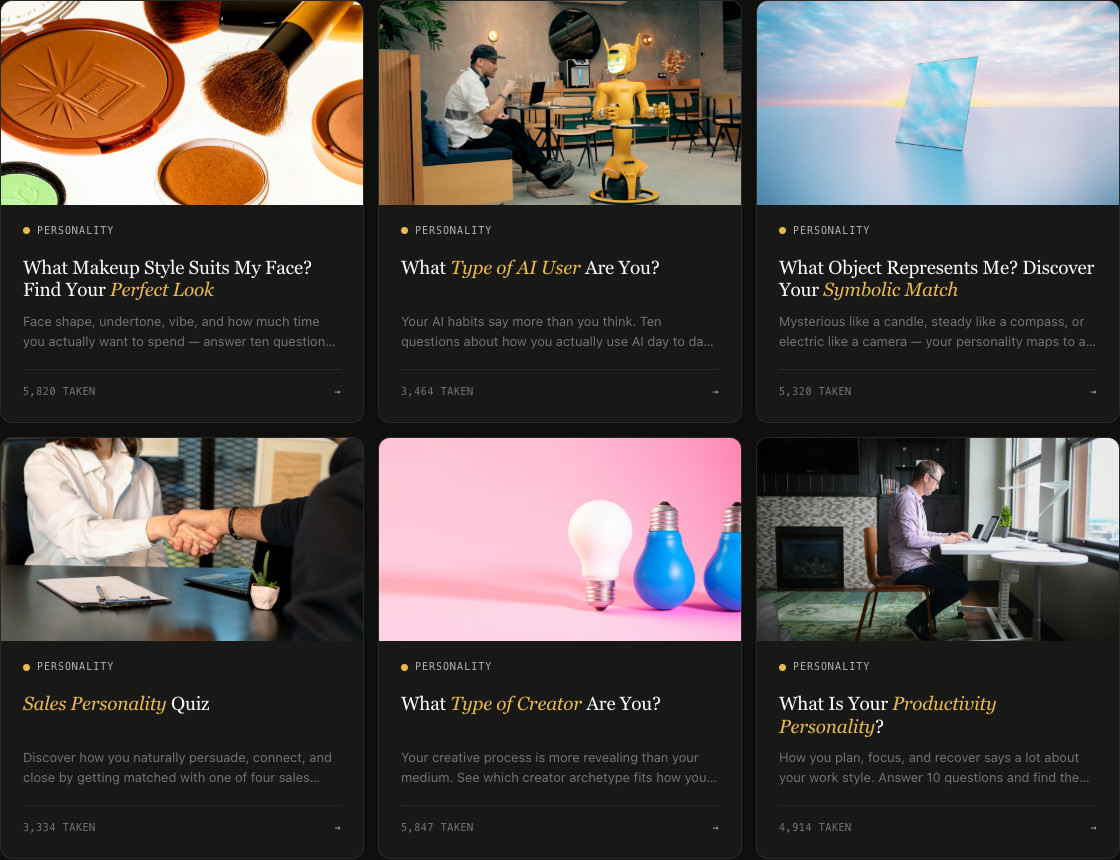
If you want to see the result patterns before building your own, browse the personality quiz examples and notice how each one uses a familiar question to create a distinct, shareable outcome.
What Makes a Personality Quiz Trustworthy?
A trustworthy personality quiz does not need to sound scientific. It needs to be clear about its limits and consistent in how it turns answers into feedback.
Use the Mirror -> Method -> Meaning framework:
| Part | What it means | Weak version | Stronger version |
|---|---|---|---|
| Mirror | Questions reflect real behavior | ”Pick a color" | "When plans change suddenly, what do you do first?” |
| Method | Scoring is consistent and explainable | Random result mapping | Each answer contributes to a type or dimension |
| Meaning | The result gives useful language | ”You are amazing" | "You bring calm structure, but may need time before committing” |
The mirror is the question set. If people cannot recognize themselves in the questions, they will not trust the result. Scenario questions usually work better than abstract trait questions because they show behavior in context.
The method is the scoring model. A quiz creator should be able to explain why a certain answer contributes to a certain result. If the answer “I plan everything before starting” maps to an impulsive result type, the scoring breaks trust.
The meaning is the result page. It should describe strengths, tradeoffs, and next steps without pretending to define the person forever. Avoid fixed labels like “You are bad at collaboration.” Use tendency language instead: “You may prefer independent progress before group alignment.”
In our own testing with FormHug quiz templates, the result page is where personality quizzes either become shareable or forgettable. People tolerate simple questions if the ending feels specific. They do not forgive generic results.
How to Create a Personality Quiz with AI
For a personality quiz, the fastest path is not to design every question manually. Give FormHug’s AI quiz maker the audience, quiz length, result style, answer format, and scoring expectation in one clear prompt:
Create a 10-question personality quiz for indie founders that reveals their product-building style. Include 4 result types, scenario-based answer choices, scoring logic, and short shareable result descriptions.
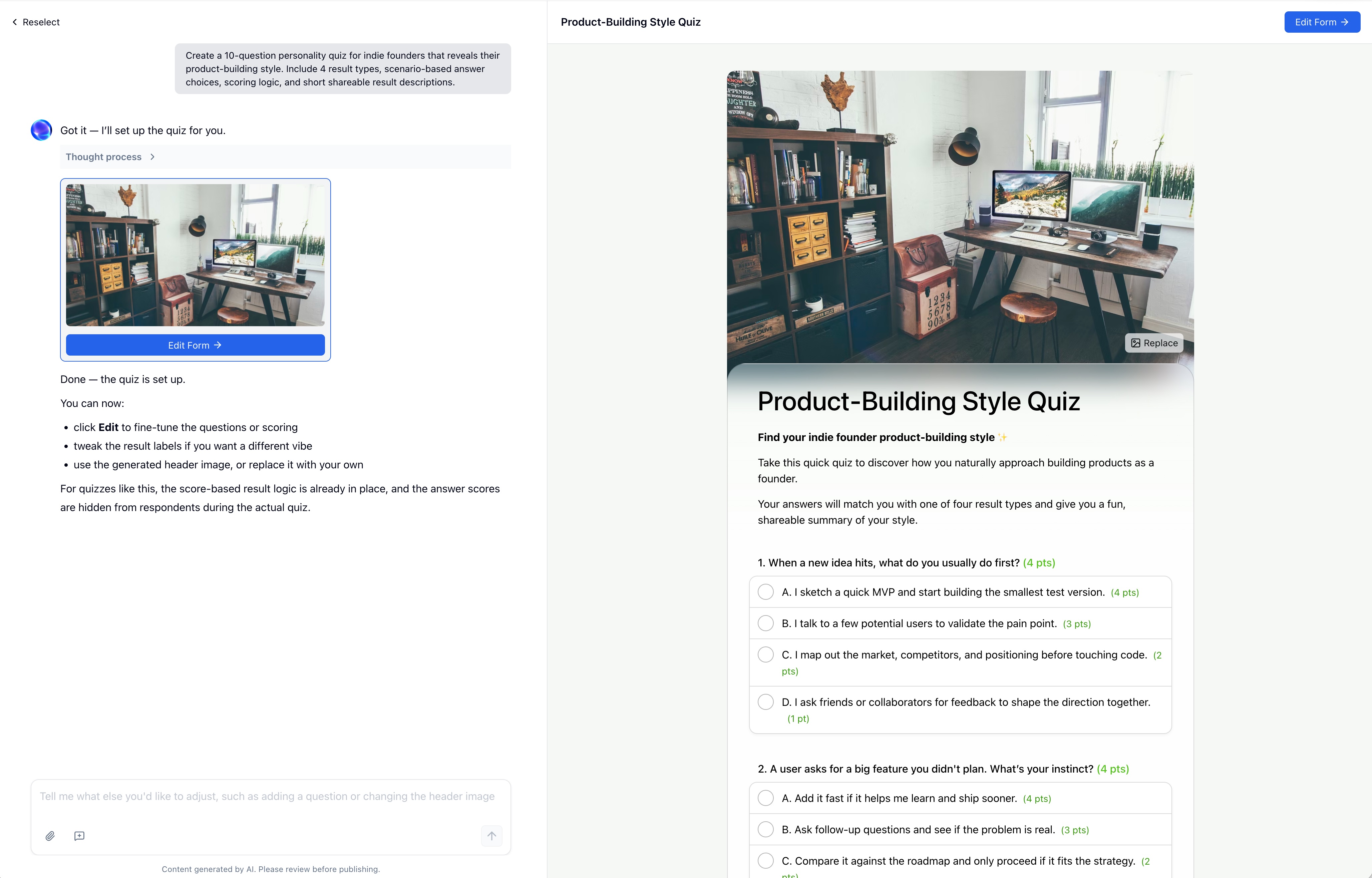
That prompt gives AI enough structure to generate the questions and result page. After generation, the main work is review: make sure the tone fits your audience, the result labels feel shareable, and the scoring does not promise more than the quiz can support. For broader setup details, see how to create an online quiz or browse live examples in FormHug Quizzes.
Frequently Asked Questions
Are personality quizzes accurate?
Personality quizzes are accurate only within the purpose they were designed for. A casual quiz can be useful for self-reflection or entertainment, but it should not be treated as a validated psychological assessment unless it has been tested for reliability and validity.
Are personality quizzes reliable?
Some personality tests are reliable, especially formal assessments that have been studied over time. Casual online quizzes are usually not reliable in the scientific sense. They can still feel useful when the questions are clear, the scoring is consistent, and the results avoid exaggerated claims.
Why do people like personality quizzes so much?
People like personality quizzes because they create a fast feedback loop: answer simple questions, receive a result, and compare it with how they see themselves. The result gives people language for identity, habits, taste, or work style.
How do personality quiz results work?
Most personality quiz results come from type scoring, dimension scoring, score ranges, or a hybrid of those models. Each answer adds points to a result type or trait, and the final result reflects the strongest pattern.
How many questions should a personality quiz have?
Most lightweight personality quizzes work well with 8 to 12 questions and 3 to 5 result types. Assessment-style quizzes often need more questions because each dimension should be measured by several items.
Can I use a personality quiz for hiring?
Do not use a casual personality quiz as a hiring test. Hiring assessments should be validated, job-related, legally appropriate, and interpreted carefully. Custom quizzes are better for coaching, team discussion, onboarding, learning, and low-stakes reflection.
Can AI create a personality quiz?
Yes. AI can draft the topic, questions, answer choices, scoring model, result names, and result analysis. You should still review the logic, test each result path, and make sure the quiz does not overclaim what it can measure.
Is FormHug free for personality quizzes?
Yes. You can use FormHug to create personality quizzes, scored quizzes, and assessment-style forms. Start from the quiz maker, browse FormHug Quizzes, or customize a quiz from the free templates collection.
Related
- How to Create an Online Personality Test or Skills Assessment - build dimension-based assessments with scoring and useful feedback.
- 55 Free Quiz Templates for Personality, AI, Trivia & Training - browse live personality, self-discovery, work, trivia, and AI quiz templates.
- Everything Can Be a Quiz: Turning Any Idea Into Questions - see how AI turns content, ideas, and source material into quiz formats.
- How to Create an Online Quiz - create scored quizzes with feedback, result pages, and shareable links.
A personality quiz loses trust when it promises more than its questions can support. Keep the promise honest, make the scoring explainable, and give people a result they can recognize. Create your quiz ->

Written by
FormHug TeamProduct, research, and form automation team
The FormHug Team brings together product builders, workflow researchers, and form automation practitioners who study how people collect, route, and act on information online. Our guides are based on hands-on product testing, template analysis, customer workflow patterns, and deep experience with forms, surveys, quizzes, AI-assisted creation, integrations, and results sharing.