Multiple Choice Quiz Questions: Examples, Distractors, and Scoring Tips
Create the assessment
Turn this into a scored assessment
Build an assessment with scoring, result pages, feedback, and records you can review later.
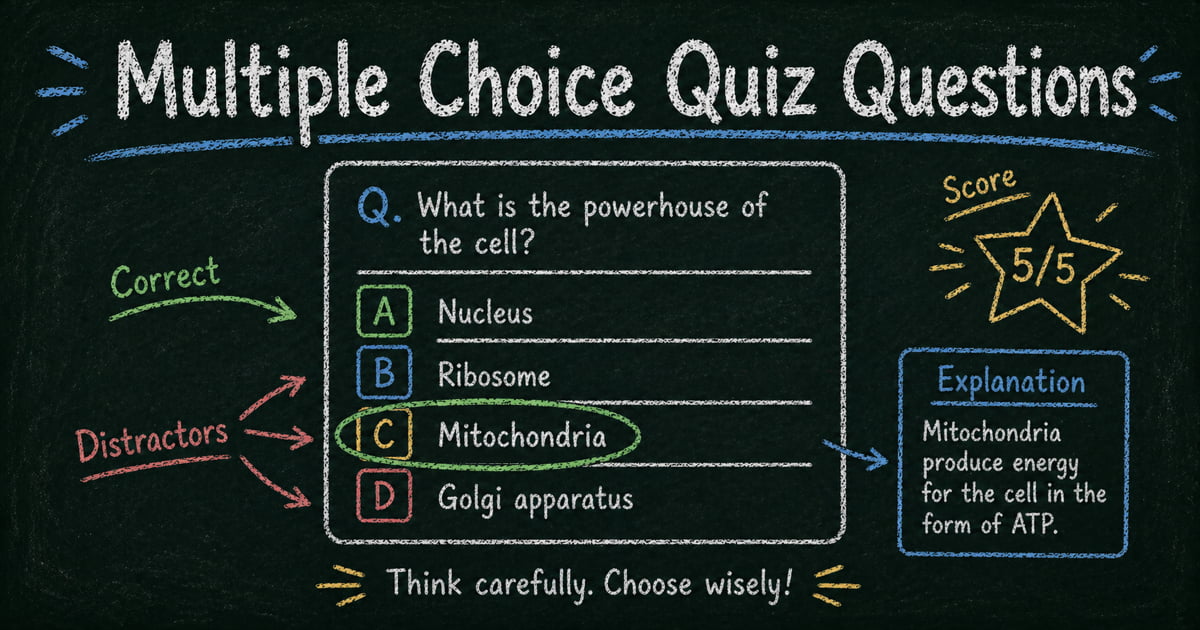
Multiple choice quiz questions are easy to publish and surprisingly easy to write badly. The prompt is unclear, two answers look correct, the wrong options are too silly, or the explanation simply says “Correct!” without teaching anything.
A strong multiple choice question does more than ask for the right answer. It reveals what the participant understands, what misconception they chose, and what feedback should help them improve.
This guide covers multiple choice quiz examples, answer option patterns, distractor writing, scoring, and how to build a scored quiz in FormHug.
TL;DR - Multiple choice quiz questions work best when one correct answer is supported by plausible wrong answers and a useful explanation.
- Write the question around one objective - each item should test one skill, fact, or decision.
- Use plausible distractors - wrong answers should reveal common mistakes, not obvious throwaways.
- Explain why the answer is correct - explanations create the learning value after scoring.
- Works for: classroom tests, training quizzes, compliance checks, hiring screens, product knowledge quizzes, and trivia.
- FormHug supports single-answer MCQs, multi-select checkbox questions, scoring, answer explanations, and result pages.
What Are Multiple Choice Quiz Questions?
Multiple choice quiz questions ask participants to choose the correct answer from a list of options. In most quizzes, one answer is correct and the others are distractors. Some questions allow multiple correct answers, usually with checkboxes.
Example:
Which survey question type is best for measuring agreement?
- Yes/no question
- Likert scale question
- File upload question
- Contact information field
Correct answer: Likert scale question.
Explanation: Likert scales measure degree of agreement, while yes/no questions force a binary response.
Multiple Choice Quiz Question Types
Recall questions
Recall questions check whether someone remembers a fact, term, or rule.
Example:
What does NPS stand for?
- Net Promoter Score
- New Product Survey
- Numeric Performance Scale
- Normalized Preference Score
Use recall questions sparingly. They are useful, but a quiz made entirely of memorization questions rarely tests whether someone can apply the material.
Application questions
Application questions ask participants to use the concept in context.
Example:
A customer gives a score of 2 on an NPS survey. What follow-up question is most useful?
- What made you choose that score?
- Would you like to see our logo?
- How did you hear about us?
- What is your job title?
Application questions are stronger for training, hiring, and classroom assessment because they test decision-making.
Scenario questions
Scenario questions describe a realistic situation and ask what should happen next.
Example:
A learner scores 55% on a compliance mini exam. The passing score is 80%. What should the results page show?
- A certificate and congratulations
- A pass message with no review
- Feedback explaining what to review and no certificate
- A blank thank-you page
Scenarios make quiz results more meaningful because the participant must interpret context.
Multi-select questions
Use multi-select only when more than one answer is correct.
Example:
Which fields can be useful in an event feedback survey? Select all that apply.
- Overall rating
- Favorite session
- One thing to improve
- Credit card CVV
Make the instruction explicit: “Select all that apply.”
Multiple Choice Quiz Examples
Training quiz examples
- Which action should happen before sharing a customer spreadsheet externally?
- What should be included in a proper handoff note?
- Which response best follows the escalation policy?
- What is the safest first step after receiving a suspicious invoice?
- Which example shows correct documentation of a customer issue?
- What should you do when a required approval is missing?
- Which message is most appropriate for a delayed project update?
- What information should not be included in a public support reply?
Classroom quiz examples
- Which sentence best states the main idea of the passage?
- Which formula should be used to solve this problem?
- What evidence best supports the claim?
- Which example correctly applies the vocabulary word?
- What is the next step in the scientific method?
- Which source is most reliable for this research question?
- Which answer explains the mistake in the solution?
- What is the strongest counterargument?
Product knowledge quiz examples
- Which feature should a user choose to collect scored answers?
- Which plan includes the capability described in the scenario?
- What is the best next step for a user who needs payment collection?
- Which integration fits the workflow described?
- Which use case is best served by a survey instead of a quiz?
- Which result page module should appear after a passing score?
- What is the correct way to explain this feature to a customer?
- Which customer need signals the strongest fit?
Trivia quiz examples
- Which planet is known as the Red Planet?
- Which country hosted the first modern Olympic Games?
- Which artist painted the Mona Lisa?
- Which ocean is the largest?
- Which element has the chemical symbol O?
- Which city is known as the City of Light?
- Which animal is the fastest land mammal?
- Which year did the first iPhone launch?
How to Write Plausible Distractors
Start with the misconception
Do not invent random wrong answers. Ask: what mistake would someone make if they almost understood the concept?
For example, in a question about Likert scales, “Yes/no question” is a plausible distractor because both are survey question types. “File upload” is less useful unless the learner is very new.
Keep options parallel
Answer options should be similar in length, grammar, and level of detail. If the correct answer is twice as specific as every wrong answer, participants can guess based on formatting.
Avoid joke answers in serious quizzes
Joke distractors are fine for casual trivia. They weaken training, compliance, hiring, and classroom quizzes because they reduce the question to two or three serious options.
Add explanations for common wrong answers
A good explanation can mention why the common distractor is tempting but wrong.
How to Build a Multiple Choice Quiz in FormHug
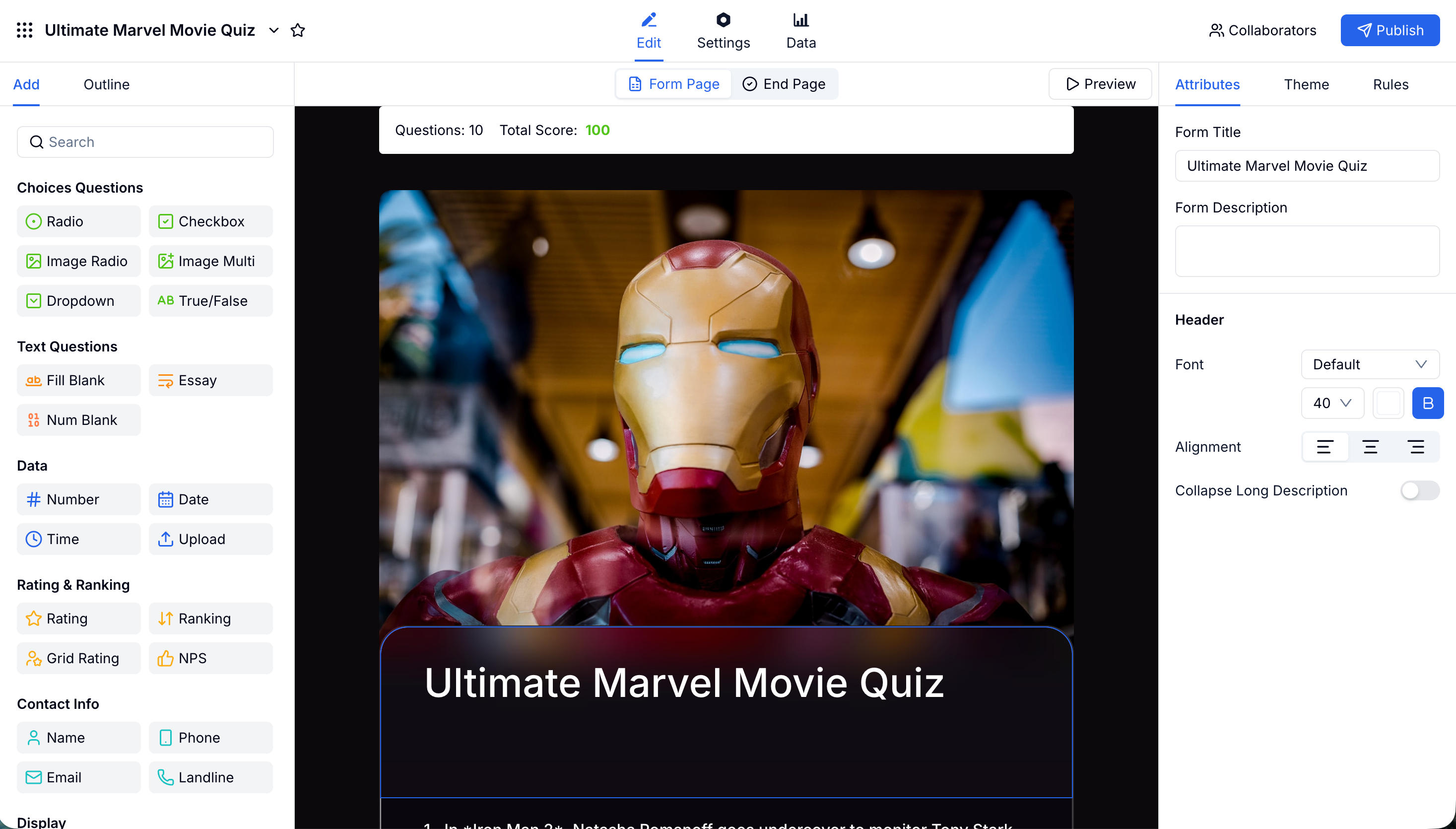
Step 1: Choose the quiz format
Use single-answer multiple choice for one correct answer. Use checkbox questions when more than one answer can be correct. Use image options when visual recognition matters.
Step 2: Generate a draft with AI
Open FormHug and prompt: “Create a 12-question multiple choice quiz for customer support training with plausible distractors, correct answers, and explanations.”
Step 3: Review answer options
Check every question for overlap, ambiguous wording, and obvious correct-answer clues. Replace weak distractors with real misconceptions.
Step 4: Configure scoring and feedback
Set point values, write explanations, and configure the results page. For formal tests, add time limits, random questions, and passing thresholds. The complete workflow is covered in how to create an online quiz.
Frequently Asked Questions
What makes a good multiple choice quiz question?
A good multiple choice quiz question has a clear prompt, one correct answer, plausible wrong answers, and an explanation that teaches why the correct answer is right.
How many answer options should a multiple choice quiz have?
Most quiz questions work well with 3 to 5 options. Four options is a common default, but three strong options are better than four weak ones.
What is a distractor in a quiz?
A distractor is an incorrect answer option. Good distractors represent realistic mistakes or misconceptions, not random answers that no one would choose.
Can multiple choice questions have more than one correct answer?
Yes, but use a checkbox or multi-select field and tell participants to select all that apply. Do not use single-choice fields when multiple answers are correct.
Can FormHug score multiple choice quizzes automatically?
Yes. FormHug supports automatic scoring for single-answer MCQs, checkbox questions, image options, true/false, and fill-in-the-blank question types.
Should every quiz question have an explanation?
Yes for learning, training, and assessment quizzes. Explanations help participants understand mistakes and make the quiz more useful than a raw score.
Related
- True or False Quiz Questions - use binary questions for quick knowledge checks
- Mini Exam Questions - design short scored checks for focused learning objectives
- Multiple Choice Survey Questions - compare scored quiz options with non-scored survey options
- How to Create an Online Quiz - build the full quiz workflow with scoring and results
The wrong answers are where a multiple choice quiz becomes useful. Write distractors that reveal real misconceptions, then use explanations to turn those mistakes into learning. Create your quiz ->

Written by
FormHug TeamProduct, research, and form automation team
The FormHug Team brings together product builders, workflow researchers, and form automation practitioners who study how people collect, route, and act on information online. Our guides are based on hands-on product testing, template analysis, customer workflow patterns, and deep experience with forms, surveys, quizzes, AI-assisted creation, integrations, and results sharing.