True or False Quiz Questions: Examples, Templates, and Writing Tips
Create the assessment
Turn this into a scored assessment
Build an assessment with scoring, result pages, feedback, and records you can review later.
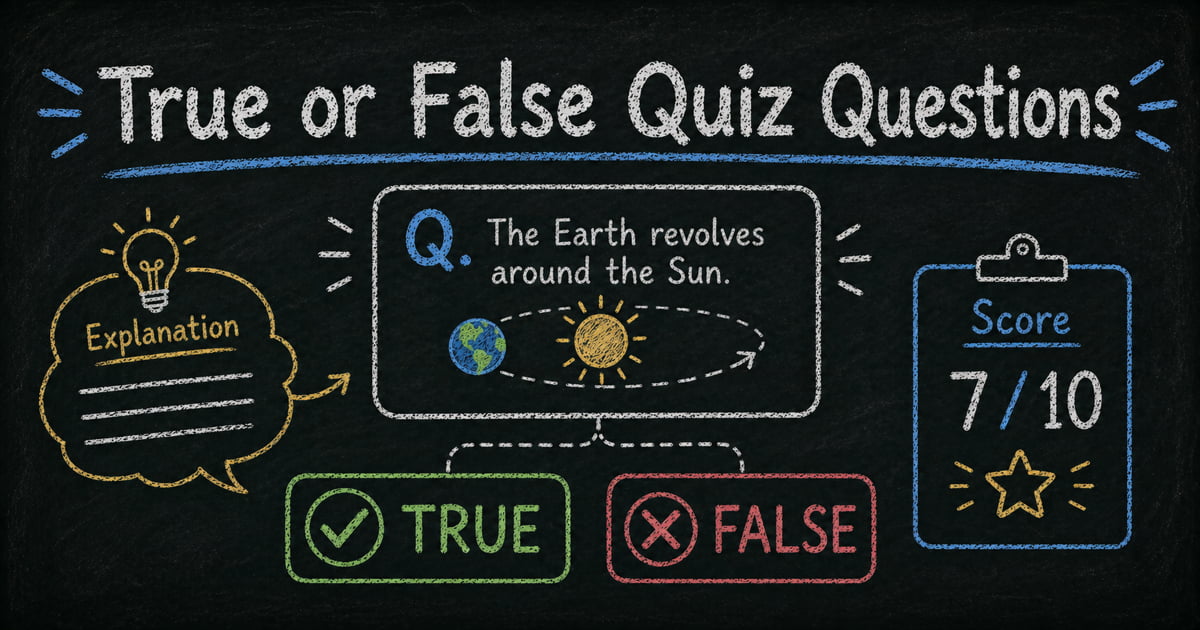
True or false quiz questions are fast to answer and easy to grade. That is why they are everywhere: classroom checks, employee training, compliance refreshers, onboarding exams, trivia games, and knowledge checks after a lesson.
The weakness is just as obvious: a participant has a 50% chance of guessing correctly. A weak true/false quiz rewards luck. A strong one tests precise misconceptions, uses clear wording, and explains the answer after submission.
This guide gives you true or false quiz question examples, writing rules, scoring tips, and a FormHug workflow for turning them into an online quiz with instant feedback.
TL;DR - True or false quiz questions work best for quick knowledge checks, misconception testing, and low-friction scored quizzes.
- Use them for exact claims - every statement should be clearly true or clearly false.
- Avoid trick wording - double negatives and vague qualifiers make the quiz feel unfair.
- Add explanations - the answer explanation is what turns a guessed answer into learning.
- Works for: classroom reviews, employee training, compliance checks, onboarding, trivia, and mini exams.
- FormHug can generate true/false questions with AI, score them automatically, and show answer explanations.
What Are True or False Quiz Questions?
True or false quiz questions present a statement and ask the participant to decide whether it is correct. They are dichotomous questions, meaning there are only two answer choices.
Examples:
- True or false: A mini exam should usually focus on one learning objective.
- True or false: Customer satisfaction and customer loyalty always measure the same thing.
- True or false: A phishing email can come from a sender name that looks familiar.
- True or false: Open-ended survey questions are always better than multiple choice questions.
True/false questions are useful when the statement itself matters. They are less useful when the topic requires explanation, ranking, or multiple correct answers.
When to Use True or False Quiz Questions
Use them to check basic understanding
True/false questions work well at the start of a topic or immediately after a lesson.
- True or false: A survey response rate measures the percentage of invited people who completed the survey.
- True or false: A quiz can provide feedback even when the answer is wrong.
- True or false: A certificate should appear only when a passing threshold matters.
These questions quickly show whether the core concept landed.
Use them to surface misconceptions
The best false statements are not random. They should represent a mistake people actually make.
Weak false statement:
- True or false: The sky is green.
Better false statement:
- True or false: A high average score always means every learner understood the topic.
The second version reveals a real misunderstanding: averages can hide patterns.
Use them for quick retention checks
After a training video, article, or classroom lesson, 3 to 5 true/false questions can reinforce memory without making the check feel like a full exam.
For broader short-test design, see how to create a mini exam online.
True or False Quiz Question Examples
Classroom examples
- True or false: A thesis statement should make a claim, not just announce a topic.
- True or false: In a fraction, the denominator tells how many equal parts make a whole.
- True or false: Primary sources are always more reliable than secondary sources.
- True or false: A hypothesis should be testable.
- True or false: The main idea of a paragraph is always the first sentence.
- True or false: An equation can have more than one solution.
- True or false: A reliable source should be evaluated for author, evidence, and date.
- True or false: Editing and revising are the same step in writing.
Employee training examples
- True or false: A customer escalation should include the issue, impact, and requested next step.
- True or false: Internal notes should avoid personal opinions about the customer.
- True or false: It is safe to share customer data in any tool approved by a teammate.
- True or false: A handoff is complete when the next owner has enough context to act.
- True or false: A missed deadline should be flagged before the deadline passes.
- True or false: Screenshots can contain sensitive information.
- True or false: A process exception should be documented if it may happen again.
- True or false: If a request is urgent, verification steps can be skipped.
Compliance examples
- True or false: Personal data should be collected only when there is a clear purpose.
- True or false: A suspected phishing email should be reported before opening attachments.
- True or false: Sharing login credentials is acceptable if the teammate is trusted.
- True or false: Access should be removed when it is no longer needed.
- True or false: An incident report should include what happened and when it was discovered.
- True or false: Public AI tools can safely receive any internal document.
- True or false: Data privacy obligations can apply after a customer cancels.
- True or false: A vendor should receive only the data needed for the task.
Trivia examples
- True or false: The Pacific Ocean is larger than the Atlantic Ocean.
- True or false: Venus is the closest planet to the Sun.
- True or false: The Olympic Games are held every two years.
- True or false: A group of crows is commonly called a murder.
- True or false: The Great Wall of China is visible from the Moon with the naked eye.
- True or false: The human body has more than 200 bones.
- True or false: Lightning can strike the same place twice.
- True or false: Water boils at the same temperature at every altitude.
How to Write Better True or False Questions
Make the statement fully true or fully false
Avoid statements that are partly true. If a reasonable expert could argue either side, the question is too ambiguous for a true/false format.
Avoid absolute words unless they matter
Words like always, never, only, and every often make statements artificially false. Use them only when the absolute claim is what you want to test.
Keep the wording short
A true/false statement should usually fit in one sentence. If you need three clauses to explain it, turn it into a multiple choice or scenario question instead.
Explain every answer
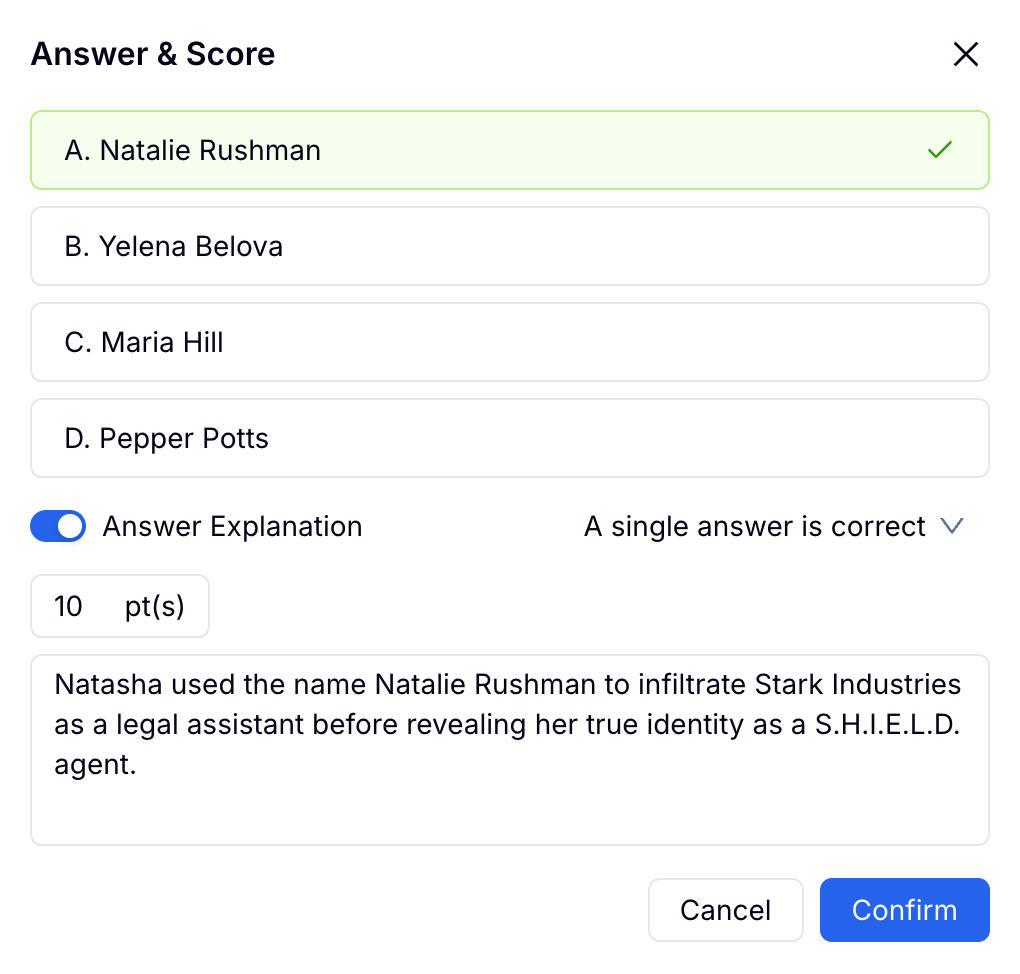
In FormHug, answer explanations appear after submission. Use them to explain why the statement is true or false, especially when the wrong answer reflects a common misconception.
How to Build a True or False Quiz in FormHug
Step 1: Choose the quiz purpose
Decide whether the quiz is for learning, compliance, trivia, or screening. The purpose affects the number of questions, passing score, time limit, and feedback tone.
Step 2: Generate questions with AI
Open FormHug and prompt: “Create a 10-question true or false quiz for data privacy training with correct answers and short explanations.”
Step 3: Review false statements carefully
False statements should represent real mistakes, not obvious nonsense. Replace anything too easy with a misconception your audience might actually believe.
Step 4: Configure scoring and results
Show answer explanations to everyone. For formal checks, add a passing threshold and certificate. For casual trivia, add score-based feedback tiers that make the result more shareable.
For full setup details, see how to create an online quiz and the FormHug quiz maker.
Frequently Asked Questions
Are true or false questions good for quizzes?
Yes, when they test clear factual claims or misconceptions. They are weaker for high-stakes exams because participants can guess correctly half the time.
How many true or false questions should a quiz have?
For a quick knowledge check, use 5 to 10 questions. For a longer quiz, mix true/false with multiple choice, scenario, and fill-in-the-blank questions.
How do I make true or false questions harder?
Test common misconceptions, avoid obvious false statements, and ask about application rather than trivia. Add explanations so wrong answers teach the concept.
Should true or false quizzes have a passing score?
Use a passing score for compliance, onboarding, certification, or training records. For trivia or practice checks, score-based feedback is usually enough.
Can FormHug create true or false quiz questions with AI?
Yes. FormHug can generate true/false questions, correct answers, explanations, scoring, and result feedback from a topic prompt or training outline.
What is the difference between true/false and yes/no questions?
True/false questions judge whether a statement is correct. Yes/no questions usually ask about a respondent’s behavior, preference, or status.
Related
- Mini Exam Questions - write short scored questions for training and classrooms
- Dichotomous Survey Questions - understand two-choice question formats beyond quizzes
- How to Create an Online Quiz - configure scoring, explanations, results, and certificates
- How to Create a Mini Exam Online - build a focused short exam after a lesson or training
True or false questions are quick, but they should not be careless. Test real misconceptions, explain the answer, and let the score point to what learners should review next. Create your quiz ->

Written by
FormHug TeamProduct, research, and form automation team
The FormHug Team brings together product builders, workflow researchers, and form automation practitioners who study how people collect, route, and act on information online. Our guides are based on hands-on product testing, template analysis, customer workflow patterns, and deep experience with forms, surveys, quizzes, AI-assisted creation, integrations, and results sharing.