Portuguese Wasn't Specific Enough
Build the form
Create the workflow with AI
Start from a prompt, a template, or a blank form and publish a polished FormHug workflow.
When we first added Portuguese to FormHug, it meant Brazilian Portuguese.
To be honest, we did not know enough to ask whether that was specific enough. In our heads, Portuguese was Portuguese. If the words could be understood, we assumed the translation had done its job.
Building a form product changed how we see that assumption.
A form is not simply a block of text. It speaks directly to someone: an attendee registering for an event, an applicant sharing their experience, or a customer trusting a business with personal information. The language of the form is part of that interaction.
Readable is not always the same as natural. And when a form does not sound natural, the distance between the organization and the person filling it out becomes a little more visible.
The Difference Appears in a Simple Form
We built a small AI workshop registration form in English, then translated the same form into Portuguese for Portugal and Portuguese for Brazil.
The structure did not change. It still asks for a name, email address, mobile number, organization, job title, preferred session, and consent to receive event updates. The same responses still enter the same workflow.
But the form does not sound exactly the same.
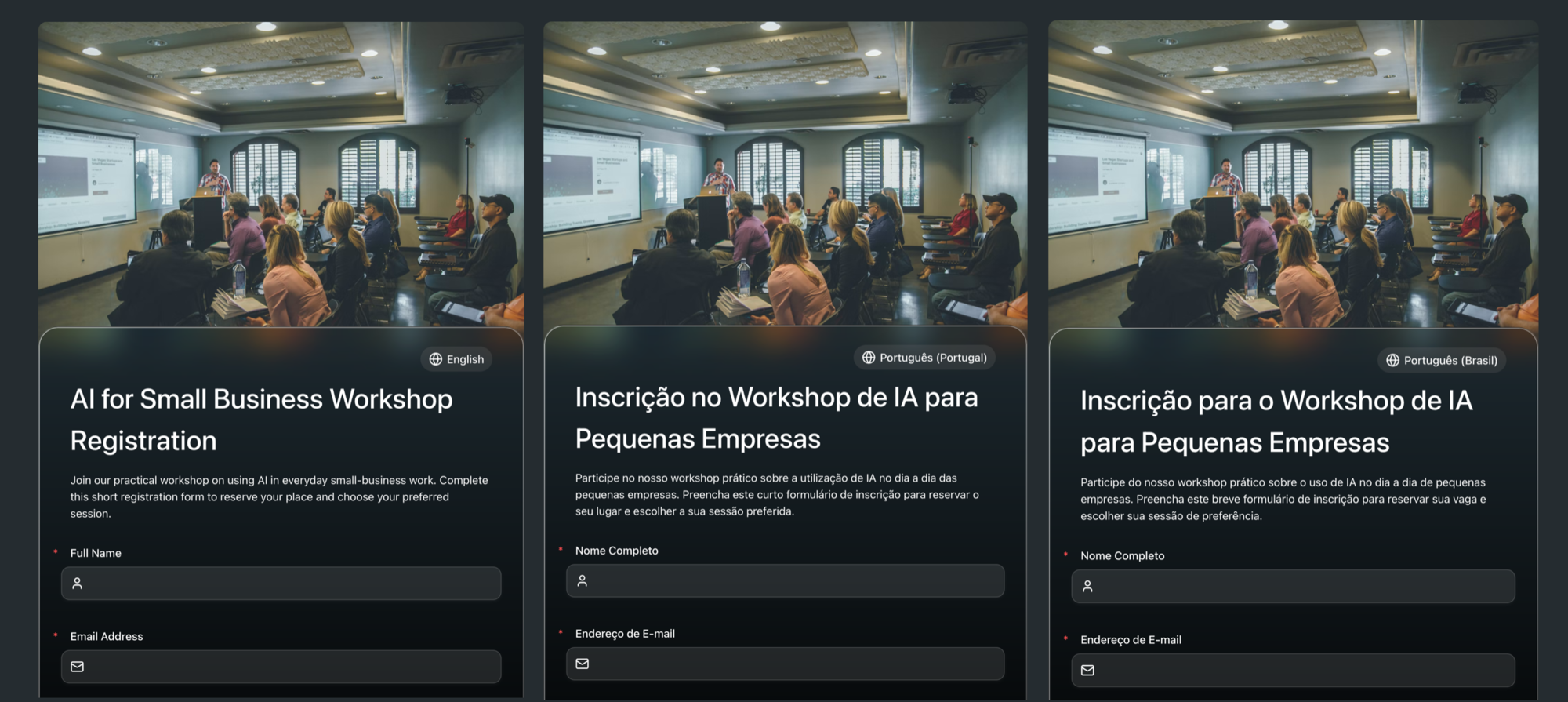
In the introduction, the Portuguese version uses utilização where the Brazilian version uses uso. One asks the attendee to reserve o seu lugar; the other says sua vaga. Even the title moves differently: Inscrição no Workshop in one version, and Inscrição para o Workshop in the other.
These are not dramatic differences. That is exactly the point. Both versions are understandable, but each one feels more at home in a different place.
Language Is Part of the Form
We have written before that forms should meet people in their own language. This experience made that idea more precise for us. Sometimes “their own language” cannot be represented by a single label in a dropdown.
So we added European Portuguese as its own translation option in FormHug. A form can now offer English, Portuguese (Portugal), and Portuguese (Brazil) through the same public link, while the person filling it out can choose the version that feels right to them.
This looks like a small localization update. For us, it is also a product lesson.
Language is not decoration placed around a form after the real work is finished. It shapes the invitation, the questions, the choices, the consent, and the final act of submitting. It is part of the form itself.
We started by learning that Portuguese was not specific enough. We ended with a broader reminder: the right language does more than help someone understand a form. It helps the form feel like it was made with them in mind.

Written by
FormHug TeamProduct, research, and form automation team
The FormHug Team brings together product builders, workflow researchers, and form automation practitioners who study how people collect, route, and act on information online. Our guides are based on hands-on product testing, template analysis, customer workflow patterns, and deep experience with forms, surveys, quizzes, AI-assisted creation, integrations, and results sharing.