Every Story Needs a Path: From Creative Classroom to Publication
Real teams, real workflows
Write your own FormHug story
It started with one simple form. See what yours could become.
In Singapore, a children’s creative education team teaches young writers and comic artists—and helps selected work continue into collections and publishing projects.
A child’s story rarely arrives all at once.
It may begin as a character with an unusual name. Then comes a place, a problem, a few panels, a first ending that does not quite work, and a better one drawn the following week.
In a creative classroom, the finished story is only the visible part. Underneath it is a trail of choices, drafts, feedback, and small moments when a child begins to see themselves as a writer or comic artist.
For this team, that trail matters twice: first as part of the child’s learning, and again when a piece is ready to move toward publication.
The challenge was not simply how to collect homework. It was how to keep the whole creative journey connected—from the first class to the final page, and sometimes beyond it.
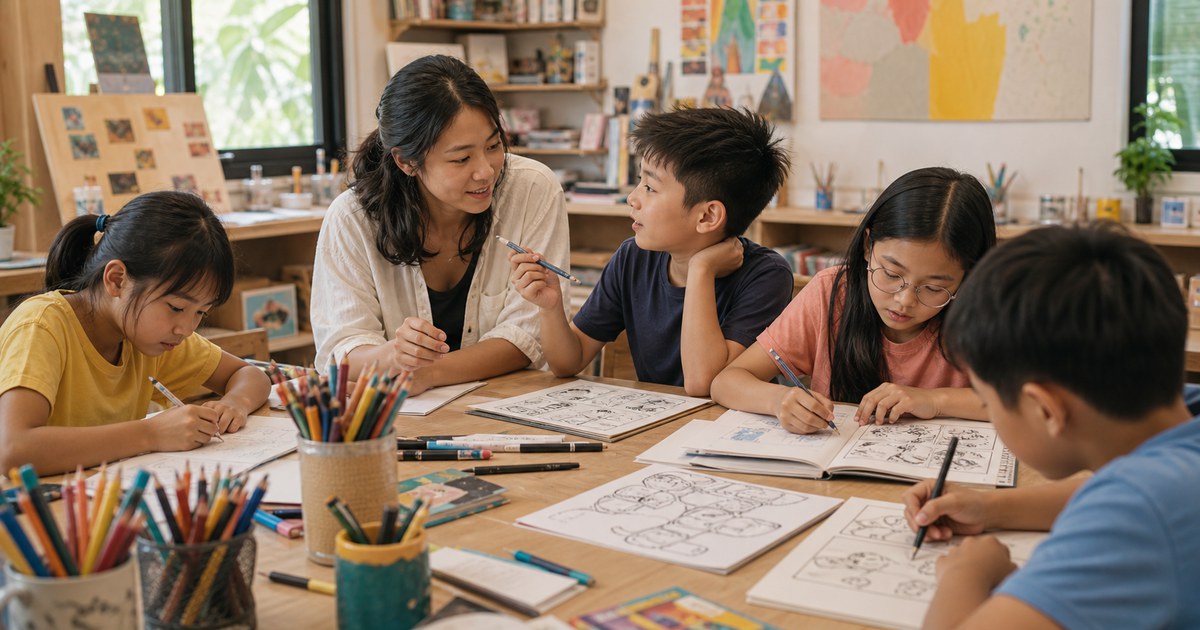
The team asked not to be named. Student identities, original course and form titles, and children’s work are not shown; the AI-generated header image depicts fictional people.
The Work Was Everywhere. The Journey Was Hard to See.
Each course generated more than one kind of material.
Teachers collected student details, first assignments, character profiles, story outlines, drafts, final versions, and learning logs. If a piece moved toward publication, the team also needed author information and confirmation from a parent or guardian.
Previously, those materials were spread across chat conversations, documents, and temporary forms.
A teacher might remember that a child had designed a character but still need to search for the original file. An outline could sit in one document while the draft arrived in a message thread. A final version might be easy to find without showing how it had grown from the earlier idea.
The content existed, but its sequence did not.
That made it difficult to answer a simple teaching question: Where is this child in the creative process right now?
It also created a second problem at the point of publication. Author details and guardian confirmation were sometimes collected only when a piece was already being prepared for a collection. Information that should have been part of the journey became a last-minute search.
A Course Is a Sequence, Not a Single Submission
Through ChatGPT, the team used FormHug to build a set of forms aligned with the rhythm of the course.
Instead of creating one large form and expecting it to hold everything, the team gave each creative stage its own place:
- Submit the first class assignment.
- Create a story character profile.
- Submit the story outline.
- Share the first draft.
- Complete the final version.
- Keep an ongoing course learning log.
- Collect author information for selected work.
- Confirm final information before publication.
Children or their parents complete the relevant form when the course reaches that stage. Teachers can review and organize the submissions in one system instead of rebuilding the story from chat history and scattered files.
The forms do not create the work. They create continuity around it.
At FormHug, we think this is an important difference. A form is often treated as a container for one moment: registration, submission, confirmation. But a connected set of forms can give a longer process a memory of its own.
Eight Forms Become One Creative Path
Each form corresponds to a different kind of attention the teacher needs to give.
The first assignment captures the starting point
The first submission shows what the child brings into the course. It gives the teacher an initial piece to respond to and a reference point for seeing how the student’s work changes later.
Characters and outlines make imagination visible
A character profile asks the child to slow down and decide who their character is. An outline asks what happens and why.
These stages are not administrative preparation for the “real” work. They are where a loose idea begins to acquire shape. When character notes and outlines have their own place, teachers can respond to the thinking before it disappears inside the draft.
Drafts preserve change, not just completion
The draft and final submission are deliberately separate moments. That separation lets the team see more than a polished result. It preserves the fact that the work was revised.
For a child, this matters. The difference between a first draft and a final page is evidence that an idea can be reconsidered, strengthened, and finished.
Learning logs hold what the finished story cannot
The ongoing course log captures another layer: what the student tried, found difficult, discovered, or wants to do next.
A finished comic may show the result of learning. A learning log can show the child becoming aware of that learning.
Together, these stages form a creative record rather than a folder of unrelated assignments.
The workflow is one example of the broader form layer that AI-agent workflows need. ChatGPT helps the team turn its course design into a repeatable structure. FormHug gives children, parents, and teachers a real surface on which that structure can continue outside the conversation.
Teaching and Publishing Can Share the Same Thread
Not every course assignment becomes a published work, nor should it.
But when the team selects a strong story or comic for a collection or publishing project, the creative history no longer has to be assembled from the beginning. The character, outline, draft, final version, and learning context have already moved through a defined path.
The later forms collect the additional information publication requires, including author details and a final confirmation step involving the parent or guardian.
That boundary is essential when children’s work is involved. A classroom submission is not automatically permission to publish. The team remains responsible for deciding which work moves forward, explaining the project, obtaining the appropriate guardian confirmation and permissions, and controlling access to children’s personal information.
FormHug supports the collection path. It does not make the editorial, safeguarding, or rights decisions.
With that separation in place, teaching and publishing can connect without collapsing into each other. The classroom remains a place to learn and experiment. Publication becomes a possible next chapter for selected work, handled through its own deliberate steps.
The Teacher Can See a Story Growing
The practical change is not that teachers have fewer files. It is that every stage now has a known place.
Instead of asking “Where did this child send the outline?” the teacher can focus on “What changed between the outline and the draft?” Instead of remembering to collect author information at the last minute, the team has a publication stage ready when it is genuinely needed.
The workflow creates a shared rhythm:
Beginning → character → structure → draft → revision → reflection → possible publication
That rhythm can be reused for the next class and the next cohort. Teachers can improve the questions without reconstructing the entire process. New team members can understand how the course moves. Parents know what is needed at each stage.
This is a more ambitious version of the forms people can build through ChatGPT. The value is not in asking the agent for eight isolated forms. It is in giving the agent the shape of the course, then turning that shape into a workflow people can actually follow.
A Course Can End Without Losing the Creative Journey
Children’s creative work is easy to underestimate while it is still becoming.
A character profile can look like a small assignment. An early draft can look unfinished. A learning log can look secondary to the final story.
Together, they show something larger: how a child moved from imagining to making.
For this Singapore team, FormHug is not simply a way to collect the final page. It is a way to give every stage before that page a place in the story.
The course may end. A selected work may continue toward publication. But the path between the first idea and the finished piece no longer has to disappear.
Every young creator begins with something fragile.
A good workflow does not make it less creative.
It helps the people around that creativity remember how to carry it forward.

Written by
FormHug TeamProduct, research, and form automation team
The FormHug Team brings together product builders, workflow researchers, and form automation practitioners who study how people collect, route, and act on information online. Our guides are based on hands-on product testing, template analysis, customer workflow patterns, and deep experience with forms, surveys, quizzes, AI-assisted creation, integrations, and results sharing.