Forms Should Meet People in Their Own Language
Create with AI
Describe the workflow and get a form draft
Use FormHug to create forms from prompts, then share, automate, and reuse the structured responses.
Forms are often treated as neutral objects.
A blank field is a blank field. A checkbox is a checkbox. A submit button is a submit button. The product asks a question, the respondent answers, and the system stores the result.
But forms are not neutral to the person filling them out. A form has a voice. It decides what counts as an answer. It decides which words are official. It decides whether the respondent feels invited, inspected, helped, or merely processed.
Language is one of the clearest places where that becomes visible.
When a form assumes one language, it is not only choosing text. It is choosing who gets to move quickly and who has to pause, translate, ask for help, or guess. In a casual poll, that may be acceptable. In a health screening, school form, application, registration, payment, or public-service intake, that friction is part of the product experience.
We think forms should meet people in their own language whenever the form’s outcome matters.
Translation Is Not the Same as Understanding
It is tempting to reduce multilingual support to a translation problem.
Take the English field label. Produce the Spanish label. Produce the Japanese label. Produce the French label. The work seems complete once the words have moved from one language to another.
But a form is not a paragraph. It is an interaction.
The respondent is not only reading. They are deciding whether they qualify, whether they trust the organization, whether they can answer honestly, whether they understand the consequence of consent, whether the next step is safe, and whether the submit button really means what they think it means.
That means multilingual forms need more than translated labels. They need translated choices, helper text, validation language, confirmation messages, and owner-reviewed wording for the parts that carry weight.
The purpose is not linguistic elegance. The purpose is confidence.
The Form Is the First Agreement
Before a team receives a submission, the respondent has already made a small agreement.
They agree that the organization is asking a legitimate question. They agree that the answer they provide will be used in a reasonable way. They agree that the next step is worth their time. Sometimes they agree to be contacted, screened, charged, scheduled, or evaluated.
That agreement is fragile when the language is fragile.
If the form’s wording feels approximate, the relationship feels approximate. If the consent text is unclear, the trust is unclear. If the post-submit message leaves the respondent unsure what happens next, the workflow is not really finished.
This is why browser translation, while useful, cannot carry the entire responsibility for important forms. It happens outside the form owner’s review process. It may help the respondent read the page, but it does not tell the respondent that the organization intentionally supports that language.
Native multilingual forms send a different signal: we expected you here.
The Language Layer Is Part of the Workflow
Product teams often think of language as presentation. The database stays the same, the form structure stays the same, and translation sits on top.
That is partly true, but incomplete.
Language affects the workflow because language affects the quality of the input. A misunderstood option can send someone to the wrong appointment type. A vague eligibility phrase can produce avoidable follow-up. A confusing payment or consent statement can stop a registration. A missing post-submit explanation can create support questions the form was supposed to prevent.
In that sense, language is operational. It shapes what happens after submission.
We wrote about the broader post-submit layer in A Form Product Does Not Need Every Integration. The same principle applies here: a form’s job is not only to collect data, but to keep the shape of the human request intact as it moves into a team, system, or agent workflow.
Language is part of that shape.
One Link Is a Product Philosophy
There is a practical reason to prefer one multilingual form link over separate language copies: it is easier to share and maintain.
But there is also a product philosophy inside that decision.
One link says the respondent’s language preference should not split the workflow. The same registration, application, intake, or feedback path should be available to different people without creating parallel systems behind the scenes.
That matters for humans. It also matters for systems.
A school should not have to reconcile separate parent forms only because families read different languages. A nonprofit should not have to maintain multiple volunteer applications with slightly different questions. A health screening team should not have to wonder whether the Spanish form and the English form still match after a last-minute change.
And in an AI-assisted workflow, one structured form is easier for an agent to create, inspect, route, and summarize. The respondent-facing language can vary while the underlying structure remains coherent.
That is the kind of human-and-agent boundary we keep coming back to in AI Forms for Humans and Agents: humans need clarity, and agents need structure. A good form can serve both.
What We Built in FormHug
FormHug now supports multilingual forms because this is not only a documentation problem or a browser problem. It is a form-product problem.
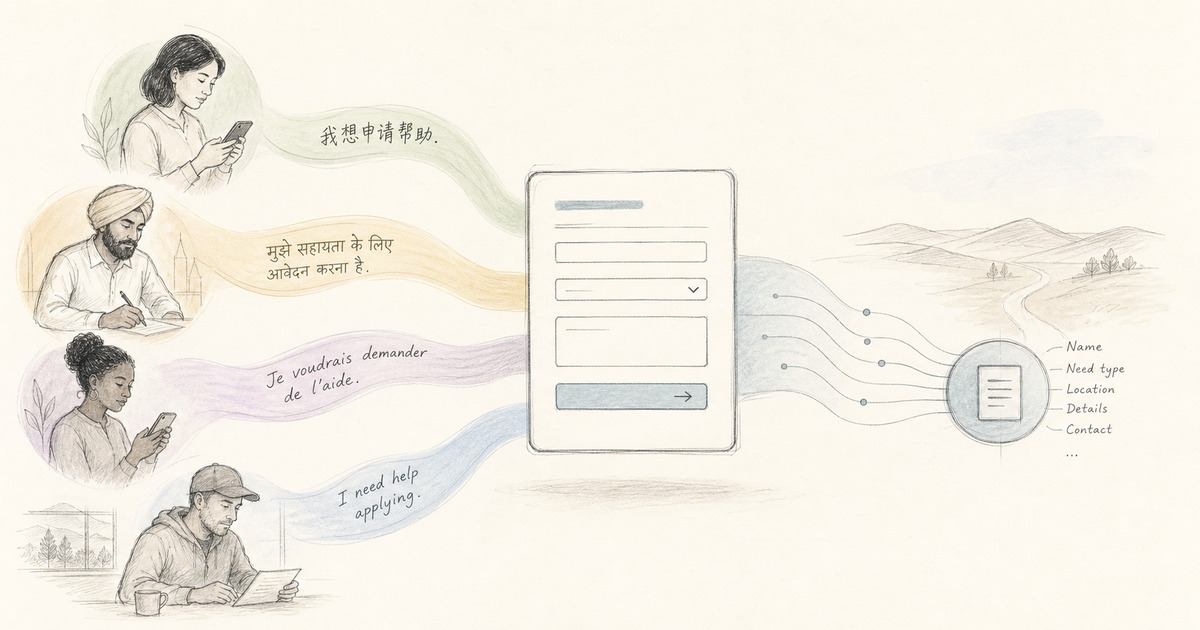
Form owners can set the form interface language, add content translation languages, let AI create the first translation draft, review and manually edit translated text, and publish one public form link for every respondent.
When a respondent opens the public form, FormHug can match their browser language when a matching translation exists. If no match exists, the form falls back to the original language. The respondent can also switch languages manually from the top of the form.
The workflow currently supports English, German, Spanish, French, Italian, Japanese, Korean, Portuguese (Brazil), Simplified Chinese, and Traditional Chinese.
The product detail is simple. The intention is larger: make the language layer visible, reviewable, and connected to the same form workflow instead of leaving it as a fragile afterthought.
For the practical version, we wrote a product note on one form, ten languages and a guide on building a multilingual registration form.
Forms Are Interfaces of Respect
The old way to think about forms was extraction: ask the question, get the answer, store the row.
The better way is relational: make the request clear enough that a person can answer with confidence, and structured enough that the next system can act responsibly.
Multilingual forms sit exactly at that boundary.
They do not replace human review. They do not make every translation perfect. They do not solve every access problem. But they make an important product choice: language is not an edge case when the audience is mixed-language. It is part of the form’s promise.
A form that meets people in their own language says something before the first field is answered.
It says: you are not an exception to this workflow. You are one of the people it was made for.

Written by
FormHug TeamProduct, research, and form automation team
The FormHug Team brings together product builders, workflow researchers, and form automation practitioners who study how people collect, route, and act on information online. Our guides are based on hands-on product testing, template analysis, customer workflow patterns, and deep experience with forms, surveys, quizzes, AI-assisted creation, integrations, and results sharing.