How to Build a Prompt Engineering Assessment
Create the assessment
Turn this into a scored assessment
Build an assessment with scoring, result pages, feedback, and records you can review later.
A polished prompt can still produce a poor answer. The real test is not whether someone remembers a list of prompting tricks; it is whether they can describe the task, provide appropriate context, set useful constraints, and judge the result before relying on it.
A prompt engineering assessment evaluates those decisions through realistic tasks and a clear review rubric. It should measure the learner’s process as well as the final output, because a lucky answer does not prove a repeatable method. This guide explains how to define the skill, write practical assessment tasks, and give feedback that helps people improve.
TL;DR — A prompt engineering assessment asks learners to use and revise prompts for a defined task, then evaluates the prompt and output against explicit criteria.
- Assess task clarity, relevant context, constraints, and output review—not memorized jargon.
- Give learners the same task, source material, and success criteria when comparing attempts.
- Include a revision round so the assessment captures how people respond to a weak first output.
- Works for: AI literacy workshops, workplace training, educator development, and prompt-writing practice.
- A prompt assessment measures performance on selected tasks; it does not establish general expertise across every model or workflow.
What Is a Prompt Engineering Assessment?
A prompt engineering assessment is a structured exercise that checks how effectively someone communicates a task to an AI system and evaluates the resulting output. It can test prompt design, use of context and examples, iteration, and a learner’s ability to identify errors or limitations.
It is not simply a terminology quiz. Knowing what “zero-shot” means does not show that a person can write a prompt that meets a real need. Google’s prompt design guidance recommends clear, specific instructions and describes prompting as an iterative process. An assessment should therefore test applied choices, not definitions alone.
Define the Skill Before Choosing a Score
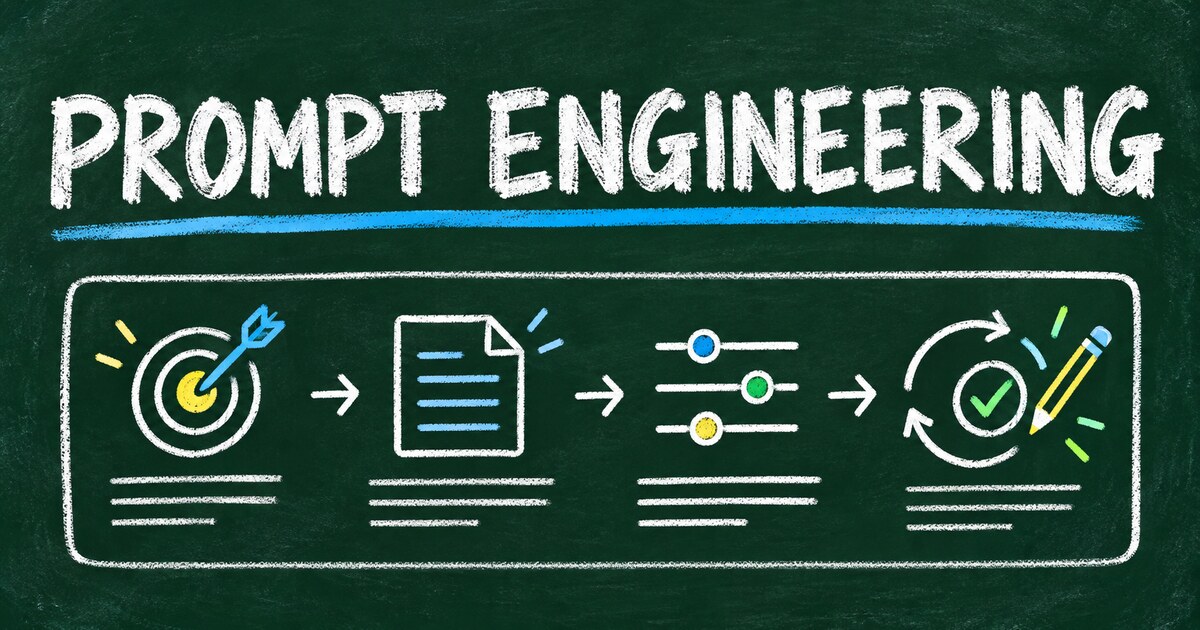
The phrase “good prompt” can mean different things for a customer-support draft, a data extraction task, or a lesson plan. Start by specifying the task and what a useful answer must do. Then assess four observable behaviors with the Goal → Context → Constraints → Check rubric:
- Goal: Does the prompt say what the model should accomplish?
- Context: Does it provide the relevant source material or background without unnecessary sensitive data?
- Constraints: Does it state important boundaries, format, audience, or quality requirements?
- Check: Does the learner inspect the output, identify gaps, and revise or verify it appropriately?
Use a simple scale such as “not demonstrated,” “partly demonstrated,” and “demonstrated” for each behavior. This is a practical classroom rubric, not a validated industry standard; define the performance level that matters for your own training. Do not award full credit merely because the model happened to return a usable answer once.
Use Tasks That Reveal Real Prompting Decisions
Give learners a task with a clear purpose and a source they are allowed to use. Keep conditions comparable: the same model or approved tool, the same input material, and the same success criteria. If learners can use different tools, record that difference rather than treating their outputs as directly comparable.
Task 1: Improve an underspecified request
Start with: “Summarize this document.” Ask learners to revise it for a specific audience and purpose. A stronger prompt might request a concise summary for a new team member, identify the source text, specify the key questions to answer, and ask the model to flag anything the source does not establish.
Assess: Did the learner define the audience and useful outcome, or only add decorative instructions?
Task 2: Add constraints without hiding the objective
Provide a writing task with a real constraint, such as drafting a customer update that must distinguish confirmed facts from pending details. Ask learners to specify the desired structure and what the model must not invent.
Assess: Are the constraints relevant and testable? Does the prompt still make the primary task clear?
Task 3: Ground an answer in supplied material
Give learners a short policy or reference passage and ask them to prompt for an answer based only on that text. Require the output to identify what the source does not answer.
Assess: Did the learner provide or identify an authoritative source, and check that the answer is supported by it?
Task 4: Revise after a flawed response
Provide a model response with a clear but realistic problem: it omits a required point, misreads a source, or uses the wrong format. Ask learners to diagnose the issue and make a targeted revision.
Assess: Can the learner explain the failure and improve the prompt or workflow, rather than repeatedly asking for “a better answer”?
Task 5: Choose when not to use AI
Describe a task that involves information or a decision outside the learner’s authority. Ask what they would do before entering information or relying on the result.
Assess: Does the learner recognize when policy, privacy, source verification, or human review takes precedence over prompt refinement?
For each task, publish the learning objective and scoring criteria. That makes the assessment fairer and helps learners distinguish prompt quality from the model’s variable response.
Score the Process and the Output Separately
A useful assessment records more than a final answer. Review the original prompt, the output, the learner’s critique, and the revised attempt. A short reflection can reveal whether the learner noticed unsupported claims or simply kept editing until the answer looked plausible.
Keep the dimensions separate. A well-structured prompt can still yield an inaccurate response; a good-looking output can result from a vague prompt by chance. For tasks based on reference material, verify important claims against that material. For open-ended work, evaluate against a task-specific rubric and make clear where judgment is involved.
Avoid a universal passing score unless the training owner has a defensible reason for one. A practice exercise may be better used for coaching, while a consequential qualification needs a carefully designed process and appropriate subject-matter review. The score should communicate what the learner demonstrated on these tasks—not claim mastery of every AI tool.
Give Feedback That Leads to a Better Second Attempt
Feedback is most useful when it names a specific behavior and suggests a next step. Instead of “write a better prompt,” say, “The request names the task but not the intended reader; add an audience and a decision the summary should support.” Then let the learner revise and explain what changed.
This Observe → Explain → Revise loop makes the assessment part of learning:
- Observe: Identify a prompt or output detail that affected the result.
- Explain: Connect it to a rubric criterion or source requirement.
- Revise: Make one targeted change, then check whether it helped.
Do not teach that longer prompts are automatically better. Add context when it helps the task, and remove instructions that are irrelevant, conflicting, or impossible to verify. The aim is deliberate communication and responsible evaluation, not prompt length.
Build a Prompt Engineering Assessment in Four Steps
Step 1: Choose a familiar, bounded task
Pick a task learners may reasonably encounter, with a source and desired result that can be reviewed. Exclude real confidential or personal information unless the training environment and policy explicitly allow it.
Step 2: Write the rubric first
Define the behaviors you want to observe and what “demonstrated” means for each. Share the criteria with learners before they begin; do not grade hidden preferences as if they were objective requirements.
Step 3: Include an output review and revision
Ask learners to inspect the first response, identify a strength or gap, and make a targeted change. Save both attempts if the purpose is to assess iteration.
Step 4: Review the assessment itself
Have a subject-matter reviewer check the task, source, rubric, and sample answers. Pilot it with a few learners to find ambiguous instructions or criteria that cannot be applied consistently, then revise before using it more broadly.
FormHug’s AI quiz maker can help draft knowledge-check questions and scoring from a topic or source material. For a performance assessment, use those questions as one part of the exercise—not a replacement for reviewing the learner’s actual prompt and revision.
Frequently Asked Questions
How do you assess prompt engineering skills?
Give learners a realistic task, the same relevant source material, and explicit success criteria. Review how they state the goal, use context, set constraints, inspect the output, and revise when needed.
What should a prompt engineering assessment include?
Include a bounded task, a transparent rubric, an output-review step, and an opportunity to revise. Choose tasks that reflect the model use cases learners are expected to handle.
Should a prompt engineering test be multiple choice or hands-on?
Multiple-choice questions can check concepts and policy awareness, but hands-on tasks reveal how someone writes and improves prompts. Combine them when both knowledge and application matter.
What is a good rubric for prompt writing?
A practical starting point is to assess the goal, relevant context, constraints, and output check. Define each criterion in observable terms and adapt it to the task; there is no universal scoring rubric for every model and use case.
Can AI generate a prompt engineering quiz?
AI can draft knowledge-check questions from a topic or supplied material, but a reviewer should verify the answer key and fit to the learning objectives. To assess practical skill, include an exercise where learners create, inspect, and revise a prompt.
Related
- AI Quiz Maker Prompt Template — Structure a prompt for generating an AI-assisted quiz.
- AI-Generated Quiz Questions: How to Check Accuracy — Review generated questions for factual and answer-key issues.
- How to Build an AI Literacy Assessment — Design a broader assessment of AI knowledge and judgment.
If a learner can only repeat prompt tips, you still do not know how they will handle a real task. A practical assessment gives them a chance to show, review, and improve their work. Create your quiz →

Written by
FormHug TeamProduct, research, and form automation team
The FormHug Team brings together product builders, workflow researchers, and form automation practitioners who study how people collect, route, and act on information online. Our guides are based on hands-on product testing, template analysis, customer workflow patterns, and deep experience with forms, surveys, quizzes, AI-assisted creation, integrations, and results sharing.