How to Build an AI Literacy Assessment
Create the assessment
Turn this into a scored assessment
Build an assessment with scoring, result pages, feedback, and records you can review later.
A learner can name a chatbot, write a prompt, and still trust a fabricated answer. Knowing the vocabulary of artificial intelligence is not the same as knowing when an AI output is useful, uncertain, or unsafe to rely on.
An AI literacy assessment checks whether someone can explain basic AI concepts, apply an AI tool to a bounded task, and make sound judgments about its output and consequences. The strongest assessments combine knowledge questions with realistic decisions; they do not treat tool familiarity as proof of understanding. This guide offers a practical framework for building one for a class, onboarding program, or workplace training.
TL;DR — An AI literacy assessment measures how well a person understands AI, uses it for a task, and evaluates its limits and risks.
- Assess concepts, applied use, and human judgment separately.
- Use realistic scenarios and ask learners to explain their reasoning.
- Include privacy, bias, verification, and accountability in the rubric.
- Works for: classroom checks, staff training, onboarding, and course evaluation.
What Is an AI Literacy Assessment?
An AI literacy assessment is a structured way to evaluate a learner’s knowledge, skills, and judgment when interacting with AI systems. It is broader than an AI terminology quiz: someone may define a language model correctly yet fail to verify its answer, protect sensitive information, or recognize when a human decision-maker must remain accountable.
UNESCO’s AI competency framework for students provides a useful reference point. It describes 12 competencies across a human-centred mindset, AI ethics, AI techniques and applications, and AI system design, with progression levels of Understand, Apply, and Create. That framework is designed for curriculum planning, not as a ready-made test. Educators should adapt its ideas to learners’ age, subject, tools, and learning goals rather than copy it as a universal pass/fail standard.
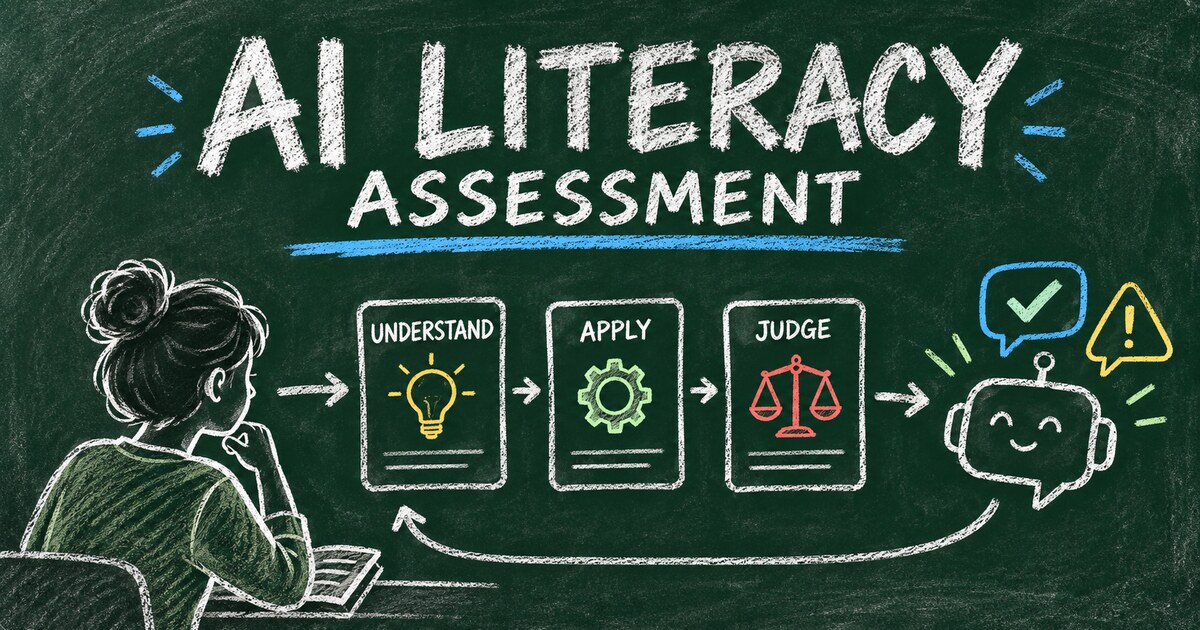
For a short course or staff workshop, a practical assessment can focus on three observable dimensions: explain a concept, use a tool thoughtfully, and judge an output before acting on it. Those dimensions make it easier to write questions that measure learning rather than confidence or access to a particular product.
What Should an AI Literacy Assessment Measure?
Start with the outcomes learners should demonstrate after instruction. A compact assessment can use the Understand → Apply → Judge framework: learners explain a relevant idea, use AI toward a defined goal, and evaluate the result in context. It is a practical instructional organizer, not a validated psychometric scale.
Understand: explain the idea in plain language
Check whether learners can describe what an AI system does and identify a limitation that matters to the task. Avoid rewarding memorized jargon alone. For example, ask a learner to explain why a chatbot’s fluent response is not, by itself, evidence that the answer is true.
Apply: choose and use AI for a bounded task
Give learners a task with a clear goal and constraints, such as drafting alternative headlines or organizing a set of non-sensitive notes. Ask them to identify what they asked the tool to do and what they changed afterward. This distinguishes purposeful use from simply accepting the first generated result.
Judge: verify, protect, and take responsibility
Ask learners to inspect an output, decide what needs checking, and explain what they would do before using it. Include context-specific concerns such as unsupported claims, potential bias, personal information, or a consequential decision that needs human review. Correct answers should show a defensible process, not just the word “verify.”
How to Write Questions That Reveal Real Understanding
Good AI literacy questions make the learner’s thinking visible. A multiple-choice item can quickly check a concept, but scenario questions are often better for finding out whether someone can transfer that concept to a new situation.
Use a mix of formats:
- Concept checks: Ask learners to distinguish an AI-generated suggestion from verified evidence.
- Scenario decisions: Present an output with a plausible error and ask what should happen next.
- Short explanations: Ask why a source should be checked or why a particular prompt includes too much sensitive information.
- Applied tasks: Have learners produce or revise a small output, then annotate what they accepted, rejected, and verified.
- Reflection: Ask where human judgment changed the result and what uncertainty remains.
For example, a scenario might say: “An AI assistant drafts a paragraph for a school newsletter and includes a statistic with no source. What would you do before publishing it?” Strong responses identify the claim, seek a credible source, and remove or qualify it if it cannot be verified. The question tests a repeatable habit instead of a learner’s ability to guess the answer the instructor prefers.
Keep assessment language accessible and avoid embedding the lesson in the question. If learners are being assessed on evaluating output, provide enough context to reason about it, but do not tell them which sentence is unreliable. For question-writing techniques that also apply to AI-related knowledge checks, see how to write better quiz questions.
Include Responsible Use Without Turning the Test Into a Policy Quiz
Responsible AI use is part of literacy, but a list of rules alone does not show whether a learner can apply them. Ask what action is appropriate in a concrete context and why. A classroom assignment, a public-facing communication, and an internal brainstorming exercise may call for different levels of review and disclosure.
Useful assessment prompts can explore:
- Accuracy: Which claims require independent confirmation before use?
- Privacy: Does the task include personal, confidential, or otherwise restricted information?
- Bias and representation: Whose perspective might be missing or misrepresented, and how could that affect the result?
- Human accountability: Who is responsible for the final decision or published work?
- Disclosure and rules: What do the relevant course, employer, or publication policies require?
Do not imply that a single checklist resolves every ethical question. The appropriate action depends on the system, the information involved, the impact of an error, and the governing policy. The assessment should make those conditions visible so learners practice explaining their decisions.
Score Reasoning, Not Just the Final Answer
A useful AI literacy rubric separates the outcome from the process. A learner might reach a reasonable conclusion by chance, while another might identify uncertainty and propose a sensible verification step even without completing the research during a timed quiz.
A simple rubric can score each response on four dimensions:
| Dimension | Evidence to look for |
|---|---|
| Conceptual understanding | Explains the relevant AI concept or limitation accurately |
| Purposeful application | Connects tool use to the stated goal and constraints |
| Evaluation | Identifies what is uncertain and proposes a proportionate check |
| Responsibility | Recognizes privacy, bias, policy, or human-accountability concerns when relevant |
Define what counts as beginning, developing, and proficient work for each dimension before learners take the assessment. Use a short written response or oral follow-up for important judgments; an automatically scored quiz can be efficient for factual checks, but it may not capture the quality of a learner’s reasoning. If your course already uses online quizzes, automatic scoring for online exams can help with objective items while leaving nuanced responses for human review.
How to Build an AI Literacy Assessment: 4 Steps
Step 1: Choose the learning context and audience
Specify who will take the assessment, what they have been taught, and what they should be able to do afterward. A middle-school classroom check and a staff assessment for handling customer data should not use the same examples or assumptions.
Step 2: Map outcomes to evidence
Write one observable outcome for each dimension—understand, apply, and judge. For each outcome, decide what answer, action, or explanation would demonstrate it. This prevents a quiz from drifting into trivia that does not inform your teaching or training.
Step 3: Draft a balanced set of items
Use a few direct concept checks alongside scenarios, short explanations, or a small applied task. Keep each item focused on one main skill, and make the expected response format clear. Include answer guidance and scoring criteria before sharing the assessment.
Step 4: Review, pilot, and revise
Ask a colleague to check whether the questions match the learning goals, use accessible language, and avoid requiring outside knowledge that was never taught. Pilot the assessment with a small group if possible. Review confusing answers and revise the item or instruction rather than assuming every unexpected response reflects a learner gap.
Frequently Asked Questions
What should an AI literacy assessment include?
It should assess understanding of relevant AI concepts, practical use toward a defined goal, and judgment about accuracy, privacy, bias, or accountability when those issues apply. Use scenarios and explanations as well as factual questions.
How do you assess whether someone can use AI responsibly?
Give them a realistic task or AI-generated output, then ask what they would verify, what information they would avoid sharing, and who remains responsible for the final decision. Score the reasoning and fit to context, not only the final choice.
Is an AI literacy test the same as an AI skills assessment?
They overlap but are not identical. An AI skills assessment usually emphasizes performance with particular tools or tasks; AI literacy also includes understanding, critical evaluation, and responsible decision-making around AI.
How many questions should an AI literacy assessment have?
Use only as many questions as needed to collect evidence for the learning outcomes. A brief knowledge check may need only a small number of focused items, while a broader course assessment may need scenarios and a rubric; there is no universal question count that guarantees validity.
Can an online quiz assess AI literacy?
An online quiz can assess definitions and scenario choices, and short-answer fields can collect explanations. For complex applied work, pair the quiz with a reviewed task or discussion so the score does not overstate what fixed-answer questions can measure.
Can I build an AI literacy assessment with FormHug?
FormHug can be used to create online forms and quizzes for collecting structured answers. Choose question types and scoring that fit your learning goals, and review the current product interface and plan details before relying on a specific feature for a graded assessment.
Related
- AI-Generated Quiz Questions: How to Check Accuracy — review generated questions for accuracy, level, and answer quality.
- How to Create a Healthcare Training Assessment — adapt assessment design to a professional training context.
- How to Create Coding Exit Tickets for Students — use a short end-of-lesson check to identify what learners understood.
An AI literacy assessment should reveal more than whether someone recognizes the latest tool name; it should show whether they can question an output and make a responsible next move. Build your assessment around the decisions learners will actually face, then create your form → to collect and review their responses.

Written by
FormHug TeamProduct, research, and form automation team
The FormHug Team brings together product builders, workflow researchers, and form automation practitioners who study how people collect, route, and act on information online. Our guides are based on hands-on product testing, template analysis, customer workflow patterns, and deep experience with forms, surveys, quizzes, AI-assisted creation, integrations, and results sharing.