AI-Generated Quiz Questions: How to Check Accuracy
Create the assessment
Turn this into a scored assessment
Build an assessment with scoring, result pages, feedback, and records you can review later.
A quiz can look ready before it is reliable. AI can produce a clean question, four plausible options, and a confident answer key in seconds—but fluency does not prove that the key is correct or that the question measures what you intended.
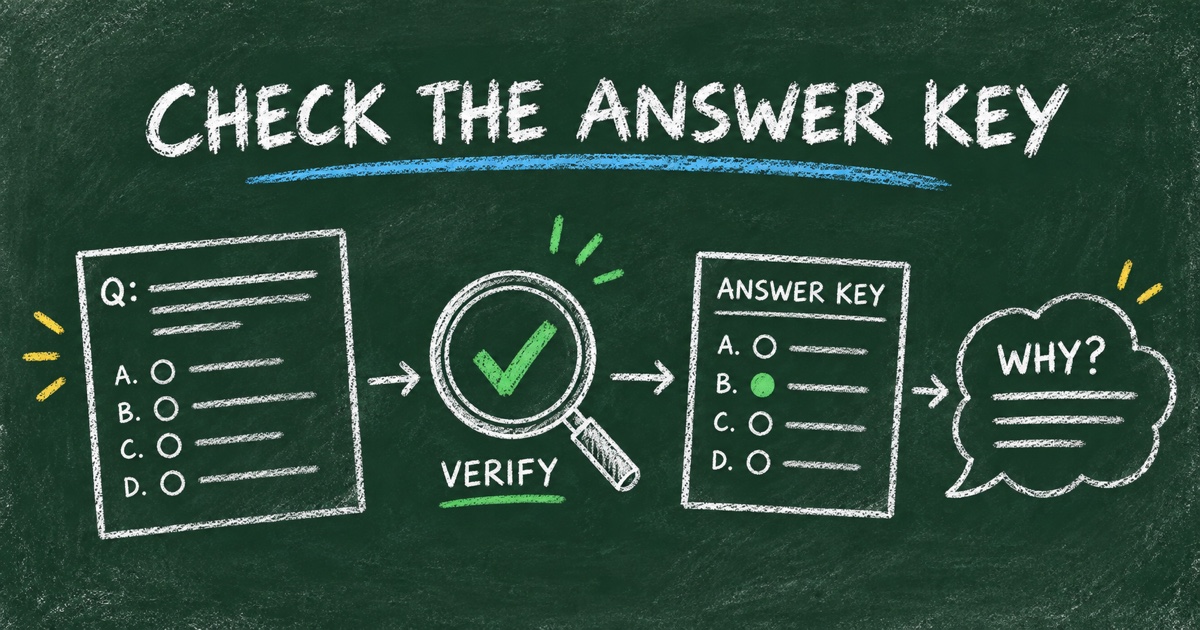
The safest way to use AI-generated quiz questions is to treat them as a draft, then review each item against a trusted source, check its wording and answer logic, and test the quiz as a participant would. This process helps teachers, instructional designers, and training teams catch errors before they confuse learners or undermine an assessment.
TL;DR — AI-generated quiz questions become usable only after a human verifies their facts, answer keys, clarity, and alignment with the learning goal.
- Check every keyed answer against a source you trust; do not use the model’s explanation as its own proof.
- Review distractors, wording, and scope for ambiguity or more than one defensible answer.
- Pilot the quiz and revise items that reveal confusion rather than the intended knowledge.
- Works for: classroom practice, onboarding, knowledge checks, and low-stakes training quizzes.
- For consequential decisions, use qualified subject-matter review and an established assessment process.
What does AI-generated quiz accuracy mean?
Accuracy is not just whether the answer key contains the right letter. A reliable quiz item must also ask a clear question, have one defensible correct answer when it is presented as single-answer, use plausible but incorrect distractors, and assess the intended learning objective.
These checks are related but distinct. A factually correct item can still be ambiguous. A clear item can test trivia instead of the skill a course taught. And a technically correct key can be paired with an explanation that teaches a misconception. Reviewing the whole item—not just its key—reduces these failure modes.
For high-stakes tests, a quick editorial review is not a substitute for a validated assessment process. The Standards for Educational and Psychological Testing, published jointly by AERA, APA, and NCME, describe testing standards and validity considerations; use qualified assessment expertise when scores affect important decisions. Read the Standards overview.
Why AI-generated quiz questions can be wrong
Generative AI produces likely text, not a guarantee that each statement has been checked against an authoritative source. Errors can enter through outdated information, an unstated assumption, a misleading premise, or a plausible-sounding explanation that rationalizes the wrong choice.
Question format can hide the problem. For example, an AI-generated item may ask, “Which treatment is best?” without specifying the patient, guideline, or context that determines the answer. A model may then select one option as if the missing context did not matter. In a history quiz, a date may be stated with confidence but conflict with the course’s source material. In workplace training, an answer may describe a general practice that does not match the organization’s policy.
This is why the source of truth must sit outside the generated item. Use the assigned textbook, course material, current policy, official documentation, or a qualified subject-matter expert appropriate to the topic. For health or safety topics, do not turn a quiz-writing workflow into advice for diagnosing or treating real situations.
Use the Source–Key–Clarity review
The Source–Key–Clarity review is a practical three-pass check for AI-generated quiz questions. It is an editorial checklist, not a psychometric validation method.
Pass 1: Source — can you verify the claim?
Find the exact source that supports the intended answer. Check that it is relevant to the audience and context, and that it is current when the subject changes over time. If you cannot find a trustworthy source, remove the claim or rewrite the question around material you can verify.
Ask:
- Does the source explicitly support the keyed answer?
- Is the fact being applied in the right context and time period?
- Does the question introduce assumptions that the source does not establish?
For a course quiz, course material may be the right reference even when other sources phrase a concept differently. Make the intended scope visible in the stem rather than expecting participants to guess it.
Pass 2: Key — is there one defensible answer?
Solve the question yourself before reading the generated key. Then check each option. If two answers can be defended, the item is not ready as a single-answer question. If the answer depends on a hidden assumption, state that assumption in the question or change the item type.
Distractors should reveal common misunderstandings, not create traps. Avoid options that overlap, differ only by a vague qualifier, or are obviously wrong because of grammar or length. If “all of the above” or “none of the above” makes the answer depend on option combinations rather than the learning goal, rewrite the item.
Pass 3: Clarity — does the question test the intended objective?
Read the question without the answer key. Can a learner tell what knowledge or skill is being assessed? Remove irrelevant details, unexplained jargon, double negatives, and wording that gives away the answer. Confirm that the difficulty matches the audience and that the item covers material learners were expected to study.
The CDC’s plain-language guidance recommends organizing information around the audience and making content easier to understand. Those principles are useful for quiz stems too: a question should make the task clear without making the underlying concept artificially easy. See CDC plain-language guidance.
Review explanations separately from answer keys
An explanation should show why the correct option follows from the source or reasoning—not simply repeat the answer. Where useful, it can also identify the misconception behind a tempting distractor. Check explanations independently; an explanation that sounds coherent can still defend a wrong key.
A useful explanation usually does three things: names the principle being tested, connects that principle to the correct option, and clarifies one likely point of confusion. Keep it proportional to the item. A short practice question may need only a sentence, while a technical training item may need a source reference or a note about the applicable policy.
When a question relies on a changing rule, standard, or product detail, record the source and review date with your authoring materials. That makes later updates safer than relying on an old generated explanation.
Pilot the quiz before sharing it widely
A correct item on paper can still confuse real participants. Ask a small group representative of the intended audience to complete the quiz without coaching. Invite them to flag unclear wording and explain how they interpreted difficult questions; their reasoning can reveal ambiguity that an author overlooks.
Review missed items as signals, not automatic proof of learner failure. A cluster of unexpected responses may point to a teaching gap, an unclear stem, a weak distractor, or a miskeyed answer. Revise the item, then check it again against the source. If you change a question after review, verify that its score logic and explanation still match.
For consequential examinations, informal piloting alone does not establish validity or fairness. Follow the assessment standards and governance process appropriate to the decisions being made.
A practical workflow for checking AI quiz questions
Use this four-step workflow whether questions are generated in a chat assistant, a quiz tool, or a document editor.
Step 1: Define the learning objective
Write what the participant should know or be able to do after the lesson. Ask AI for draft questions tied to that objective, with the audience, topic boundaries, question format, and requested source material clearly specified. A detailed prompt can improve relevance, but it cannot verify the result.
Step 2: Build a reviewable answer key
Keep each question, intended answer, explanation, learning objective, and supporting source together. Mark uncertain items for review instead of allowing a polished answer key to make them look settled.
Step 3: Apply Source–Key–Clarity
Verify the evidence, solve the question independently, evaluate the distractors, and check that the wording matches the objective. Ask a subject-matter reviewer to resolve questions that require expertise beyond the quiz author.
Step 4: Pilot, revise, and recheck
Test the quiz with representative learners. Fix confusing or misaligned items, then recheck changed answers and explanations. Share the quiz only when the version participants see matches the version you reviewed.
Frequently Asked Questions
How do you check if AI-generated quiz questions are accurate?
Verify every intended answer against a trusted source, solve the question without looking at the generated key, check that only one answer is defensible when appropriate, and review whether the wording tests the intended learning objective.
Can AI-generated quiz answers be wrong?
Yes. A confident answer or explanation is not independent evidence. AI-generated content can contain factual errors, outdated details, hidden assumptions, ambiguous wording, or an answer key that does not match the question.
What is the difference between checking an answer key and validating a test?
Checking an answer key verifies individual items against evidence and logic. Test validation is a broader process that evaluates whether score interpretations are appropriate for a particular use, population, and decision. A quick editorial review does not validate a high-stakes assessment.
Should AI write quizzes for high-stakes exams?
AI may help draft material, but high-stakes assessment requires qualified human review and the relevant institutional or professional validation process. Do not treat generated questions as ready for consequential use without that oversight.
How can I make AI-generated quiz questions less ambiguous?
State the audience, context, and scope in the question; avoid vague terms and hidden assumptions; ensure the options do not overlap; and ask a reviewer unfamiliar with the draft to explain how they interpret the stem.
Can I turn reviewed AI-generated questions into a FormHug quiz?
Yes. FormHug can be used to build quizzes and assessments from reviewed questions. Verify the current question, scoring, and feedback options in the product before publishing, especially when the quiz supports an important decision.
Related
- How to Create an AI Quiz with Correct Answers and Explanations — Build answer keys and explanations that support learning.
- The AI Quiz Maker Prompt Template: From Idea to Results — Structure a prompt around goals, questions, scoring, and results.
- How to Create a Quiz for Employee Training and Learning Checks — Plan workplace knowledge checks around a training goal.
A polished quiz is not necessarily a trustworthy one; verify the source, key, and clarity before learners rely on it. Create your quiz →

Written by
FormHug TeamProduct, research, and form automation team
The FormHug Team brings together product builders, workflow researchers, and form automation practitioners who study how people collect, route, and act on information online. Our guides are based on hands-on product testing, template analysis, customer workflow patterns, and deep experience with forms, surveys, quizzes, AI-assisted creation, integrations, and results sharing.