How to Create a Healthcare Training Assessment
Create the assessment
Turn this into a scored assessment
Build an assessment with scoring, result pages, feedback, and records you can review later.
A healthcare training assessment can look complete on paper while leaving the most important question unanswered: can someone use what they learned in the work they are expected to do? A score alone cannot establish readiness, especially when a course covers both factual knowledge and practical judgment.
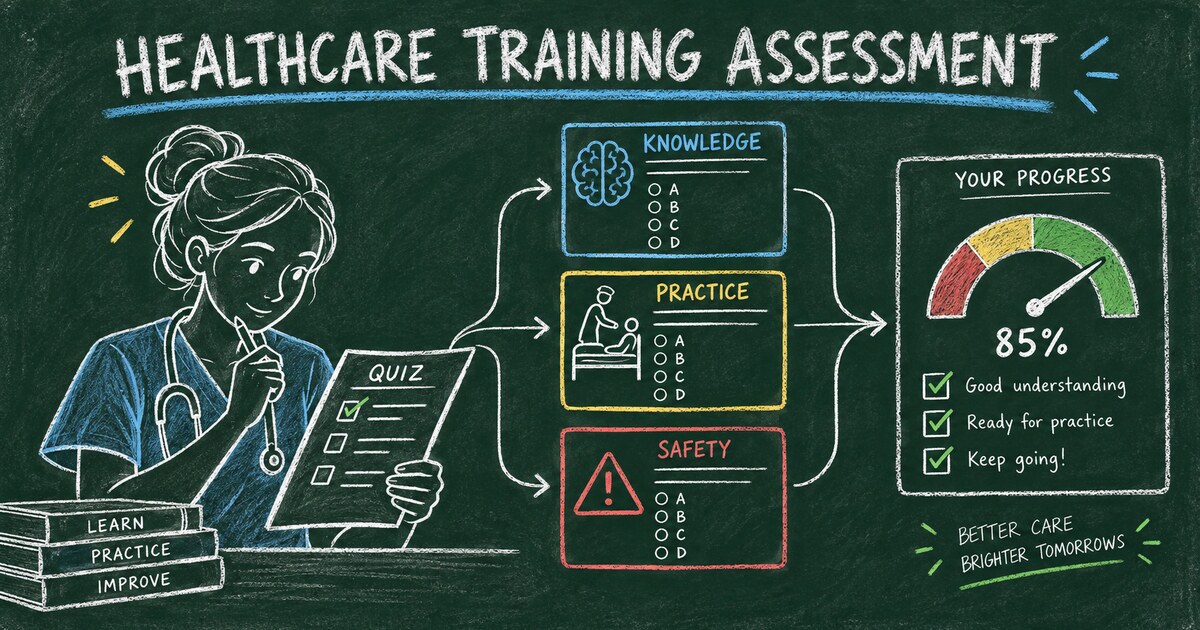
The useful alternative is to assess the learning objective, not merely the lesson. Separate recall from application, make the scoring rules visible, and route uncertain or incorrect answers into appropriate review rather than treating a quiz as proof of clinical competence. This guide explains how to build that kind of assessment for healthcare training without turning it into medical advice or a substitute for supervised evaluation.
TL;DR — A healthcare training assessment is a structured check of whether learners understand and can apply the specific material taught in a healthcare course.
- Start with learning objectives — write each question to measure a defined knowledge or decision-making outcome.
- Separate recall from application — factual questions and realistic scenarios reveal different kinds of learning.
- Make scoring and feedback actionable — explain why an answer is correct and what learners should review.
- Works for: onboarding, policy training, continuing education, and course knowledge checks.
- A quiz can support learning review; it does not by itself certify clinical competence or replace observed practice.
What Is a Healthcare Training Assessment?
A healthcare training assessment is a planned set of questions or activities used to check learning from a healthcare-related course, orientation, or training session. It may test recall of a policy, recognition of a situation, or selection of an appropriate next step within the scope of the training.
It is not the same as a clinical competency evaluation. A multiple-choice score shows how a person answered those questions under those conditions; it does not prove that they can perform a procedure safely in practice. When practical capability matters, assessment should be paired with the organization’s applicable supervision, observation, and credentialing processes.
Start With the Learning Objective, Not the Question Type
Before writing questions, state what a learner should know or be able to do after training. A useful objective is observable: “identify the required escalation route in the organization’s policy” is easier to assess than “understand escalation.”
Use an Objective → Evidence → Question sequence:
- Objective: What should a learner know or decide?
- Evidence: What answer or reasoning would demonstrate that learning?
- Question: What prompt can elicit that evidence without testing unrelated reading tricks?
For example, if a module teaches a reporting workflow, an assessment might ask learners to identify which information the policy requires them to report. Use the current policy as the authority; do not invent clinical guidance or use a quiz to establish rules that the training itself has not taught.
Balance Knowledge Questions With Scenarios
Recall questions are useful for names, definitions, sequence, and policy details. Scenario questions can test whether learners recognize which principle applies in a described situation. Both have limits: recall does not establish transfer, while a scenario can be ambiguous if it omits relevant context.
Use these checks when drafting:
- Keep each question tied to one learning objective.
- Include only details needed to answer; avoid trick wording and irrelevant complexity.
- Make distractors plausible but clearly incorrect under the material taught.
- Avoid asking learners to diagnose, prescribe, or make decisions outside the training’s intended scope.
- Ask a qualified subject-matter reviewer to confirm the answer key and scenario assumptions.
For an introductory knowledge check, a short set of focused items may be more useful than a long test that mixes unrelated topics. The right length depends on the breadth of the material and the time available; do not imply that a fixed question count guarantees competence.
Make Scores and Feedback Explain What to Do Next
A score is a summary, not a learning plan. Tell learners what the result means, what to revisit, and whether the next step is another attempt, a conversation with a trainer, or a separate practical review.
Choose a pass threshold only when the training owner has a defensible reason for it. If the assessment is formative, describe it as a knowledge check and use missed questions to guide review. If a result has employment, safety, or certification consequences, the organization should define and validate the assessment process with appropriate subject-matter and compliance owners.
Useful feedback explains the principle behind an answer, points back to the relevant course material, and avoids shaming the learner. For a missed policy question, for instance, direct the learner to the current policy section rather than improvising a new instruction in the quiz explanation.
Build a Healthcare Training Assessment in Four Milestones
Step 1: Scope the training
Name the audience, course, and learning objectives. Keep the assessment within the content learners were actually taught, and identify any outcomes that require supervised demonstration instead of a written quiz.
Step 2: Draft and review the questions
Mix direct knowledge checks with carefully bounded scenarios where they serve the objective. Have an appropriate subject-matter reviewer check every question, answer, and explanation against current training materials and policy.
Step 3: Set scoring and feedback rules
Decide whether the assessment is formative or consequential, document how results are interpreted, and define what learners should do after an incorrect or incomplete result. Do not present a quiz score as a credential unless the responsible program has established that meaning.
Step 4: Test the learner experience
Ask a representative learner or reviewer to complete the assessment. Check that prompts are clear, the answer key is correct, feedback is understandable, and the assessment works on the devices learners will use. Revise ambiguous items before distributing it.
Use an Online Quiz When You Need a Repeatable Knowledge Check
An online quiz can organize questions, collect responses, and show learners feedback in one repeatable flow. It is useful for course review, onboarding checks, and tracking which topics need reinforcement. It is not a replacement for hands-on observation, professional judgment, or the organization’s required training records.
FormHug can be used to create online quizzes and assessments. The best setup depends on the assessment’s purpose: keep low-stakes learning checks simple, and involve the responsible training and compliance owners before using results for high-impact decisions. See our guides to creating an online quiz and building an evaluation form for related formats.
Frequently Asked Questions
How do you create a healthcare training assessment?
Define measurable learning objectives, write questions that match those objectives, review the answer key with a qualified subject-matter expert, and explain how learners should use their results. Pair written checks with supervised evaluation when practical performance matters.
What questions should a healthcare training quiz include?
Include questions about the material actually taught, such as policy knowledge, key concepts, or bounded scenarios that test application. Avoid ambiguous prompts and clinical decisions outside the course scope; have a qualified reviewer validate every item.
How many questions should a healthcare training assessment have?
There is no universal question count. Use enough items to cover the stated objectives without adding repetitive questions, and choose a format appropriate to the time, stakes, and breadth of the course.
Can a quiz prove that healthcare staff are competent?
A quiz can show how someone answered a defined set of questions, but it does not by itself demonstrate practical competence. Use the organization’s appropriate observation, supervision, and credentialing processes when performance must be evaluated.
Can I create a healthcare training quiz with FormHug?
FormHug supports creating online quizzes and assessments. Confirm that the chosen format and result workflow fit the training purpose, and do not treat an online score as clinical certification or a substitute for required review.
Related
- How to Create an Online Quiz — Build a shareable quiz with a clear question-to-result flow.
- How to Create an Evaluation Form — Structure evaluations for feedback and review.
- Skills Assessment Template — Explore a skills-focused assessment format.
A healthcare training score is most useful when it points to a specific learning objective and a responsible next step—not when it is mistaken for proof of hands-on readiness. Create your form →

Written by
FormHug TeamProduct, research, and form automation team
The FormHug Team brings together product builders, workflow researchers, and form automation practitioners who study how people collect, route, and act on information online. Our guides are based on hands-on product testing, template analysis, customer workflow patterns, and deep experience with forms, surveys, quizzes, AI-assisted creation, integrations, and results sharing.