15 Best Employee & Workplace Survey Templates for 2026 (HR-Ready)
Start collecting responses
Turn this into a shareable survey
Draft the questions, publish a clean link, and keep every response organized in FormHug.
According to SurveyMonkey’s 2026 State of Work report, 30% of employees say burnout is actively affecting their productivity — and that figure was collected before the latest wave of AI-driven restructuring announcements. The challenge for HR teams is not that employees are unwilling to share how they feel. It’s that most organizations don’t have a consistent, structured way to ask.
An all-hands meeting captures who speaks up loudest. An anonymous, well-designed survey captures what people actually think. The gap between those two data sources is where most workforce problems are allowed to develop undetected — until they show up in attrition data or exit interviews, at which point the cost is already paid.
These 15 templates cover the full range of workplace research for 2026: job security and AI disruption anxiety, remote work preferences and return-to-office sentiment, work-life balance, burnout and mental health, employee engagement, and hiring and skills gap dynamics. Each template links directly to a ready-made FormHug form you can customize, brand, and distribute within minutes.
TL;DR — These 15 HR and workplace survey templates give People Ops and HR teams structured question sets for every major workforce research challenge in 2026 — from job security to hybrid work policy to mental health.
- Job security & AI disruption — layoff experience, job security confidence, career transitions, salary vs AI impact
- Remote work & flexibility — return-to-office sentiment, hybrid work policy, work-life balance, digital nomad, freelance preferences
- Wellbeing & engagement — burnout & stress, mental health at work, employee engagement pulse, skills gap
- Works for: HR teams, People Ops, managers, L&D leads, and organizational researchers
- All templates are free, anonymous-capable, and customizable in minutes
Quick Comparison: 15 Employee & Workplace Survey Templates
| Template | Best for | Primary data captured |
|---|---|---|
| 2026 Layoff Experience Survey | Post-restructuring pulse | Emotional impact, confidence, transition support |
| 2026 Job Security Survey | Proactive sentiment tracking | Job security confidence, fear triggers |
| 2026 Career Switching Survey | Retention risk assessment | Field-change intent, motivations |
| 2026 Salary vs AI Impact Survey | Compensation + AI intersection | Salary satisfaction tied to AI skill level |
| 2026 Remote vs Office Preference Survey | Policy design input | Preference strength, productivity by location |
| 2026 Return-to-Office Survey | RTO decision research | Resistance reasons, hybrid acceptance |
| 2026 Work-Life Balance Survey | Sustainability signal | After-hours behavior, boundary strength |
| 2026 Digital Nomad Survey | Global team flexibility | Location flexibility use, productivity impact |
| 2026 Freelance vs Full-time Survey | Workforce structure research | Employment preference, switching barriers |
| 2026 Hybrid Work Policy Feedback | Policy post-implementation review | Manager vs IC perception gap |
| 2026 Burnout & Stress Survey | Burnout early detection | Workload, energy levels, disengagement signs |
| 2026 Mental Health at Work Survey | Wellbeing program design | Mental health access, stigma, support quality |
| 2026 Employee Engagement Pulse Survey | Recurring engagement tracking | Engagement score, belonging, intent to stay |
| 2026 Skills Gap Survey | L&D planning | AI skills deficit, training needs, self-assessment |
| 2026 Hiring Trends Survey | Talent acquisition intelligence | AI resume screening, candidate expectations |
Job Security, AI Disruption & Career Transitions
The most pressing workforce research category of 2026 is also the most uncomfortable to run. Employees know that AI is reshaping roles — the question is whether HR has a way to measure the anxiety that creates, before it drives the team members they most want to keep toward the exit. For AI adoption measurement from the tool-usage side, see AI & productivity survey templates.
These four templates are designed for anonymous distribution. The data they produce is only useful if people feel safe enough to answer honestly.
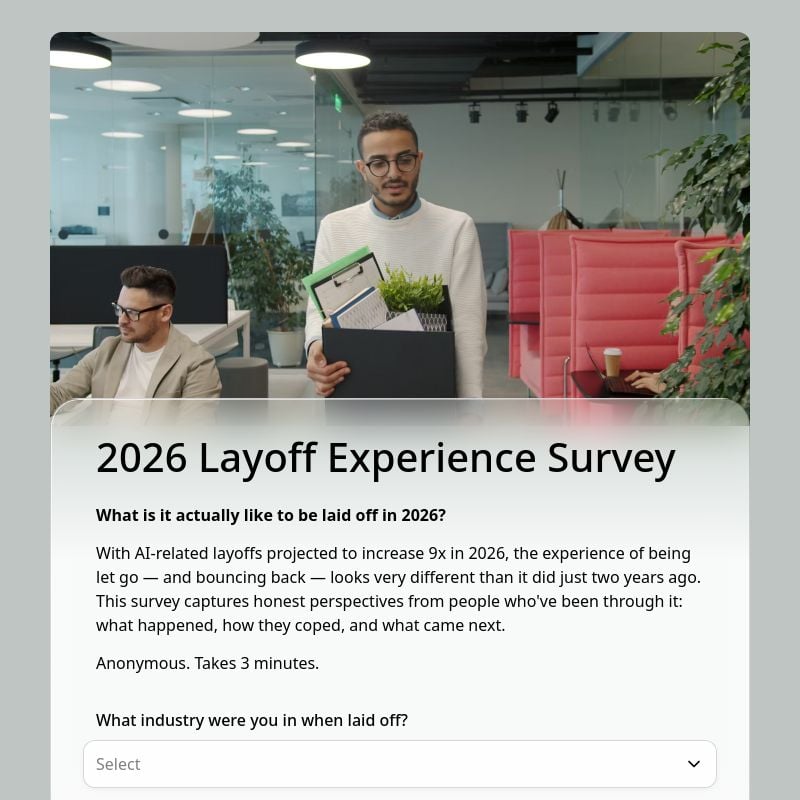
AI-related layoffs are forecast to increase roughly 9× in 2026 compared to 2024. For organizations that have already gone through restructuring — or are about to — this template gives impacted employees a structured way to share how they experienced the process: communication quality, severance adequacy, transition support, and confidence about what comes next. For HR leaders, it’s post-mortem data that directly informs how to handle the next restructuring more effectively.
26% more workers reported worrying about job loss in 2026 compared to 2025. This template captures that anxiety at the level of specificity that makes it actionable: which aspects of the role feel stable, what changes have eroded confidence, and what the organization could do to rebuild it. Running this anonymously before an all-hands or town hall gives leadership the data needed to address real fears — rather than the questions that get raised by the employees least likely to leave.
69% of workers report having considered a career or field change in the past year. This template distinguishes between those who are actively planning to switch, those who are curious but uncommitted, and those who raised the question and returned to their current path. For HR, that segmentation is the difference between a retention problem and a normal level of career exploration. The template also captures what would make someone stay — an underused lever in retention conversations.
2026 Salary vs AI Impact Survey
Research from Microsoft shows that AI super-users are 3× more likely to receive a positive performance review than non-users. This template examines whether employees perceive that connection between AI skills and compensation — and whether compensation is keeping pace with the additional productivity AI is producing. Useful for compensation benchmarking and for identifying the gap between what AI-enabled employees expect and what current pay structures deliver.
Remote Work, Flexibility & Work Arrangements
85% of workers say they value remote work more than a salary increase — a figure that has held steady since 2023 and shows no signs of reversing despite high-profile return-to-office mandates. These six templates give HR and People Ops teams the data they need to design work arrangement policies that reflect actual workforce preferences rather than executive intuition.
2026 Remote vs Office Preference Survey
The definitive baseline for any work arrangement policy decision. This template measures not just preference (remote vs in-person vs hybrid) but preference strength — how much productivity, collaboration, and wellbeing are tied to a specific arrangement. For organizations drafting flexible work policies, the granular data this produces is far more useful than a simple “prefer remote: 71%” headline.
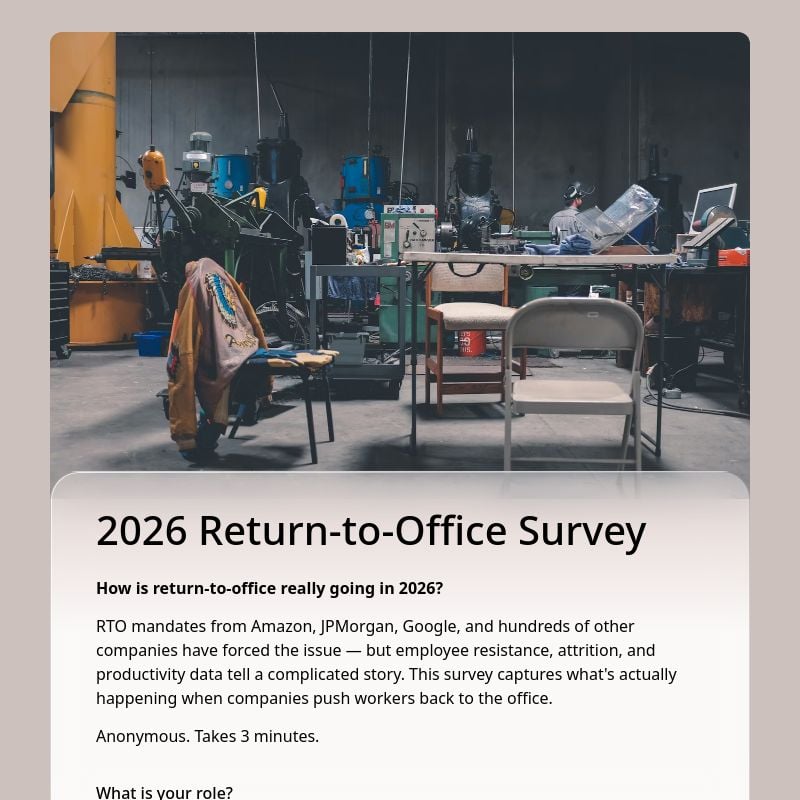
Designed for organizations that have issued or are considering RTO mandates, this template captures employee perspectives on both employer and individual dimensions: commute impact, collaboration quality, productivity comparison, and the specific objections most likely to drive attrition. The questions are written to get at reasons, not just reactions — “What’s the primary reason you prefer not to return full-time?” produces more actionable data than “How do you feel about RTO?”
2026 Hybrid Work Policy Feedback
Built specifically for post-implementation review of hybrid policies — after the policy has been communicated and is being practiced. It surfaces the gap between management perception (how the policy is supposed to work) and individual contributor experience (how it actually plays out day-to-day). Particularly useful 90 days after a hybrid policy change, when initial adjustments have settled and genuine friction points become visible.
Work-life balance research paired with remote work data reveals the mechanism behind the numbers: employees who work remotely report higher work-life balance scores not because they work fewer hours, but because they have more control over how they distribute them. This template measures that control — boundary strength, after-hours work frequency, the ability to disconnect — rather than just satisfaction scores, which tend to reflect broader morale rather than specific balance indicators.
For organizations with distributed or globally remote teams, this template captures the actual experience of location-flexible work: productivity by timezone, collaboration friction, legal and tax complications, and whether the arrangement is serving both the employee and the business. The Remote vs Office Preference Survey gives you aggregate policy input; this template gives you the operational ground truth for people already working remotely from multiple locations.
2026 Freelance vs Full-time Survey
With more than 50 million freelancers in the US alone, the freelance-vs-full-time question is now relevant not just for hiring decisions but for retention strategy. This template surveys employees on their preferences and switching barriers — what would make full-time employment more appealing, what freelance arrangements they’re already running on the side, and what it would take for them to shift. For HR teams designing benefits packages, the data is a direct input into what to prioritize.
Employee Wellbeing, Skills & HR Operations
Burnout, mental health, engagement, and skills development are the four areas where HR data most directly connects to business outcomes — and where survey frequency matters most. A once-a-year engagement survey misses everything that happened in months two through eleven.
30% of employees say burnout is actively affecting their output, according to SurveyMonkey’s 2026 State of Work data. This template distinguishes between acute stress (high workload in a finite period) and chronic burnout (a sustained depletion that doesn’t recover with a long weekend). The questions map to the Maslach Burnout Inventory dimensions — emotional exhaustion, cynicism, and reduced sense of efficacy — without requiring clinical language that makes respondents self-conscious. Pair it with the Mental Health survey for the full wellbeing picture.
2026 Mental Health at Work Survey
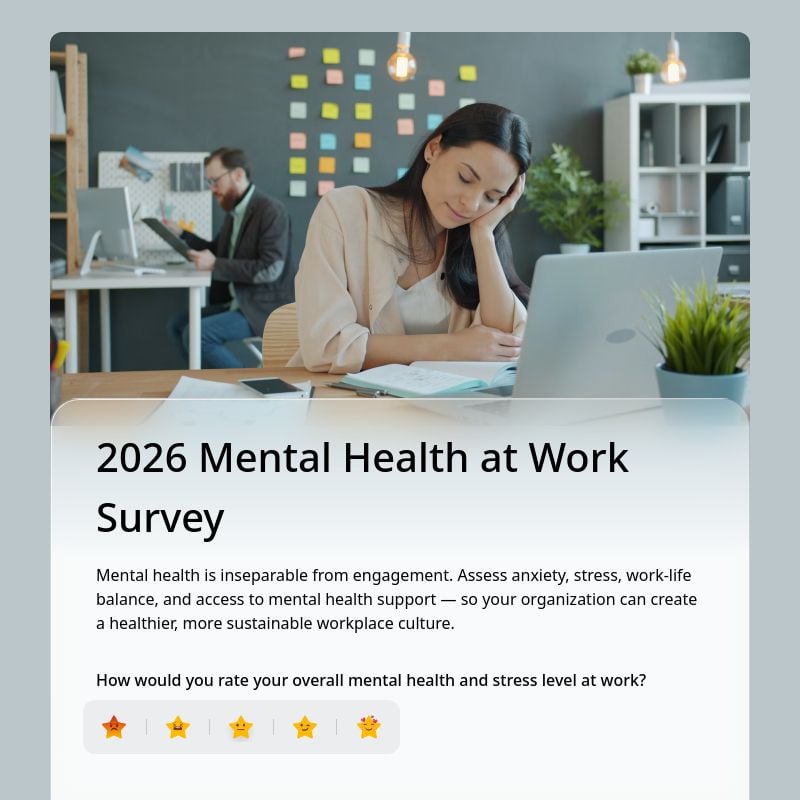
Separate from general burnout, this template focuses specifically on mental health access, stigma, and the quality of organizational support structures: whether employees know what’s available, whether they feel comfortable using it, and whether they’ve found it helpful when they did. The design assumes anonymous responses — questions that ask about past use of mental health resources require anonymity assurance to produce honest data. We’ve structured this template with that assumption built in.
2026 Employee Engagement Pulse Survey
The most widely used HR survey type — but most effective when run frequently rather than annually. This template is designed for recurring weekly, bi-weekly, or monthly distribution: short enough to answer in under three minutes, structured enough to track engagement score, sense of belonging, and intent to stay over time. The trend line it produces is more useful than any single data point. For teams that want to see the signal before the attrition spike, this is the right instrument.
AI skills gap is the top L&D concern for HR leaders in 2026, according to Gartner research. This template measures self-perceived AI literacy across specific skill categories — prompting, workflow automation, output verification, tool selection — and surfaces the gaps most likely to affect productivity. Unlike a skills assessment test, a self-assessment survey captures the confidence dimension that determines whether employees attempt to use AI tools at all. Low self-efficacy is often the barrier, not capability. For organizations that want to go deeper on AI adoption patterns beyond skills assessment, the AI & productivity survey templates cover AI usage, policy, ROI, and burnout from an organization-wide perspective.
Designed for talent acquisition and recruiting teams, this template tracks how hiring processes are changing: which AI tools are being used to screen resumes, what candidates expect from the process, and whether AI-assisted screening is introducing bias that hiring managers can feel but not quantify. Useful for TA teams building a case for or against AI resume tools, and for benchmarking hiring experience against what candidates now expect from companies that use AI responsibly.
How to Choose the Right HR Survey Template
Are you responding to an event or tracking ongoing sentiment?
Event-triggered surveys (Layoff Experience, Return-to-Office, Hybrid Work Policy Feedback) should be deployed within 2–4 weeks of a major change, while the experience is fresh. Ongoing tracking surveys (Employee Engagement Pulse, Burnout & Stress) need a regular cadence — monthly or quarterly — to produce the trend data that makes them useful. Running a pulse survey once and shelving it tells you less than not running it at all.
Does this survey require anonymity to produce honest data?
Job security, burnout, mental health, and career switching surveys will produce unreliable data if employees believe responses can be traced back to them. FormHug supports anonymous submissions by default — but you should also communicate that anonymity explicitly in the survey introduction. Templates in this collection that particularly require anonymity: Layoff Experience, Job Security, Mental Health at Work, and Career Switching.
Are you collecting data for internal decisions or publishable research?
Internal HR surveys need demographic segmentation by department, tenure, and role level to be actionable. Research-grade surveys (Career Switching, Freelance vs Full-time, Salary vs AI Impact) need industry and company size questions to produce benchmarkable data. If publishing is part of the goal, add those demographic fields before deployment.
Is this a one-time survey or a recurring pulse format?
The Employee Engagement Pulse is explicitly designed for recurrence — short, consistent, trackable. Most others in this collection are designed as periodic benchmarks (quarterly or semi-annual). Running the same burnout survey twice per year with the same questions lets you track whether interventions are working. Running a different survey each time gives you snapshots with no trend line. For teams that want to build longitudinal workforce data, consistency of instrument matters more than novelty of questions.
Final Recommendation
For most HR teams, the right starting point is the Employee Engagement Pulse Survey as a recurring instrument and the Burnout & Stress Survey as a quarterly deep-dive. Together, they give you both the early warning signal and the diagnostic depth to understand what’s driving disengagement before it becomes an attrition event.
If your organization is actively navigating AI-related change — new policies, restructuring, shifting role definitions — add the Job Security Survey to your stack. The data it surfaces is uncomfortable to read but far less costly than discovering the same concerns through departures.
For remote and hybrid teams, the Return-to-Office Survey and Hybrid Work Policy Feedback template together give you the before/after data needed to evaluate whether your current work arrangement policy is serving the organization or slowly eroding it.
All 15 templates are free to customize and deploy, with anonymous submission support built in. For a full overview of FormHug’s survey builder — question types, logic branching, and real-time analytics — see the survey maker feature page. For a deeper trust checklist before sending sensitive HR feedback, use the anonymous survey guide. Start with a free HR survey →
Frequently Asked Questions
What is an employee survey template?
An employee survey template is a pre-built set of HR-focused questions designed to collect structured data about workforce sentiment, wellbeing, work preferences, or skills. Templates save the time required to design validated question sets from scratch and ensure you’re asking about the dimensions most relevant to a specific HR research goal — rather than defaulting to generic satisfaction questions.
How do I make an employee survey anonymous?
FormHug supports anonymous submissions by default — no login is required to respond, and IP addresses are not attached to submissions. To ensure employees trust the anonymity, include a clear statement in your survey introduction: “This survey is completely anonymous. Your responses cannot be linked back to you.” For highly sensitive topics (mental health, layoff experience, job security), that statement is essential for response honesty.
How often should I run an employee engagement survey?
Pulse surveys (short, 3–5 question formats) work best on a monthly or bi-weekly cadence. Full engagement surveys (15–20 questions) are appropriate quarterly. Annual surveys produce data that’s too old to act on by the time insights are ready. The most effective approach is to pair a short recurring pulse with a longer periodic deep-dive — the pulse catches emerging issues, the deep-dive explains them.
What’s the difference between a burnout survey and a mental health survey?
A burnout survey measures work-specific depletion — exhaustion tied to workload, disengagement, and reduced sense of effectiveness at work. A mental health survey is broader: it asks about overall psychological wellbeing, access to mental health resources, stigma around seeking help, and the quality of organizational support. Both are valuable, but they serve different purposes. Run the burnout survey when you suspect workload or role demands are the issue; run the mental health survey when you want to understand whether the organization’s support structures are working.
Can I use these templates for a team of fewer than 10 people?
Yes, but interpret the results differently. With small teams, statistical significance is limited — a single outlier response can skew aggregate scores. For small teams, the value of survey data is qualitative rather than quantitative: it gives people a structured, anonymous channel to share concerns they might not raise directly. For very small teams (under 5 people), consider individual check-ins rather than surveys, since anonymity is difficult to maintain at that scale.
Are these employee survey templates compliant with GDPR?
FormHug stores response data on servers subject to GDPR requirements. For surveys distributed to employees in the EU, you should include a brief data notice explaining what data is collected, how long it’s retained, and who has access. Anonymous surveys (where no identifying information is collected) have a lighter compliance footprint. For any survey collecting names, emails, or other personal data alongside survey responses, consult your organization’s legal or privacy team before deployment.

Written by
FormHug TeamProduct, research, and form automation team
The FormHug Team brings together product builders, workflow researchers, and form automation practitioners who study how people collect, route, and act on information online. Our guides are based on hands-on product testing, template analysis, customer workflow patterns, and deep experience with forms, surveys, quizzes, AI-assisted creation, integrations, and results sharing.