16 Best AI & Productivity Survey Templates for 2026
Start collecting responses
Turn this into a shareable survey
Draft the questions, publish a clean link, and keep every response organized in FormHug.
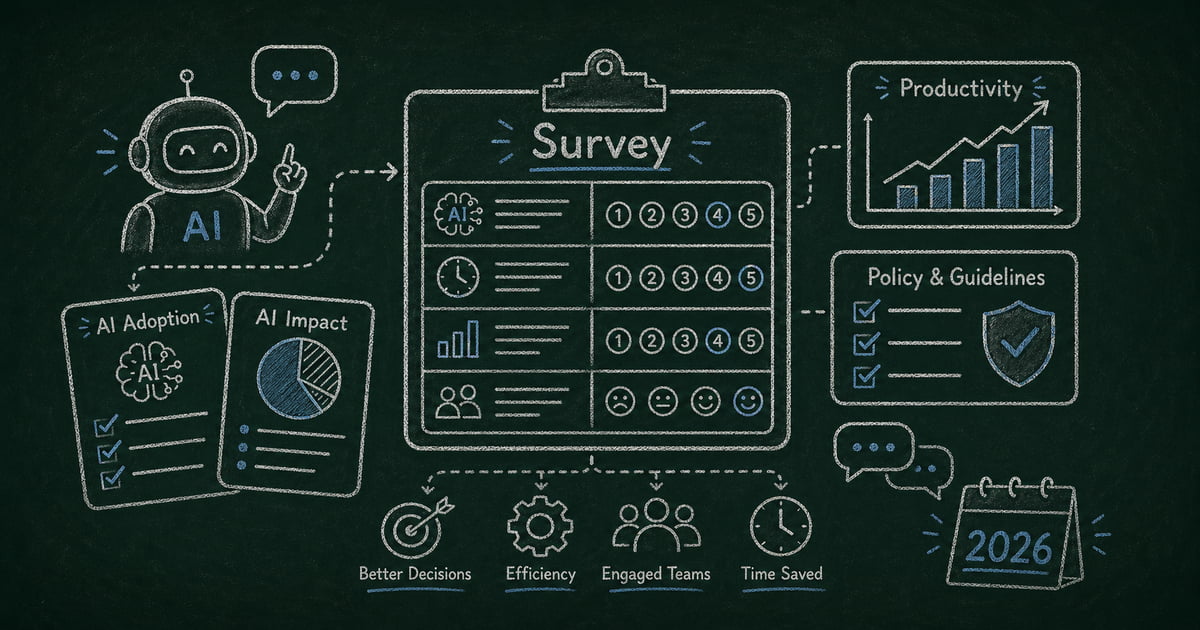
Most AI adoption programs fail for the same reason: teams launch the initiative before measuring where people actually are. They run a pilot, collect anecdotal feedback from the loudest voices, and conclude the rollout is going well — right until the productivity data shows otherwise. The challenge isn’t willingness to adopt AI. It’s the absence of structured data on who’s using what, where the friction actually is, and what the workforce actually fears. What most teams get back from informal listening sessions is noise. What they need is signal.
A well-designed AI survey template asks the right questions at the right level of specificity. Not “Do you use AI?” but “Which tasks take the longest when you do them without AI support?” Not “Are you worried about job replacement?” but “How has your confidence in your current role changed over the past six months?” The difference between a useful survey and a forgettable one is almost always in the question design, not the delivery tool.
These 16 templates cover the full range of AI-related research: adoption and usage patterns, productivity and ROI measurement, employee sentiment on job security, AI policy clarity, skills gaps, and role-specific workflows for developers, marketers, and support teams. Each template links directly to a ready-made FormHug form you can customize and publish in minutes — no survey design experience required.
TL;DR — Structured AI surveys produce actionable data; informal feedback channels produce noise. These 16 templates give you the right question sets for every stage of the AI adoption lifecycle.
- 5 core adoption templates — AI adoption benchmark, productivity impact, tools usage, job replacement fear, and agent usage; highest search volume and most immediately deployable
- Policy & sentiment templates — AI policy clarity, ROI perception, burnout risk, and human-vs-AI work boundaries
- Role-specific templates — AI for developers, marketers, customer support teams, and prompting skill self-assessment
- Works for: HR teams, People Ops, product managers, founders, researchers, and L&D professionals
- All templates are free to customize and deploy — no coding required
Quick Comparison: 16 AI Survey Templates for 2026
| Template | Best for | Primary data captured |
|---|---|---|
| 2026 AI Adoption Survey | Baseline benchmark | Tools used, adoption rate, barriers |
| 2026 AI Productivity Impact Survey | ROI measurement | Hours saved, tasks accelerated |
| 2026 AI Job Replacement Fear Survey | Workforce sentiment | Job security confidence over time |
| 2026 AI Tools Usage Survey | Tool landscape mapping | ChatGPT vs Claude vs Copilot vs Gemini |
| 2026 AI Agent Usage Survey | Agentic AI readiness | Agent awareness, task delegation patterns |
| 2026 AI Burnout vs Productivity Survey | Wellbeing signal | Cognitive load, sustainable AI use |
| 2026 AI vs Human Work Survey | Thought leadership research | Tasks seen as AI-safe vs human-critical |
| 2026 AI Spending Survey | Budget benchmarking | Individual + company AI tool spend |
| 2026 AI in Marketing Survey | Marketing team maturity | Content gen, ad copy, SEO automation |
| 2026 AI Accuracy & Trust Survey | Trust & verification habits | Hallucination concerns, output checking |
| 2026 AI Prompting Skill Survey | AI literacy self-assessment | Prompt confidence, iteration habits |
| 2026 AI Policy at Work Survey | Policy clarity audit | Guideline awareness, compliance gaps |
| 2026 AI ROI Perception Survey | Executive research | Perceived value vs investment |
| 2026 AI in Customer Support Survey | CX team AI workflows | Chatbot use, escalation patterns |
| 2026 AI Learning Curve Survey | Onboarding research | Learning difficulty, resources used |
| 2026 AI Coding Usage Survey | Developer team adoption | Copilot/Cursor/Claude Code usage |
AI Adoption, Usage & Impact Surveys
These five templates address the most immediate questions any organization faces when assessing its AI posture: who’s using what, what’s the measurable effect on productivity, and what does the workforce actually fear?
The design principle across all five is specificity over breadth. An adoption survey that asks “Do you use AI?” produces a number. One that asks “Which of your five most time-intensive tasks have you attempted with AI in the last 30 days?” produces a roadmap. We built these templates to capture the latter.
The foundational benchmark template. It measures where your organization stands today: which tools are in active use, which workflows have been touched by AI, and what barriers are preventing broader adoption. Particularly useful for HR and operations leads running quarterly or annual reviews. The data informs training budgets, software procurement decisions, and team-level AI enablement initiatives. Run it before any major AI rollout to establish your baseline.
2026 AI Productivity Impact Survey
Research from WRITER found that AI-assisted workers save an average of 9 hours per week — but that figure conceals enormous variance across roles and task types. This template helps you verify whether that holds in your organization and where the gains are concentrated. It pairs naturally with the AI Adoption Survey as a follow-up: first understand who’s using what, then measure what it’s producing. The output makes the business case for expanded AI investment far more credible than benchmarked data alone.
2026 AI Job Replacement Fear Survey
60% of companies plan AI-driven workforce changes in 2026. Whether or not yours is one of them, the fear of displacement already affects morale and productivity in most organizations. This template gives employees a structured, anonymous channel to articulate those concerns — and gives HR a concrete signal to act on before anxiety compounds into retention risk. The questions are designed to surface specific fears (skill obsolescence, role elimination, reduced advancement opportunity) rather than a single sentiment score.
A precise snapshot of the AI landscape inside your organization: which tools have employees tried, which have they adopted consistently, and which did they try once and abandon? The template covers major platforms — ChatGPT, Claude, Gemini, Copilot — as well as category-specific tools for writing, coding, design, and research. Useful for IT procurement decisions, vendor evaluation, and understanding organic adoption patterns before rolling out a formal AI stack.
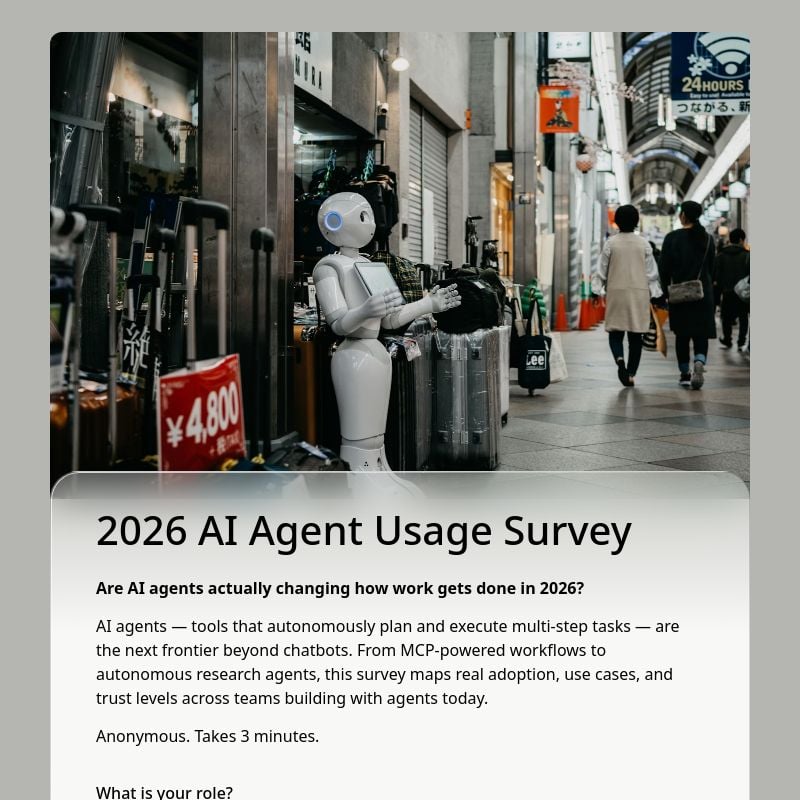
Agentic AI — systems that can take actions across applications, not just answer questions — is still early but moving fast. This template captures where your team is on that curve: awareness, experimentation, and actual task delegation. For organizations building AI strategy, early signal on agent adoption is worth tracking now, before it becomes a standard expectation rather than an emerging experiment. FormHug itself is built for AI agent use via MCP — see FormHug for Claude for how agentic form workflows look in practice.
AI Workplace Policy, ROI & Wellbeing Surveys
Once you know how AI is being used, the next question is whether it’s being used well — and whether the organization is supporting people through the transition. These five templates address the governance, economics, and human dimensions of AI at work.
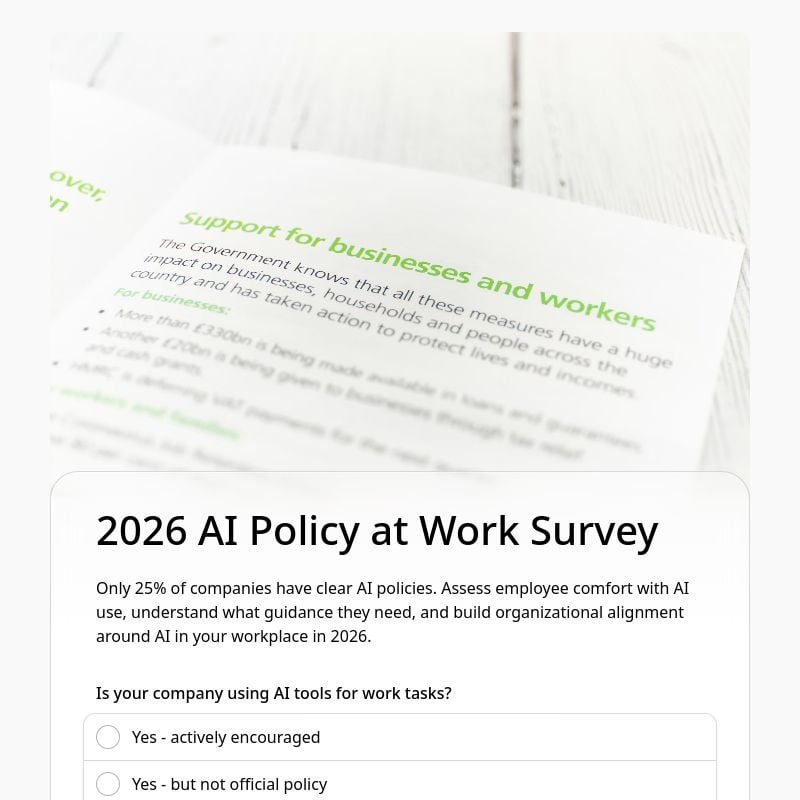
Only 25% of companies report that employees clearly understand the organization’s AI policy. This template identifies which guidelines employees are aware of, where the confusion lies, and how confident they feel about what’s permitted in their specific role. It’s the right tool to run before any policy update or AI governance initiative — measuring the current state of understanding before adding to it. The questions distinguish between awareness (have you read the policy?) and comprehension (can you apply it to a real decision?).
Designed for leadership and executive audiences, this template examines the gap between what companies are spending on AI and what they believe they’re getting back. Most organizations increased AI investment in 2025–2026 without clear measurement frameworks. This survey surfaces perception data — from CFOs, VPs, and senior managers — that can inform budget conversations, help prioritize investments with visible returns, and surface the disconnect between AI spend and employee-perceived value.
2026 AI Burnout vs Productivity Survey
AI tools can increase output — but they can also increase cognitive load when employees feel pressure to use them constantly, verify their outputs, and maintain the same quality standards while working faster. This template tracks the balance: where AI is genuinely reducing effort versus where it’s adding new forms of fatigue. It pairs well with the AI Productivity Impact Survey to build a full picture — productivity gains alongside sustainability indicators.
More conceptual than operational, this template explores where people draw the line between tasks they trust AI to do and tasks they feel must remain human. The data is useful for thought leadership content, team workshops, and informing role design decisions as AI capabilities expand. The questions are structured to surface reasoning, not just preference — respondents explain why certain tasks feel off-limits for AI, which produces richer qualitative data than agree/disagree scales alone.
2026 AI Accuracy & Trust Survey
Hallucination and accuracy concerns are the primary reason people limit AI use to low-stakes tasks. This template measures trust levels by task type — writing, research, code, financial analysis, legal drafting — and tracks the verification habits employees rely on to catch errors. Useful for AI trainers, prompt engineers, and teams designing AI-assisted workflows that need to account for human oversight at each stage.
AI Skills, Roles & Spending Surveys
These six templates cover workforce capability gaps, role-specific adoption patterns, and the economics of AI use at the individual and team level.
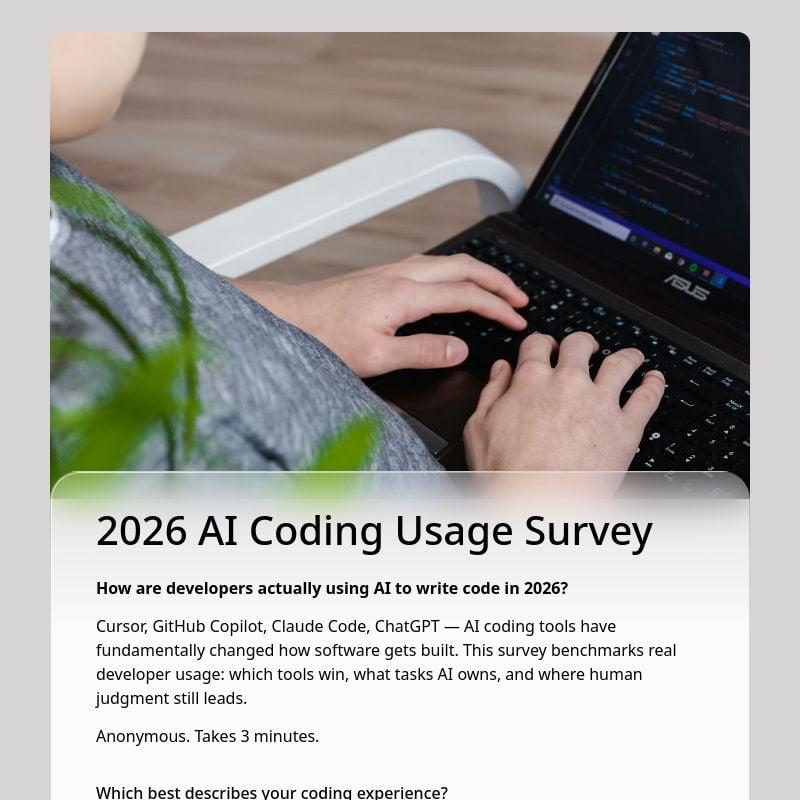
Targeted at developer teams, this template maps adoption of AI coding assistants — Copilot, Cursor, Claude Code, and others — across specific tasks: code completion, debugging, documentation, code review, and test writing. The results help engineering leads understand where AI is being integrated into existing workflows and where adoption is stalling. Useful for developer experience teams and engineering managers making tool procurement and training decisions.
For marketing teams evaluating their AI maturity, this template covers the specific workflows where AI is most relevant: content generation, ad copy, SEO automation, social media scheduling, and email personalization. AI super-users in marketing roles are 3× more likely to receive positive performance reviews than non-users, according to Microsoft research — but adoption is uneven across functions. This template surfaces which tools marketers have tried versus which they use regularly, and what’s preventing broader uptake.
2026 AI in Customer Support Survey
Customer support teams are often among the earliest and most visible AI adopters inside organizations. This template captures how CX teams are using AI — chatbots, response suggestions, ticket classification — how satisfied they are with AI performance, and what escalation patterns look like when AI falls short. Useful for CX leads evaluating chatbot ROI, identifying handoff friction points, and designing escalation protocols that maintain quality.
2026 AI Prompting Skill Survey
Self-assessed prompt engineering confidence is a reliable proxy for AI literacy and output quality. This template measures how employees rate their own prompting skills, how often they iterate versus accept the first output, and whether they’ve invested time in learning structured prompting techniques. Useful for L&D teams designing AI training programs and for identifying internal AI champions who can coach and upskill others.
An assessment-style template that captures how employees experienced the process of learning to use AI tools: what they found difficult, which resources helped, how long it took to feel productive, and what they wish they’d known sooner. More reflective than operational, it’s well suited for onboarding program design and for understanding the gap between “tool rollout” and “actual adoption” — a gap most organizations underestimate.
What are individuals and teams actually spending on AI tools — not what’s in the IT budget, but what’s on personal credit cards and expensed informally? This template captures both personal AI subscriptions and company-funded spend, revealing the gap between official allocation and grassroots adoption. Useful for finance teams rationalizing AI tool spend and for founders benchmarking their organization against peers in similar growth stages.
How to Choose the Right AI Survey Template
Are you measuring adoption or impact?
Adoption surveys (AI Adoption, AI Tools Usage) answer: “who’s using what and how often.” Impact surveys (AI Productivity Impact, AI ROI Perception) answer: “what is that usage actually producing?” Start with adoption if you don’t have baseline data yet. Move to impact surveys once adoption is established enough to measure meaningfully — running an impact survey in an organization where fewer than 20% of employees use AI tools regularly produces data that’s too noisy to act on.
Is this for leadership, employees, or a specific team?
The AI ROI Perception and AI Policy surveys are written for management audiences and work best as top-down feedback mechanisms. The AI Burnout, AI Job Replacement Fear, and AI Learning Curve surveys produce more honest data when run anonymously — responses change significantly when employees believe their answers are linked to performance reviews. Role-specific templates (Coding, Marketing, Customer Support) should go only to the relevant team, not the whole organization.
Do you need a one-time snapshot or recurring pulse data?
The AI Adoption and AI Tools Usage surveys are designed as point-in-time benchmarks — appropriate to run quarterly or twice per year. The AI Burnout vs Productivity and AI Policy at Work surveys benefit from more frequent measurement because the underlying conditions shift quickly. For a lighter-weight recurring check-in between formal surveys, the employee engagement templates include pulse formats built for bi-weekly or monthly cadences.
Are you building internal data or publishable research?
The AI Adoption, AI Tools Usage, AI vs Human Work, and AI Spending templates produce data worth publishing as original research or industry benchmarks. They ask about usage patterns at a level of specificity that’s meaningful beyond a single organization. If publishing is the goal, add demographic questions — industry, company size, role, years of experience with AI — to enable segmentation and make the results citable.
Final Recommendation
For most organizations, the right starting point is the AI Adoption Survey paired with the AI Productivity Impact Survey: the first establishes your baseline, the second tells you whether adoption is translating into measurable value. Run them back-to-back with a 60-day gap and you have before/after data capable of driving real decisions.
If workforce sentiment is a current priority — and in 2026, it should be — add the AI Job Replacement Fear Survey to your stack. The data it surfaces is uncomfortable in the short term but far less costly than discovering the same concerns through exit interviews six months later.
For teams that have already established AI adoption and want to go deeper, the AI Policy at Work Survey and AI Prompting Skill Survey together reveal the two most common sources of underperformance: employees who aren’t sure what they’re allowed to do, and employees who haven’t yet developed the prompting skills to get reliable output. Both are fixable — if you know they’re the problem.
All 16 templates are free, customizable in minutes, and designed to collect structured data rather than vague sentiment. For a broader template library beyond AI and productivity topics, browse the surveys and feedback templates. For a full overview of FormHug’s survey builder capabilities — question types, logic branching, and real-time analytics — see the survey maker feature page. Start with a free AI survey →
Frequently Asked Questions
What is an AI survey template?
An AI survey template is a pre-built set of questions designed to collect structured data about how people use, experience, or feel about artificial intelligence tools at work. Rather than designing questions from scratch, a template gives you a validated question set that captures the data most relevant to a specific research goal — adoption measurement, sentiment tracking, skills assessment, or ROI evaluation.
How do I choose between an AI adoption survey and an AI tools usage survey?
An AI adoption survey asks broader questions: have you used AI tools, how frequently, what are the barriers? An AI tools usage survey gets more specific: which platforms have you tried (ChatGPT, Claude, Copilot, Gemini), which do you use regularly, and for which tasks? Start with the adoption survey if you want an overall organizational picture. Use the tools usage survey when you already know adoption is happening and need to understand the specific tool landscape inside your organization.
Can I use these AI survey templates for academic or industry research?
Yes. The AI Adoption, AI Tools Usage, AI vs Human Work, and AI Spending templates are structured to produce publishable data. If you’re conducting research across organizations, customize the demographic questions to capture industry, company size, role, and geography — that segmentation is what turns internal data into citable research. You retain ownership of all response data collected through FormHug.
How long do these AI surveys take to complete?
Most templates are designed to take 3–5 minutes to complete. The AI Prompting Skill and AI Learning Curve surveys run slightly longer — 5–8 minutes — because they include self-assessment components. Keeping surveys under 5 minutes typically yields completion rates above 70%; anything above 10 minutes risks dropping below 40%, especially for unsolicited surveys distributed via email or Slack.
How often should I run an AI survey at my organization?
For adoption and tools usage surveys, quarterly measurement is appropriate — AI capabilities and employee behaviors both shift quickly enough that annual data becomes stale between cycles. For sentiment surveys (burnout, job security, policy clarity), monthly or bi-monthly pulse formats are more actionable because they catch changes before they compound. The AI Policy at Work survey is best run whenever a significant policy update is made, or at least annually as part of a formal governance review.
Are these AI survey templates free to use?
All 16 templates are free to access and customize in FormHug. You can edit questions, reorder sections, add your organization’s branding, and publish without a paid subscription. Response data is stored in the FormHug dashboard and exportable to CSV or connected tools at any time.

Written by
FormHug TeamProduct, research, and form automation team
The FormHug Team brings together product builders, workflow researchers, and form automation practitioners who study how people collect, route, and act on information online. Our guides are based on hands-on product testing, template analysis, customer workflow patterns, and deep experience with forms, surveys, quizzes, AI-assisted creation, integrations, and results sharing.