6 Best EV & Energy Survey Templates for 2026
Start collecting responses
Turn this into a shareable survey
Draft the questions, publish a clean link, and keep every response organized in FormHug.
Deloitte’s annual global EV survey covered 28,000+ respondents across 22 countries — and found that EV purchase intent has held steady despite rising vehicle prices and persistent charging infrastructure anxiety. That aggregate number is useful context. What it can’t tell you is how those dynamics play out for your specific audience: the EV owners who already made the switch, the near-buyers who hesitated at the last step, or the skeptics whose objections haven’t been addressed by any manufacturer yet.
First-party EV research closes that gap. A survey distributed to your own audience — dealer network, loyalty program, research panel, community forum — produces the segmented, actionable data that industry benchmarks can’t provide. It tells you whether your specific buyer is more sensitive to range anxiety or charging speed, whether they made the purchase decision despite total cost of ownership uncertainty or because of it, and which competitors they seriously evaluated before choosing.
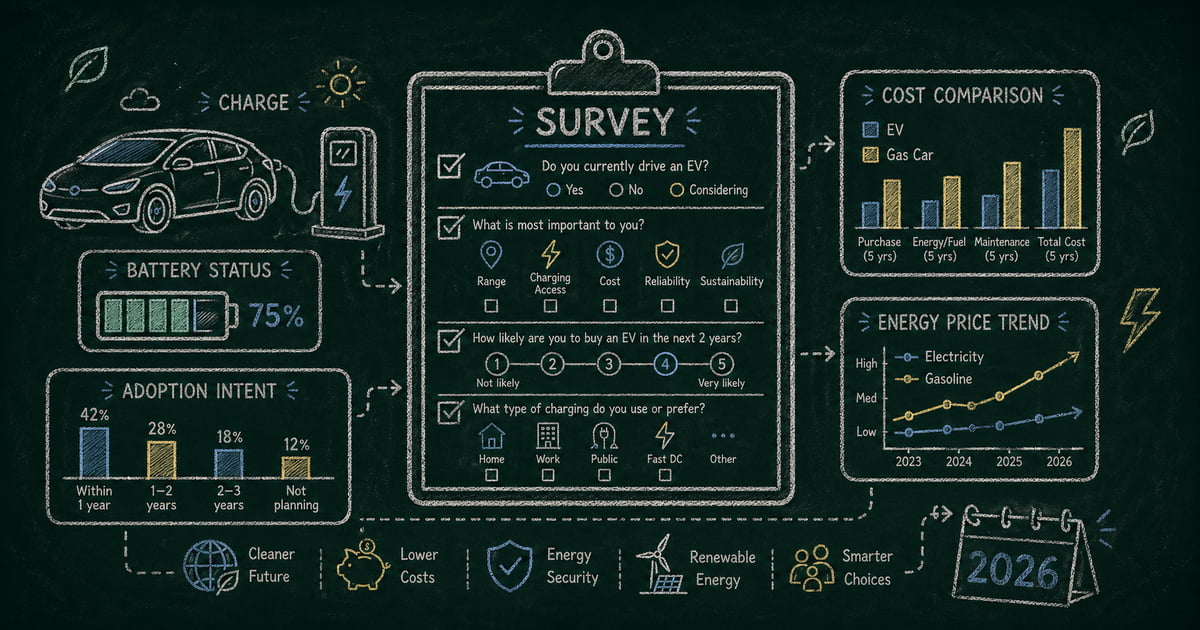
These 6 templates cover the full EV consumer research cycle: adoption intent and purchase barriers, ownership experience, charging infrastructure satisfaction, brand preference, gas vs EV cost comparison, and broader energy cost impact. Each template links to a ready-made FormHug form you can customize and deploy within minutes.
TL;DR — These 6 EV and energy survey templates give automotive researchers, EV brands, energy companies, and policy teams structured question sets to collect first-party data on adoption, ownership, and cost perception.
- EV adoption & consumer intent — purchase barriers, adoption intent, ownership experience, brand preference
- Energy costs & market dynamics — gas vs EV cost comparison, energy price impact on behavior
- Works for: automotive researchers, EV brands, energy companies, policy researchers, journalists, and market research teams
- All templates are free to customize and deploy
Quick Comparison: 6 EV & Energy Survey Templates
| Template | Best for | Primary data captured |
|---|---|---|
| 2026 EV Adoption Intent Survey | Purchase intent research | Barriers, timeline, influencing factors |
| 2026 EV Ownership Survey | Owner experience benchmarking | Satisfaction, real-world range, regret rate |
| 2026 EV Charging Experience Survey | Infrastructure pain point mapping | Charging frequency, speed satisfaction, reliability |
| EV Brand Preference Survey | Competitive positioning | Tesla/BYD/Rivian/Hyundai consideration set |
| 2026 Gas vs EV Cost Comparison Survey | TCO perception research | Cost perception accuracy, fuel savings awareness |
| 2026 Energy Cost Impact Survey | Energy price behavior research | Price impact on purchase intent and daily behavior |
EV Adoption, Ownership & Consumer Intent
The most common failure mode in EV market research is measuring stated intent without measuring barriers. “Would you consider buying an EV?” produces uniformly high agreement across most demographics. “What’s the specific thing most likely to prevent you from buying an EV in the next 18 months?” produces data you can actually use.
These four templates are built around that distinction — they’re designed to surface the specific objections, experience gaps, and competitive considerations that drive real purchase decisions, not just survey-friendly expressions of intent. For a broader consumer and market research toolkit that includes economic confidence, tariff impact, and energy cost sentiment, see market research survey templates.
2026 EV Adoption Intent Survey
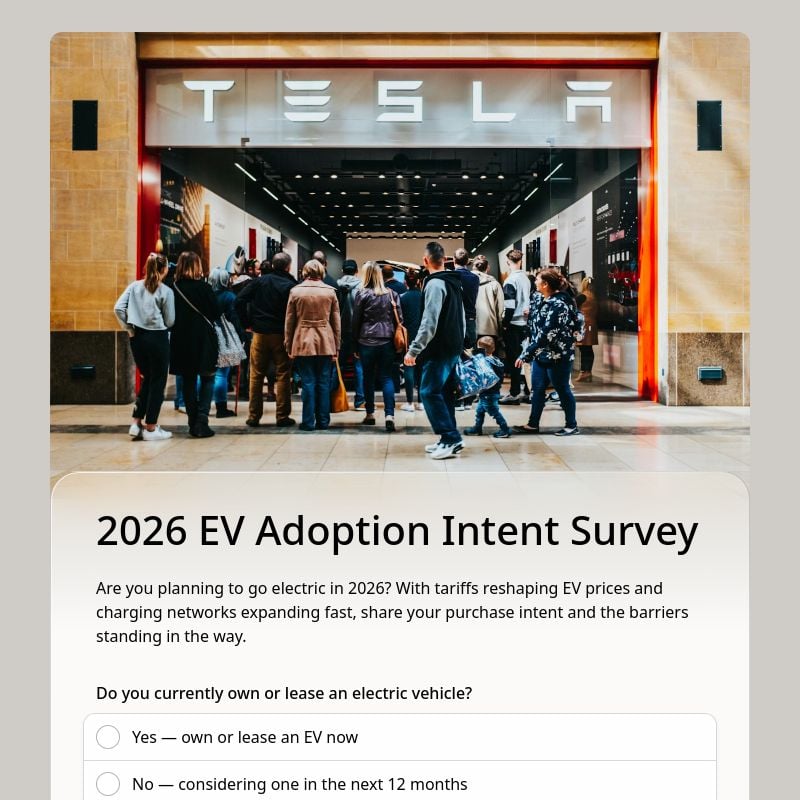
The flagship EV research template — and the P1 priority in this collection for good reason. Inspired by the format used by Plug In America in its annual consumer research, this template captures purchase intent across a 6–24 month timeline, the specific barriers most likely to prevent adoption (range, charging access, upfront cost, total cost uncertainty, resale value concern), and the factors most likely to accelerate it (lower prices, better charging infrastructure, improved range, employer incentives). For automotive researchers and EV brands, the barrier segmentation by respondent profile (urban vs rural, current ICE owner vs non-driver) is where the actionable data lives.
A post-purchase experience survey for current EV owners. It measures satisfaction across the dimensions that matter most: real-world range vs advertised range, home charging setup experience, public charging reliability, total ownership cost versus expectation, and the big question: would you buy again, and would you recommend? Deloitte’s 28,000-respondent benchmark provides useful comparison context — this template helps you understand how your specific owner base compares to the industry average on satisfaction and regret rate.
2026 EV Charging Experience Survey
Charging infrastructure is consistently the top barrier to EV adoption in consumer research. This template goes beyond “are there enough chargers?” to capture the specific friction points that actually affect behavior: charger reliability (what percentage of attempted charges succeed?), wait time experience, payment system complexity, and the psychological anxiety of long-distance trip planning around charging availability. For charging network operators and energy companies, this data maps where infrastructure investment has the highest impact on EV adoption rates.
A competitive landscape survey covering the major EV brands — Tesla, BYD, Rivian, Hyundai/Kia, Ford, Chevrolet, BMW, and others. It captures consideration set composition (which brands are in the active evaluation set?), brand perception across key dimensions (range, charging network, software quality, value), and the specific brand attributes most likely to convert consideration into purchase intent. For automotive marketers, the competitive consideration data reveals which brands your target segment is cross-shopping — and what you need to win on to close the decision.
Energy Costs, TCO Perception & Market Dynamics
Total cost of ownership is the most misunderstood dimension of EV evaluation. Many prospective buyers dramatically overestimate the price premium and underestimate the fuel and maintenance savings — a perception gap that’s costing EV adoption even among consumers who can afford the switch. These two templates measure that gap and the broader energy cost anxiety that’s shaping consumer behavior in 2026.
2026 Gas vs EV Cost Comparison Survey
Most consumers systematically underestimate EV fuel savings and overestimate charging costs — a perception gap that represents a significant marketing opportunity. This template measures cost perception accuracy: what do respondents believe the monthly fuel and maintenance cost difference is between a comparable EV and ICE vehicle? It then captures whether that perception (accurate or not) is a driver or inhibitor of their purchase intent. For EV marketers and researchers, the gap between perceived and actual TCO is one of the most actionable findings available — it defines exactly where education and messaging investment pays off.
2026 Energy Cost Impact Survey
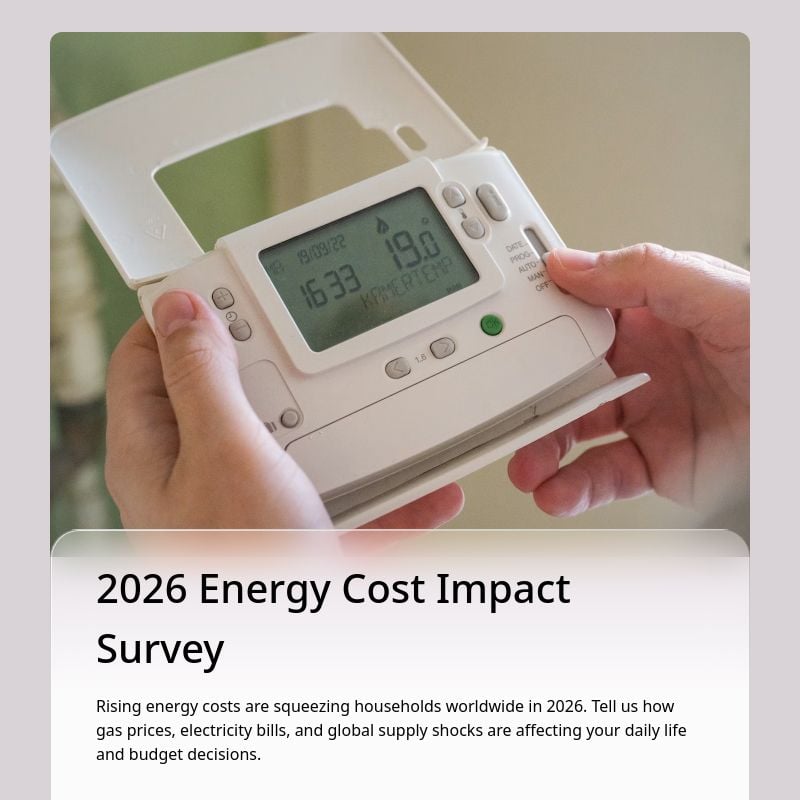
Oil price volatility in 2026 — driven partly by geopolitical events and partly by global demand shifts — has created a new data collection opportunity: measuring how energy cost anxiety is affecting EV consideration in real time. This template captures whether respondents have reconsidered their vehicle purchase or driving behavior in response to recent energy price changes, and whether higher gas prices are pushing them toward EV consideration or making any large vehicle purchase feel too risky. For energy companies and policy researchers, it provides a real-time read on how consumer behavior responds to energy price shocks.
How to Choose the Right EV Survey Template
Are you studying potential buyers or current owners?
The EV Adoption Intent Survey and EV Brand Preference Survey are designed for the pre-purchase segment — people who are considering an EV but haven’t bought yet. The EV Ownership Survey and EV Charging Experience Survey are designed for current EV owners. The Gas vs EV Cost Comparison Survey works for both, since cost perception research is relevant at every stage of the decision journey.
Are you doing academic or industry research, or informing a business decision?
For publishable research, pair the EV Adoption Intent Survey with demographic segmentation (urban/rural, income range, current vehicle type, state/country) — the segmented data is what makes EV research reports citable. For internal business decisions (charging network investment, marketing message testing, product positioning), the EV Charging Experience and EV Brand Preference surveys produce the most directly actionable data.
Is charging infrastructure or cost the primary friction in your market?
The answer differs significantly by geography. In dense urban markets with established public charging networks, cost and range anxiety are the primary barriers. In rural and suburban markets, charging access is the dominant concern. The EV Charging Experience Survey is your instrument if infrastructure is the question; the Gas vs EV Cost Comparison Survey is the right tool if cost perception is where the friction lives.
Do you need data on behavior or on opinion?
Opinion surveys (“would you buy an EV?”) produce inflated intent numbers because people answer aspirationally. Behavior surveys (“have you charged at a public station in the last 90 days, and what was the experience?”) produce more reliable data because they anchor to specific past experiences rather than hypothetical future decisions. The EV Ownership Survey and EV Charging Experience Survey are behavior-anchored; the EV Adoption Intent Survey deliberately mixes both to capture the gap between aspiration and action.
Final Recommendation
For teams launching EV market research for the first time, the EV Adoption Intent Survey is the right starting point — it produces the broadest baseline picture of where your target market is in the adoption journey and what specific barriers are in the way. Run it with the Gas vs EV Cost Comparison Survey in the same distribution to understand whether TCO misperception is a significant factor in those barriers.
For researchers focused on the ownership experience and charging infrastructure quality, the EV Ownership Survey and EV Charging Experience Survey form a natural pair: the first tells you how the overall ownership decision landed, the second tells you where the day-to-day experience is falling short of expectation.
For teams tracking how energy price volatility is affecting EV consideration in real time, the Energy Cost Impact Survey is a timely instrument — the data window for capturing genuinely reactive behavior closes quickly after a price shock settles into the background. For researchers who also need templates covering broader consumer economic anxiety, the consumer & market research survey collection includes the Economic Confidence and Cost of Living surveys that provide useful context alongside EV-specific data.
All 6 templates are free to customize and deploy. For a full overview of FormHug’s survey builder — question types, logic branching, and real-time analytics — see the survey maker feature page. Start your EV research survey →
Frequently Asked Questions
What is an EV survey template?
An EV survey template is a pre-built set of questions designed to collect structured data about electric vehicle adoption intent, ownership experience, charging infrastructure satisfaction, or energy cost perception. Rather than designing questions from scratch, a template gives you a validated question set that captures the specific data most relevant to your EV research goal — whether that’s purchase barrier mapping, owner satisfaction benchmarking, or TCO perception measurement.
How do I find respondents for an EV survey?
The most effective EV research distribution channels depend on your target segment. For potential buyers: automotive forums (Reddit r/electricvehicles, brand-specific communities), EV-focused newsletters, and social media communities targeting eco-conscious consumers. For current owners: owner loyalty programs, service center follow-up emails, EV charging app user bases, and brand community groups. For general market research: consumer panels, social distribution to broad audiences, and partnership with EV advocacy organizations.
How many responses do I need for EV survey data to be reliable?
For regional or segment-specific EV research (e.g., US urban EV owners), 200–400 responses produce data with acceptable statistical reliability. For national-level publishable research comparable to Deloitte’s benchmark studies, 1,000+ responses with demographic stratification are appropriate. For internal product or marketing decisions where precision matters less than directionality, 100–150 responses are often sufficient to see clear patterns in adoption intent or charging experience data.
What’s the difference between purchase intent and adoption intent in EV research?
Purchase intent asks: “Are you planning to buy a vehicle in the next X months, and are you considering an EV?” Adoption intent is broader: “Do you intend to switch to electric transportation at some point, regardless of near-term purchase plans?” The distinction matters for research design. Near-term purchase intent data is most useful for sales forecasting and inventory planning. Long-term adoption intent data is more useful for infrastructure planning, policy decisions, and brand awareness investment. The EV Adoption Intent Survey captures both dimensions.
Can these EV templates be used for policy research?
Yes. The EV Adoption Intent Survey, EV Charging Experience Survey, and Energy Cost Impact Survey all produce data relevant to transportation policy, infrastructure investment decisions, and energy transition planning. For policy-grade research, add demographic fields (state/region, income range, vehicle ownership status, commute distance) that enable the segmentation analysis policymakers need. The Gas vs EV Cost Comparison Survey is particularly useful for policy research on consumer subsidy design — it reveals the TCO perception gaps that subsidies and incentives most need to address.
Are these EV survey templates free to use?
All 6 templates are free to access and customize in FormHug. You can edit any question, adjust the answer options to reflect your specific market (different EV brands, local charging networks, regional energy providers), and publish without a paid subscription. Response data is stored in the FormHug dashboard and exportable to CSV or connected analytics tools.

Written by
FormHug TeamProduct, research, and form automation team
The FormHug Team brings together product builders, workflow researchers, and form automation practitioners who study how people collect, route, and act on information online. Our guides are based on hands-on product testing, template analysis, customer workflow patterns, and deep experience with forms, surveys, quizzes, AI-assisted creation, integrations, and results sharing.