Forms Aren't Dead. They Just Got an AI Brain.

Create with AI
Describe the workflow and get a form draft
Use FormHug to create forms from prompts, then share, automate, and reuse the structured responses.
Every few years, someone declares that forms are dead.
Chatbots were supposed to replace them. Voice assistants were supposed to replace them. Now AI agents are supposed to replace them. The argument sounds reasonable at first: if people can just talk to software, why would anyone fill out a form?
But that question misses what forms actually do. Forms are not just a user interface. Forms are how the internet turns messy human intent into structured data that a system can store, compare, route, analyze, and act on.
TL;DR - Forms are not disappearing in the AI era. They are becoming agent-native.
- Chat captures intent - people can describe what they want in flexible language.
- Forms create structure - fields, choices, and submissions make data usable.
- Agents need both - chat for understanding, forms for reliable collection.
- Works for: registrations, surveys, feedback, lead capture, quizzes, approvals, and research.
- The future of forms is not less structure. It is structure that AI agents can create, read, and act on.
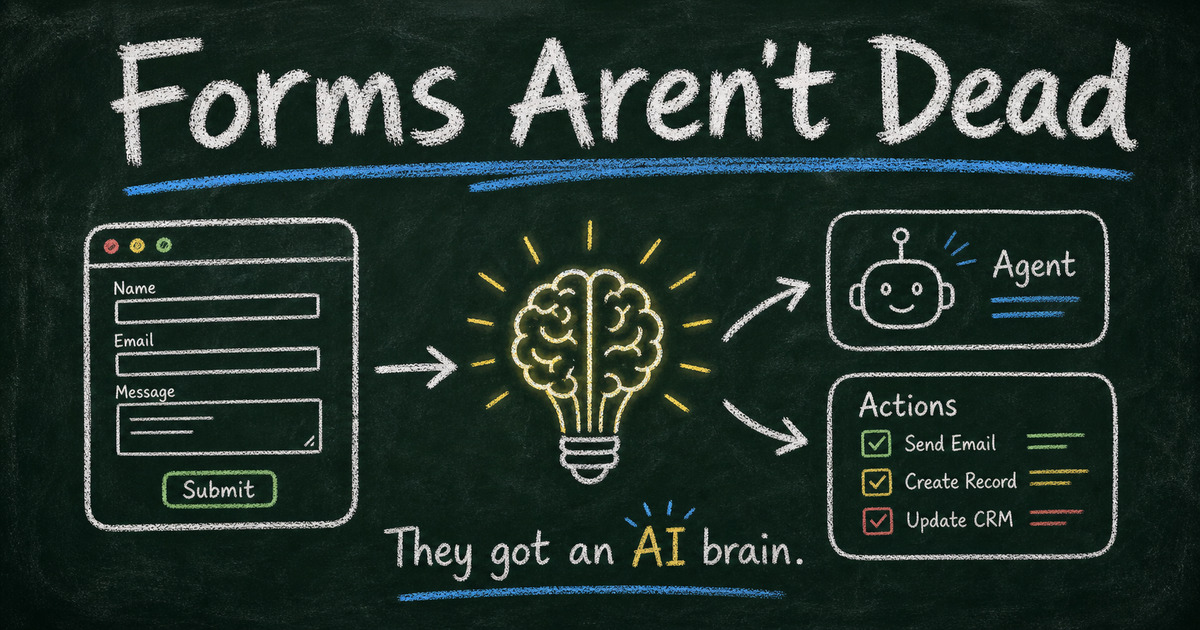
The Future of Forms Is Not Fewer Forms
AI changes who can create forms and what happens after someone submits one. It does not remove the need for structured collection.
A team still needs registration data before an event. A founder still needs waitlist responses before launching. A teacher still needs quiz answers. A sales team still needs qualification details. A product team still needs feedback that can be grouped, filtered, and compared.
Chat is excellent when the goal is exploration. It is less reliable when the goal is consistent collection from many people.
If twenty people answer in twenty different chat threads, the agent has to clean up the mess before it can reason. If twenty people answer a form with consistent fields, the agent starts from structured input.
That is why the future of forms is not fewer forms. It is smarter forms.
AI Form Builders Are Moving Beyond Generation
The first wave of AI form builders focused on speed:
“Describe a form. AI generates the fields.”
That is useful. It saves setup time. But in 2026, creation speed is no longer the most interesting part.
The bigger shift is that AI agents can participate in the workflow around the form. They can help decide what questions to ask, create the form, read the submissions, summarize patterns, draft follow-up, and route the next action.
That changes the job of a form builder.
An AI form builder should not only help a human make a form faster. It should make forms available to agents as part of a workflow.
Agent-Native Forms Still Need Humans
There is a trap in AI product thinking: once the agent can do something, the human experience gets treated as secondary.
That does not work for forms.
Every form still has someone on the other side: a customer, applicant, attendee, student, employee, patient, researcher, or lead. That person decides whether the form feels trustworthy enough to complete.
An agent-generated form that looks generic, confusing, or careless will still lose responses. Automation does not rescue a bad public experience.
This is why agent-native forms need two qualities at the same time:
- Beautiful for humans: clear, polished, mobile-friendly, and credible.
- Friendly for agents: structured, readable, and available through tools like MCP.
The form is the handshake between human context and machine action.
Forms Are Becoming the I/O Layer for AI Workflows
AI agents can write, plan, search, summarize, and call tools. But the useful work often depends on input from people who are not inside the agent conversation.
That is where forms fit.
A form can collect information from a public audience, a private team, a customer segment, or a classroom. The agent can then read that structured input and continue the workflow.
The pattern is simple:
- A human describes the goal.
- An agent creates or updates the form.
- People submit structured responses.
- The agent reads the submissions.
- The workflow continues into analysis, routing, or follow-up.
This is the AI brain forms were missing. Not a gimmick. Not a chatbot taped onto a form. A real loop between people, structured input, and agent action.
What FormHug Is Building Toward
FormHug is built around the idea that forms now have two audiences.
Humans need forms that feel good to complete. Agents need forms they can create, inspect, read, and use inside workflows. That is why FormHug supports both polished public form experiences and MCP for agents.
If you want the broader campaign argument, read AI Forms for Humans and Agents. If you want the technical category explanation, read MCP Form Builder. If you work inside Claude, the Claude form builder walkthrough shows the workflow in practice.
Forms are not dead. The AI era does not kill forms. It makes them agent-native. Forms are becoming the interface between human context and AI action.
FAQ
Will AI agents replace forms?
AI agents will replace some informal collection tasks, but they will not replace every form. Whenever a workflow needs consistent fields, comparable answers, consent, scoring, routing, or auditable submissions, forms still matter.
What are agent-native forms?
Agent-native forms are forms that humans can complete normally and AI agents can create, read, and use through tools or protocols such as MCP.
What does an AI form builder do in 2026?
An AI form builder should generate forms from natural language, publish polished forms for humans, and give agents a way to read submissions and continue the workflow.
Why do forms still matter if chat is flexible?
Chat is flexible, but forms are structured. A form turns many people’s answers into comparable data that an agent can summarize, filter, route, and act on.
Related
- AI Forms for Humans and Agents - the main campaign essay
- MCP Form Builder - why agents need forms as tools
- Claude Form Builder - how to build forms inside Claude
- 5 AI Agent Workflows That Need a Form Layer - practical scenarios where agents need structured human input
The AI era is not the end of forms. It is the beginning of forms that humans can trust and agents can use. Explore MCP for agents →

Written by
FormHug TeamProduct, research, and form automation team
The FormHug Team brings together product builders, workflow researchers, and form automation practitioners who study how people collect, route, and act on information online. Our guides are based on hands-on product testing, template analysis, customer workflow patterns, and deep experience with forms, surveys, quizzes, AI-assisted creation, integrations, and results sharing.