Knowledge Quiz or Personality Quiz: Which Format Should You Build?
Create the assessment
Turn this into a scored assessment
Build an assessment with scoring, result pages, feedback, and records you can review later.
The same topic can produce two completely different quizzes.
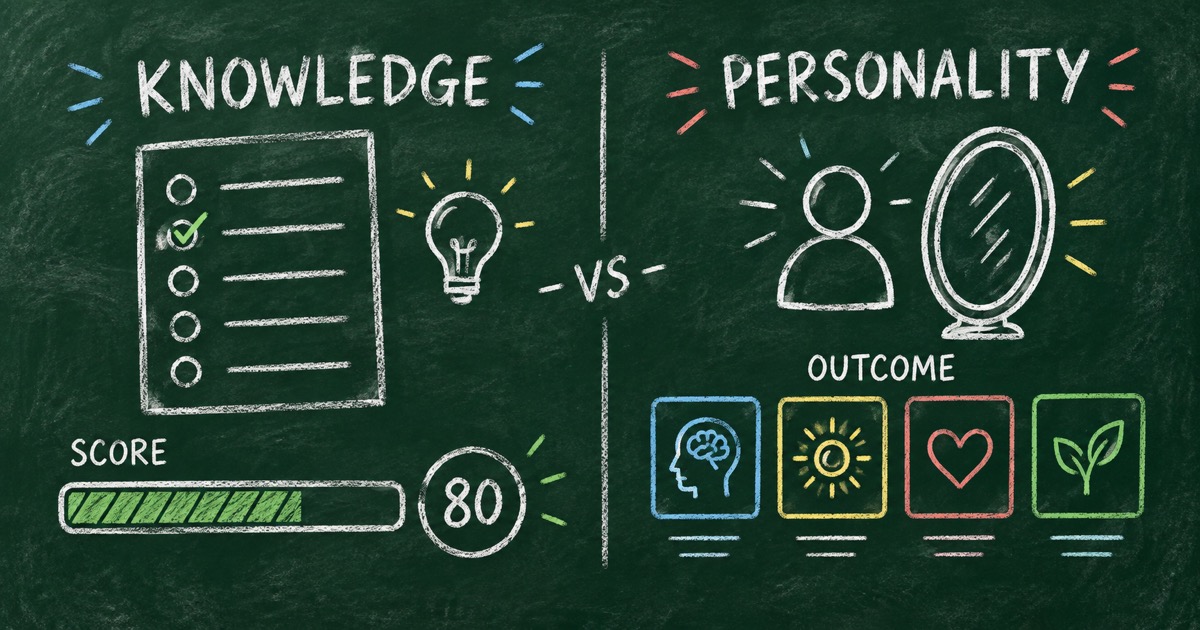
Ask “Which company acquired Fitbit?” and you are testing knowledge. Ask “How do you use your fitness tracker?” and you may be exploring a personal style. One question has a correct answer. The other has a pattern to interpret.
Choosing the format first makes every later decision easier: what to ask, how to score, what to write on the result page, and what the participant should do next.
TL;DR — Build a knowledge quiz when answers can be correct or incorrect; build a personality quiz when different answers reveal preferences, habits, or styles.
- Knowledge quiz — uses answer keys, points, explanations, and score ranges.
- Personality quiz — uses outcome profiles, contextual patterns, and recommendations.
- Recommendation quiz — sits between them and maps preferences to a next choice.
- Works for: trivia, training, self-discovery, product guidance, and team workshops.
- The format should follow the participant’s promised result, not the topic alone.
Knowledge quiz versus personality quiz
| Decision | Knowledge quiz | Personality quiz |
|---|---|---|
| Main question | What do you know? | What pattern fits you? |
| Answer logic | Correct or incorrect | Mapped to outcomes |
| Scoring | Points, percentage, pass threshold | Usually no right/wrong score |
| Result | Level, score, explanation | Type, style, or profile |
| Best ending | Review and next lesson | Reflection and recommendation |
| Example | Wearable Technology Quiz | Makeup Style Quiz |
The table is a starting point, not a rigid rule. A training assessment can include reflective questions. A personality quiz can include a simple score. The question is which logic is doing the main work.
Choose the result before the questions
Use the Result-First Decision:
- What should participants receive?
- What evidence is needed to produce it?
- Which question format captures that evidence honestly?
If the result is “You scored 8 out of 10 and should review sensors,” you need factual questions and an answer key. If the result is “You are The Co-Pilot because you refine AI output through dialogue,” you need scenario questions and outcome mapping.
Starting with the questions often creates a mismatch. The quiz becomes a collection of interesting prompts without a coherent ending.
When to build a knowledge quiz
Choose a knowledge quiz when you want to:
- check whether people remember a lesson;
- run trivia for a community or event;
- test product or policy knowledge;
- identify learning gaps;
- issue a pass/fail result or certificate.
The Greek Mythology Quiz is a straightforward example. Its questions have factual answers about Poseidon, the Minotaur, Medusa, Pandora, and the underworld. A score-based result makes sense because the participant is testing recall.
For a knowledge quiz, include answer explanations whenever possible. The explanation turns a wrong answer into a small learning moment.
When to build a personality quiz
Choose a personality quiz when you want to:
- help someone reflect on a preference or habit;
- create a playful social experience;
- start a team conversation;
- suggest a style, product, or next step;
- give an audience a result that feels personal.
The Makeup Style Quiz asks about face shape, undertone, eye and lip features, time, and aesthetic preferences. It does not grade a participant for choosing bold colors. It uses the pattern to recommend one of four style directions.
Keep the claim contextual. A personality result should not pretend to diagnose or permanently define someone.
The middle format: recommendation quizzes
Recommendation quizzes combine the most useful parts of both formats. There may be no objectively correct answer, but the outcome still leads to a decision.
Examples include:
- which product or plan fits a person;
- which course should they start with;
- which travel style matches their constraints;
- which makeup look fits their time and preferences.
The result needs a reason, not only a label. Explain which answers drove the recommendation and what the participant can do next.
Create the right format with AI
Use FormHug’s AI quiz maker and state the desired outcome explicitly:
Create a knowledge quiz. Every question must have one correct answer,
10 points, and a short explanation.
Or:
Create a personality quiz. There are no right answers. Map responses to four
distinct profiles and explain the behavior pattern behind each result.
The prompt tells the AI whether to generate an answer key or an outcome map. It also helps the result page stay consistent with the experience.
For more prompt patterns, see the AI quiz maker prompt template. For a product and workflow perspective, read forms are becoming interactive content.
Frequently Asked Questions
What is the difference between a knowledge quiz and a personality quiz?
A knowledge quiz tests correct or incorrect answers and returns a score or level. A personality quiz maps valid preferences or behaviors to descriptive outcome profiles.
Should I use points in a personality quiz?
Use points only when the number supports a meaningful interpretation. If the goal is to assign a style or profile, outcome mapping is usually clearer than a right/wrong score.
Can one quiz combine knowledge and personality questions?
Yes, but separate the logic in the result. For example, a course quiz could score knowledge and ask one reflection question for a recommended next lesson. Do not let the two systems blur into an unexplained number.
Which quiz type is better for product recommendations?
A recommendation quiz is usually the best fit. Ask about needs, constraints, preferences, and context, then explain why the result matches.
Can FormHug create both knowledge and personality quizzes?
Yes. FormHug’s AI quiz maker can generate scored knowledge quizzes, personality outcomes, recommendation flows, result explanations, and shareable quiz pages.
Related
- How to Create a Scored Quiz with AI from One Prompt — build a knowledge quiz with score logic
- How to Create a Personality Quiz with AI — create contextual outcome profiles
- A Good Quiz Has a Point of View — decide what your quiz is really trying to show
Choose the ending first, then build the questions that earn it with FormHug’s AI quiz maker →

Written by
FormHug TeamProduct, research, and form automation team
The FormHug Team brings together product builders, workflow researchers, and form automation practitioners who study how people collect, route, and act on information online. Our guides are based on hands-on product testing, template analysis, customer workflow patterns, and deep experience with forms, surveys, quizzes, AI-assisted creation, integrations, and results sharing.