How to Create a Personality Quiz with AI
Make it interactive
Turn these questions into a scored quiz
Build a quiz with answer keys, result pages, explanations, and a shareable link.
Personality quizzes are easy to start and surprisingly hard to finish well. The questions can be playful, but the result still needs to feel specific enough that a participant thinks, “That sounds like me.”
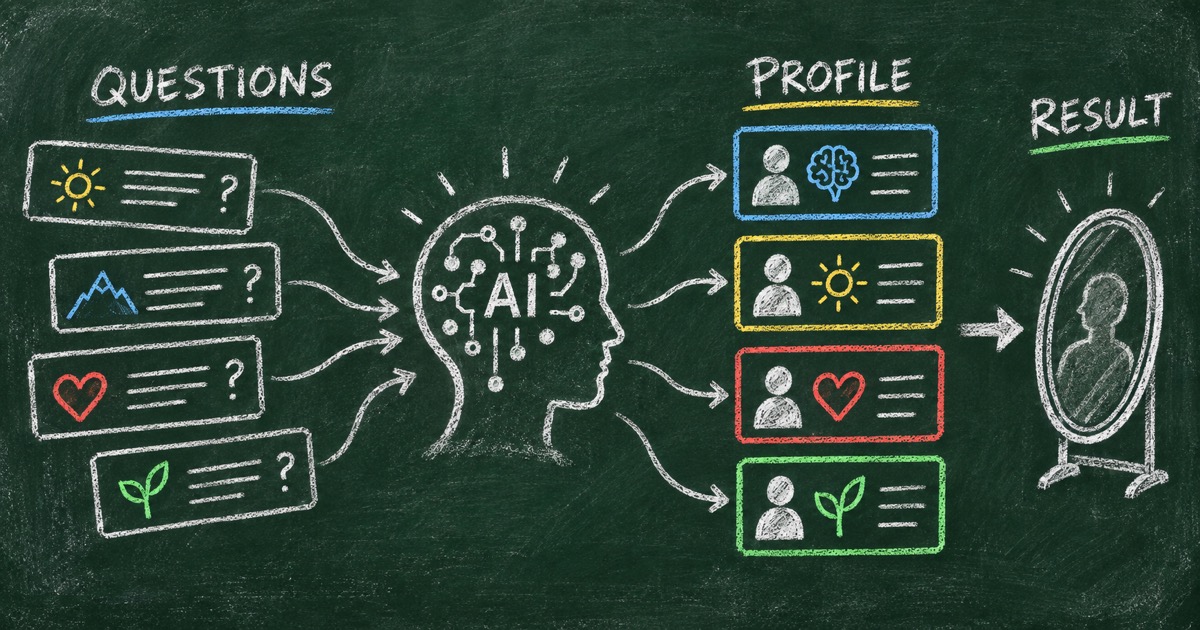
AI helps with the first draft. It can suggest outcome types, write scenario-based questions, and map answer patterns to profiles. But the creator still decides what the quiz is allowed to say. A good personality quiz describes a pattern in a particular context. It does not pretend that ten answers can define a whole person.
The What Makeup Style Suits My Face? quiz is a useful model. It asks about face shape, undertone, features, time, and vibe, then maps answers to four style directions: Natural Beauty, Soft Glam, Classic Glam, and Bold / Statement.
TL;DR — An AI personality quiz turns context-specific preferences into distinct outcome profiles with explanations and practical next steps.
- Start with four to six outcomes — each should have a clearly different point of view.
- Ask about behavior or preference — concrete situations produce better signals than labels.
- Write results with a strength and a watch-out — warmth plus friction feels more credible.
- Works for: style, work habits, collaboration, communication, travel, food, and self-reflection.
- Keep the result interpretive; do not present a lightweight quiz as a diagnosis.
What is a personality quiz?
A personality quiz is an interactive set of questions that maps preferences, habits, or choices to one of several descriptive outcomes. Unlike a knowledge quiz, it usually has no single correct answer.
The result is a lens, not a verdict. “You tend toward Soft Glam” or “Your AI collaboration style is The Verifier” gives the participant language for a pattern in the quiz context.
The Outcome-First Framework
Before writing questions, define the outcomes. Use this four-part brief for each one:
- Name — memorable, distinct, and easy to share.
- Pattern — what choices or behaviors lead here.
- Strength — what this pattern makes easier.
- Watch-out — where the pattern can become limiting.
The makeup quiz adds practical tips after these parts. That is why the result feels more useful than a label alone.
Choose outcomes that are genuinely different
Four outcomes are often enough for a short quiz. More outcomes can create nuance, but only if the questions can distinguish them.
For a makeup style quiz, “Natural Beauty,” “Soft Glam,” “Classic Glam,” and “Bold / Statement” create a visible spectrum. For an AI work-style quiz, “Delegator,” “Co-Pilot,” “Verifier,” and “Experimenter” describe different relationships with delegation, iteration, checking, and exploration.
Avoid outcome names that differ only in tone. “The Creative Planner” and “The Strategic Creator” may sound different but leave participants unsure how the profiles vary.
Write questions that reveal preference
Step 1: Use recognizable situations
Ask what the participant would do, choose, or prioritize:
- How much time do you want to spend getting ready?
- When an AI answer looks surprising, what do you do next?
- When planning a vacation, which part do you decide first?
These questions reveal behavior without forcing the participant to identify with a label.
Step 2: Cover the dimensions promised by the result
If the result depends on style, ask about style. If it depends on collaboration, ask about collaboration. The makeup quiz covers face shape and undertone alongside vibe and time because the result promises a realistic style recommendation.
Step 3: Remove questions that do not change the outcome
If two answers would lead to the same profile, one of the questions may be unnecessary. A short quiz with ten purposeful questions is stronger than a long quiz with repeated signals.
A personality quiz prompt you can copy
Create a 10-question personality quiz called “What Is My AI Collaboration Style?”

The quiz is for people who use AI at work. It should explore how they delegate,
iterate, verify, and experiment. Create four outcomes:
1. The Delegator
2. The Co-Pilot
3. The Verifier
4. The Experimenter

Use scenario-based multiple-choice questions. Map each answer to an outcome,
not to right or wrong points. For each outcome, include a description, a
strength, a watch-out, and one practical suggestion. Keep the result contextual
and reflective; do not diagnose or rank intelligence.
Build the personality quiz with AI
Step 1: Start from the outcome promise
Use FormHug’s AI quiz maker to describe the topic, audience, and outcomes. For a faster starting point, browse the FormHug quiz templates or try the Makeup Style Quiz template.
Step 2: Review the mapping
Check whether each answer contributes to one outcome. Read the questions as a participant, not as the author. If the intended result is impossible to predict from the choices, the mapping needs clearer signals.
Step 3: Rewrite the result profiles
Make every result specific. Add one strength, one watch-out, and one next step. Avoid generic praise that could fit every participant.
Step 4: Test different answer patterns
Take the quiz with a clear preference for each outcome. Confirm that the result changes in the way you expect and that no profile is impossible to reach.
Responsible result writing
Use words such as “style,” “pattern,” “preference,” or “tendency” for lightweight reflection. Avoid medical, psychological, employability, or attractiveness claims unless the product and research basis genuinely support them.
The personality quiz maker guide covers more question examples. For a deeper product perspective, read why personality quizzes are tools for reflection, not diagnosis.
Frequently Asked Questions
How do you create a personality quiz with AI?
Define the audience, context, four to six distinct outcomes, the behaviors that distinguish them, and the tone of the result profiles. Then ask AI to generate scenario-based questions and map answers to outcomes.
How many questions should a personality quiz have?
Eight to ten questions is a practical starting point for a short online personality quiz. Use fewer questions for a playful interaction and more only when each one adds a distinct signal.
Should personality quiz questions have correct answers?
Usually no. Personality quizzes map choices to outcome profiles rather than grading right and wrong answers. If there is a knowledge component, separate the scored section from the reflective section.
How many results should a personality quiz have?
Four outcomes are often enough to create meaningful contrast without making the result logic difficult to understand. Add more only when the questions can clearly distinguish them.
Can I make a personality quiz in FormHug?
Yes. FormHug can generate personality questions, outcome profiles, explanations, and a shareable result page. You can also start from an existing quiz template and customize it.
Related
- Personality Quiz Maker — explore personality quiz formats and examples
- A Quiz Is a Conversation, Not a List of Questions — design the interaction around the ending
- How to Build a Product Recommendation Quiz — turn preferences into a next step
Give people a useful mirror, not a fixed label. Start your next personality quiz with FormHug’s AI quiz maker →

Written by
FormHug TeamProduct, research, and form automation team
The FormHug Team brings together product builders, workflow researchers, and form automation practitioners who study how people collect, route, and act on information online. Our guides are based on hands-on product testing, template analysis, customer workflow patterns, and deep experience with forms, surveys, quizzes, AI-assisted creation, integrations, and results sharing.