Product Purchase Survey Questions: 25 Examples to Understand Buying Decisions
Start collecting responses
Turn this into a shareable survey
Draft the questions, publish a clean link, and keep every response organized in FormHug.
People rarely buy a product for just one reason. A customer may like the features, hesitate over the price, and finally decide because the product fits a specific situation better than the alternatives. If your survey asks only “Did you like it?”, you get a score — not an explanation.
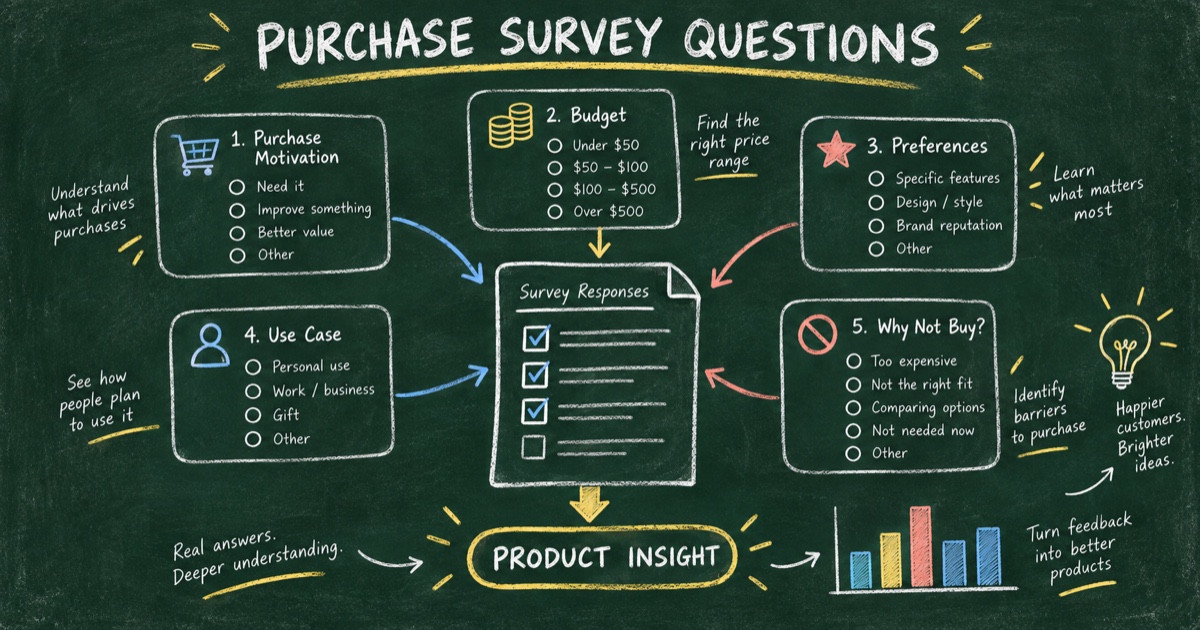
Product purchase survey questions are designed to uncover the reasoning behind a buying decision. They help you learn what triggered interest, what customers compared, how they plan to use the product, and what stopped people who considered it but did not buy. This article gives you 25 questions, a practical structure, and a simple way to turn responses into product decisions.
TL;DR — A product purchase survey asks why people buy, what they value, what they can spend, and what prevents purchase so teams can improve the product and the buying experience.
- Ask about the decision path — motivation, discovery, comparison, and timing reveal how a purchase actually happened.
- Separate value from friction — preferences explain what to improve, while non-purchase reasons explain what is blocking demand.
- Use a mix of question types — multiple choice gives you comparable data; open text explains the reason behind it.
- Works for: consumer products, SaaS, subscriptions, services, ecommerce, and market research.
- Keep the survey focused on one purchase decision rather than trying to measure the entire customer relationship.
What Is a Product Purchase Survey?
A product purchase survey is a structured questionnaire about how and why someone decided to buy, delay, compare, or reject a product. It is different from a general customer satisfaction survey: satisfaction looks back at an experience, while a purchase survey investigates the decision itself.
The most useful purchase surveys connect five areas:
- Motivation — what created the need or interest?
- Budget — what price range felt realistic?
- Preferences — which features, outcomes, or signals mattered?
- Use case — where and how did the buyer plan to use it?
- Barriers — what nearly stopped the purchase, or stopped it completely?
This five-part structure works for both customers and prospects. For customers, it explains conversion. For non-buyers, it identifies demand that your current product, pricing, message, or timing is not capturing.
Product Purchase Survey Questions for Buying Motivation
Start with the event or problem that made the respondent consider a purchase. These questions are more useful than asking whether someone “likes” a product because they connect demand to a real situation.
- What problem were you trying to solve when you started looking for a product like this?
- What was the main reason you decided to consider this product?
- Which outcome mattered most to you when making the purchase?
- How urgent was the need when you began looking?
- I needed a solution immediately
- I needed one within the next month
- I was planning ahead
- I was only researching
- What changed that made this purchase feel worthwhile now?
Use one or two open-ended questions here, not all five. “What problem were you trying to solve?” often produces better language for product pages and sales conversations than a list of assumptions written by the team.
Questions About Product Features and Preferences
Feature questions should identify priorities, not invite respondents to select everything. Ask people to choose their top one or three options so the results support a decision.
- Which product benefit mattered most to you?
- Which three features influenced your decision the most?
- Which feature did you expect to use most often?
- How important were the following when comparing products?
- Ease of use
- Reliability
- Speed
- Design
- Integrations
- Customer support
- What is one feature you wish this product had?
- Which description best matches what you wanted from the product?
- A cheaper option
- A simpler option
- A more powerful option
- A more flexible option
- A more trustworthy option
The important distinction is between a feature people say they want and a benefit they use to make a decision. Ask at least one outcome-based question so your roadmap is not driven by a long unranked feature list.
Product Purchase Survey Questions About Budget and Price
Price questions work best when they are tied to a product category and a realistic purchase context. A bare question such as “How much would you pay?” is difficult to interpret because respondents may imagine different versions of the product.
- Which price range were you considering for this purchase?
- How did the price compare with what you expected to pay?
- Much lower than expected
- A little lower
- About what I expected
- A little higher
- Much higher
- Which pricing option would feel easiest to choose?
- One-time purchase
- Monthly subscription
- Annual subscription
- Usage-based pricing
- Not sure yet
- What would make the price feel more worthwhile?
- Did you compare the price with another product or alternative?
- Yes
- No
- I considered building or doing it myself
- If you did not purchase, was price the main reason?
Avoid treating “too expensive” as a complete diagnosis. Follow it with a question about expected price, perceived value, or the alternative the person chose. The same response can mean an absolute budget constraint, unclear value, or a mismatch between the pricing model and the buyer’s situation.
Questions About Use Case and Purchase Context
The same product can serve very different jobs. Segmenting by use case helps you see which customer needs are strong enough to support a focused message, template, or onboarding path.
- How do you plan to use the product?
- Personal use
- Work or business
- Education or training
- As a gift
- Another purpose
- How often do you expect to use it?
- Who else will use or influence the purchase?
- Where did you expect to use the product most often?
- What would success look like after your first month with the product?
This is the Need → Constraint → Outcome framework: identify the job, understand the boundary around the purchase, and define the result the buyer wants. It keeps a purchase survey connected to action instead of turning it into a generic preference poll.
Questions for People Who Considered but Did Not Buy
Non-buyers are not failed respondents. They are often the people who can explain the gap between interest and conversion most clearly. Give them a dedicated path rather than forcing them through questions meant for customers.
- What was the main reason you decided not to purchase?
- The price was too high
- It was not the right fit
- I chose another option
- I decided to wait
- I could not find enough information
- I did not need it anymore
- What information would have helped you decide?
- What would need to change for you to consider purchasing in the future?
If you use conditional logic, show questions 23–25 only to respondents who did not buy. That keeps the customer path short and gives non-buyers room to explain the barrier. For more general research design, compare this structure with market research survey templates and multiple-choice survey questions.
How to Structure a Product Purchase Survey
Most purchase surveys can be built in four stages:
Step 1: Define the decision you need to make
Write the decision before writing the questions. Are you choosing which feature to build, testing a price, improving a product page, or learning why prospects do not convert? One survey can support several related questions, but it should have one primary decision.
Step 2: Choose the respondent path
Decide whether the survey is for recent buyers, current customers, prospects, or people who abandoned a purchase. If buyers and non-buyers receive the same long questionnaire, the answers become harder to interpret.
Step 3: Combine comparable and explanatory questions
Use multiple choice, rating, and ranking questions for patterns you want to compare. Add one or two open-ended questions for the language and context behind those patterns. A useful first version is often 6–10 questions, not all 25 examples above.
Step 4: Connect every answer to an action
Before launch, decide what you will do with each result. A high share of “not enough information” suggests a messaging or education problem. A high share of “not the right fit” suggests segmentation or product scope. A high share of “too expensive” needs to be compared with expected value and alternatives before changing price.
We built this kind of branching structure in FormHug because purchase research is easier to act on when customer and non-customer responses remain distinct. FormHug supports shareable forms, conditional logic, and real-time results, so a team can test a focused questionnaire before turning it into a larger research program.
Ready-Made Product Research Templates
If you want to start with a real research context rather than a blank form, these FormHug templates provide useful starting points:
- Gen Z Shopping Habits Survey Template — explore discovery channels, price comparison, social proof, and purchase preferences.
- 2026 Consumer Tariff Impact Survey — study how economic concerns affect purchase timing and product categories.
- 2026 SaaS Stack Survey — understand the tools teams use, evaluate, and replace.
Use a template as a starting hypothesis, then remove questions that do not support your decision. A shorter survey with a clear audience usually produces more actionable responses than a comprehensive questionnaire sent to everyone.
Frequently Asked Questions
What questions should I ask in a product purchase survey?
Ask about the problem that triggered the search, the main purchase motivation, the most important feature or outcome, the expected price range, the intended use case, the alternatives considered, and the reason for not buying if the respondent stopped.
How many questions should a product purchase survey have?
Start with 6–10 focused questions for a quick purchase study. Add more only when each question supports a decision. Use conditional logic to keep follow-up questions relevant to buyers and non-buyers.
Should product purchase surveys be anonymous?
Anonymous responses can produce more candid answers about price, competitors, and purchase barriers. If you need to follow up with a respondent, collect contact information separately or explain clearly why you are asking for it.
What is the difference between a purchase survey and a customer satisfaction survey?
A purchase survey investigates the decision to buy, delay, compare, or reject a product. A customer satisfaction survey measures how the customer felt after an interaction or experience. They can be used together, but they answer different questions.
Should I ask open-ended or multiple-choice questions?
Use multiple choice when you need comparable categories and open-ended questions when you need the respondent’s own language. A practical survey usually combines both: structured questions for the pattern and one or two open questions for the explanation.
Can I create a product purchase survey in FormHug?
Yes. You can create a form with multiple-choice, rating, ranking, and open-text questions, share it with a link, and use conditional logic to show different follow-ups. Create a product research form in FormHug →
Related
- Customer Satisfaction Survey Questions: Examples and Templates — connect purchase research with post-purchase feedback.
- How to Write Unbiased Survey Questions — reduce wording bias before you collect responses.
- Best Market Research Survey Templates in 2026 — choose a starting point for broader consumer or product research.
The best product purchase survey does not ask customers to predict your roadmap. It reveals the problem, constraint, and outcome behind a real decision — then gives your team enough evidence to improve the next one. Create your product research form →

Written by
FormHug TeamProduct, research, and form automation team
The FormHug Team brings together product builders, workflow researchers, and form automation practitioners who study how people collect, route, and act on information online. Our guides are based on hands-on product testing, template analysis, customer workflow patterns, and deep experience with forms, surveys, quizzes, AI-assisted creation, integrations, and results sharing.