How to Write Survey Questions That Don't Lead Respondents
Start collecting responses
Turn this into a shareable survey
Draft the questions, publish a clean link, and keep every response organized in FormHug.
One biased word can move a survey result. “How helpful was our excellent support team?” is not a question; it is a tiny argument wearing a question mark. Respondents may still answer, but the data is already bent.
Unbiased survey questions are not bland. They are disciplined. They ask about one thing at a time, avoid telling people what the “right” answer is, and give respondents answer options that fit reality instead of the researcher’s hope.
This guide explains how to write survey questions that do not lead respondents, with examples, rewrite patterns, and a FormHug workflow for testing your survey before you send it.
TL;DR - An unbiased survey question asks one clear thing in neutral language and gives answer options that do not push the respondent toward a preferred answer.
- Remove praise and blame - words like “excellent,” “frustrating,” and “obviously” can steer answers.
- Ask one thing at a time - double-barreled questions create answers you cannot interpret.
- Balance answer choices - include positive, neutral, and negative options when measuring opinion.
- Works for: customer feedback, employee surveys, market research, student surveys, product testing, and polls.
- FormHug AI can draft survey questions, but the strongest surveys still need a human bias pass.
What Is an Unbiased Survey Question?
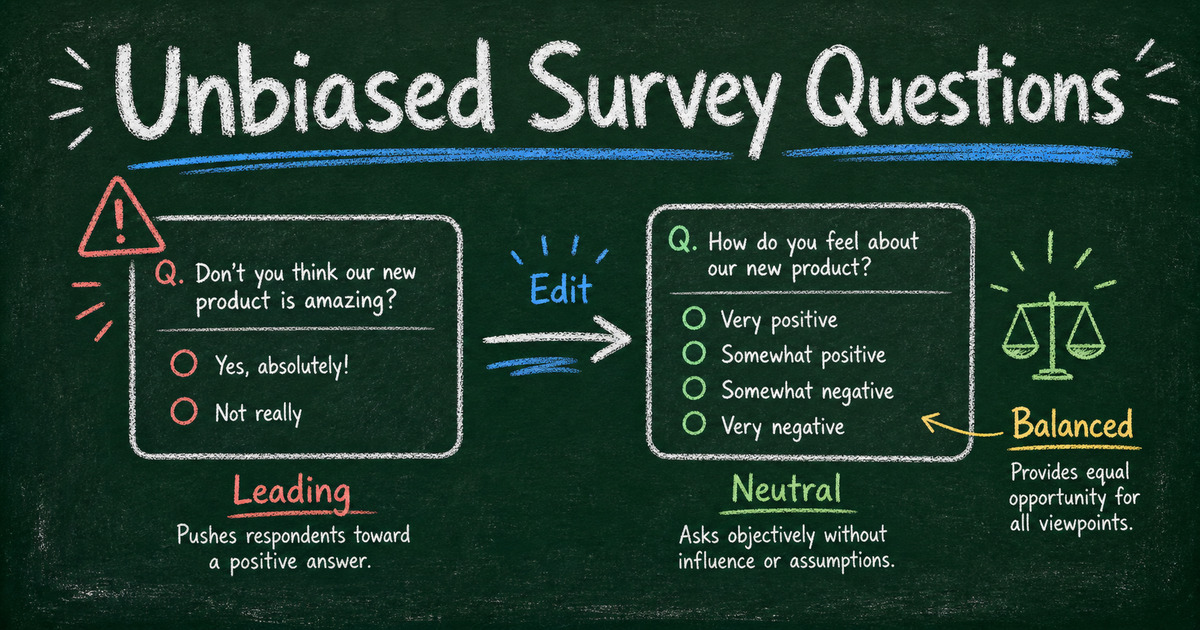
An unbiased survey question is worded so the respondent can answer honestly without being nudged toward a preferred option. It avoids leading language, hidden assumptions, emotional framing, and answer choices that make one response easier or more socially acceptable than another.
Compare these:
| Biased question | Better question |
|---|---|
| How much did you enjoy our new onboarding? | How would you rate the new onboarding experience? |
| Why is our pricing too high? | How do you feel about the current pricing? |
| Do you agree that remote work improves productivity? | What effect has remote work had on your productivity? |
| Was the event useful and well organized? | How useful was the event? |
The better versions do not guarantee perfect data, but they remove the obvious steering. For question-type choices, pair this guide with multiple choice survey questions and Likert scale survey questions.
The Bias Audit Framework
Use the Bias Audit Framework before publishing any survey:
| Check | Question to ask | Common failure |
|---|---|---|
| Language | Are any words praising or blaming? | “excellent service” |
| Assumption | Does the question assume something happened? | ”What did you like about…” |
| Scope | Is it asking one thing? | “useful and easy” |
| Balance | Are answer options symmetrical? | 3 positive choices, 1 negative |
| Order | Could earlier questions influence later answers? | asking satisfaction after a complaint prompt |
We use this framework when testing FormHug survey drafts. AI is good at creating a useful first version, but it can still mirror the user’s framing. If the prompt says “write questions showing customers love our new plan,” the draft will probably be tilted. A bias pass turns the draft into research.
Avoid Leading Language
Leading language tells the respondent what answer the survey owner wants.
Watch for words that evaluate the answer before the respondent does:
- excellent
- disappointing
- innovative
- confusing
- overpriced
- easy
- valuable
- unnecessary
Sometimes the bias is subtle. “How easy was checkout?” assumes checkout was at least somewhat easy. “How would you rate checkout?” leaves room for easy, neutral, or difficult.
Use this rewrite pattern:
| Instead of | Ask |
|---|---|
| How satisfied are you with our fast delivery? | How satisfied are you with delivery speed? |
| What did you love about the workshop? | What, if anything, worked well in the workshop? |
| Why was the app confusing? | Which parts of the app, if any, were confusing? |
The phrase “if anything” is useful because it gives respondents permission to disagree with the premise.
Remove Hidden Assumptions
Hidden assumptions are more dangerous than obvious bias because they look normal.
Examples:
- “What improvements would make you buy again?” assumes the person bought before and might buy again.
- “Which feature saved you the most time?” assumes a feature saved time.
- “Why did you choose us over competitors?” assumes the respondent compared competitors.
Better:
- “Have you bought from us before?”
- “Did any feature save you time?”
- “Did you compare other options before choosing?”
This is where conditional logic helps. Ask the gate question first, then show the follow-up only when it applies. The same principle appears in dichotomous survey questions: a clean yes/no gate can protect the rest of the survey from false assumptions.
Ask One Thing at a Time
A double-barreled question asks about two ideas but allows only one answer.
Bad:
How satisfied are you with the instructor and course materials?
If someone liked the instructor but disliked the materials, the answer is unusable. Split the question:
- How satisfied are you with the instructor?
- How satisfied are you with the course materials?
Double-barreled questions often hide behind pairs:
- quality and price
- speed and accuracy
- manager support and team communication
- onboarding and documentation
- design and usability
The One Job Rule is simple: each survey question should produce one interpretable signal. If you cannot name the one signal, split or delete the question.
Balance the Answer Options
Answer options can bias results even when the question sounds neutral.
Unbalanced:
- Excellent
- Very good
- Good
- Okay
- Poor
Balanced:
- Very satisfied
- Somewhat satisfied
- Neither satisfied nor dissatisfied
- Somewhat dissatisfied
- Very dissatisfied
For frequency questions, make ranges concrete when possible. “Often” means different things to different people. “3 to 5 times per week” is clearer.
For ranking or priority questions, keep lists short. If you ask people to rank 12 items, fatigue becomes its own bias. See ranking survey questions for when ranking is better than rating.
How to Build an Unbiased Survey in FormHug
Step 1: Draft around the decision, not the desired answer
Use a prompt like:
Create a 7-question customer feedback survey to help us decide which onboarding step to improve. Use neutral wording and include one open-ended question.
Avoid prompts that include the conclusion you hope to prove.
Step 2: Run the Bias Audit Framework
Check every question for leading words, assumptions, double-barreled structure, unbalanced options, and order effects.
Step 3: Add gates before sensitive follow-ups
If a follow-up only applies to some respondents, use conditional logic. Ask “Did you use the feature?” before asking “What was difficult about the feature?”
Step 4: Test with two people before sending
Ask one person close to the project and one person less familiar with it to read the survey. In our testing, the fastest way to catch biased wording is to ask, “What answer do you think this question wants?”
Frequently Asked Questions
How do you write unbiased survey questions?
Use neutral wording, ask one thing at a time, avoid assumptions, balance answer options, and test whether the question seems to prefer one answer.
What is an example of a leading survey question?
“How helpful was our excellent customer support?” is leading because “excellent” praises the support before the respondent answers. A neutral version is “How would you rate the customer support experience?”
How do I know if my survey question is biased?
Look for emotional words, assumed facts, missing answer options, or two topics inside one question. If a reasonable respondent cannot disagree with the premise, the question is biased.
Are yes/no questions biased?
Not automatically. A yes/no question is useful when the answer is genuinely binary. It becomes biased when the wording assumes one answer is better or leaves out a legitimate “not sure” option.
Should I use neutral answer choices?
Use a neutral midpoint when the topic allows genuine neutrality. Removing neutral options can force false opinions, especially for satisfaction and agreement questions.
Can AI write unbiased survey questions?
AI can create a good first draft, but it still needs review. The best workflow is to generate the draft, then run a human bias audit before publishing.
Can FormHug help me create better survey questions?
Yes. FormHug AI can draft survey questions from a plain-language goal, and you can edit wording, answer choices, and conditional paths before sharing the survey.
Related
- Multiple Choice Survey Questions - write answer options that fit the question
- Likert Scale Survey Questions - use balanced agreement and satisfaction scales
- Open-Ended Survey Questions - ask neutral follow-ups that explain the score
- Quantitative Survey Question Types - choose the right format before writing the wording
Biased questions create confident-looking data that points in the wrong direction. Give every question one job, remove the nudge, and let respondents tell you what is actually true. Create your survey →

Written by
FormHug TeamProduct, research, and form automation team
The FormHug Team brings together product builders, workflow researchers, and form automation practitioners who study how people collect, route, and act on information online. Our guides are based on hands-on product testing, template analysis, customer workflow patterns, and deep experience with forms, surveys, quizzes, AI-assisted creation, integrations, and results sharing.