Customer Satisfaction Survey Questions: Examples and Templates
Start collecting responses
Turn this into a shareable survey
Draft the questions, publish a clean link, and keep every response organized in FormHug.
Customer satisfaction surveys fail when they ask customers to do the company’s thinking. “Tell us what you think” is too broad. “How satisfied were you with checkout, and what nearly stopped you?” is useful.
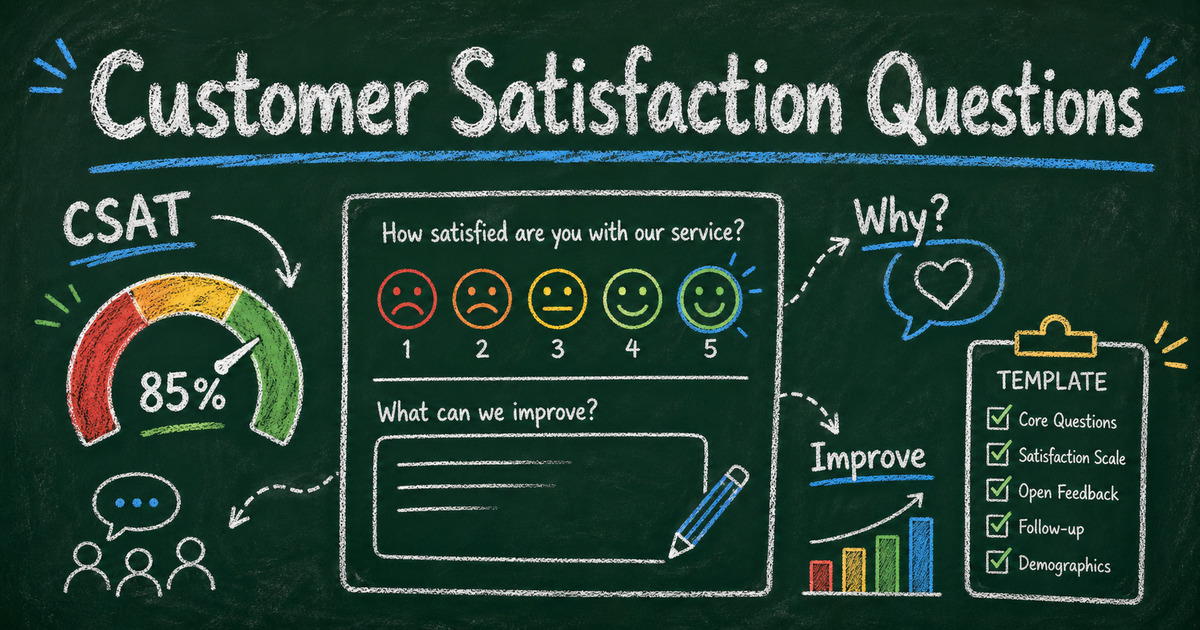
A good customer satisfaction survey is short, specific, and tied to a decision. It should tell you what customers liked, where they struggled, and what to fix first. The score matters, but the follow-up question is where the work begins. If you need a broader question bank before writing the survey, start with feedback form questions.
This guide gives you customer satisfaction survey questions by use case, shows how to structure a CSAT survey, and explains how to build one in FormHug without turning it into a long research project.
TL;DR - FormHug helps you create customer satisfaction surveys with CSAT ratings, follow-up questions, templates, conditional logic, and shareable links.
- Ask one overall score - CSAT, NPS, or a product rating gives you a clean signal.
- Ask one reason - the follow-up explains what drove the score.
- Ask one improvement question - this turns feedback into a next action.
- Works for: product feedback, support follow-up, onboarding, checkout, event feedback, training, and service delivery.
- Keep the first version under 8 questions unless you are doing deeper market research.
What Is a Customer Satisfaction Survey?
A customer satisfaction survey measures how happy customers are with a product, service, support interaction, purchase, event, or experience. It usually combines a rating question with one or two follow-up questions.
Common metrics include:
- CSAT - “How satisfied were you with your experience?”
- NPS - “How likely are you to recommend us?”
- CES - “How easy was it to complete your task?”
- Product rating - “How would you rate this feature?”
- Open-ended feedback - “What should we improve?”
CSAT works best when you ask it close to the experience. A support CSAT should go out after the ticket is resolved. A checkout CSAT should appear after purchase. A training CSAT should arrive while the session is still fresh.
The Best Customer Satisfaction Survey Structure
Use the Score -> Reason -> Action framework:
- Score: Ask for a rating so you can track the trend.
- Reason: Ask why they gave that score.
- Action: Ask what would improve the experience.
That is enough for most customer satisfaction surveys. If you need more, add targeted questions about the specific experience: support, onboarding, product quality, delivery, pricing, or documentation.
For loyalty measurement, use NPS survey best practices. For richer written feedback, use the patterns in open-ended survey questions.
Customer Satisfaction Survey Questions by Use Case
General CSAT questions
- How satisfied are you with your overall experience?
- What is the main reason for your score?
- What could we improve first?
- What did we do especially well?
- Did anything feel harder than expected?
- Would you use this product or service again?
Product feedback questions
- How satisfied are you with this feature?
- How easy was it to complete your task?
- What nearly stopped you from finishing?
- Which feature do you use most often?
- Which feature feels missing or incomplete?
- What should we improve before you recommend this product?
Customer support questions
- How satisfied were you with the support you received?
- Did we resolve your issue?
- How easy was it to get help?
- How long did the process feel?
- What could the support team have done better?
- Would you contact support again if needed?
Onboarding questions
- How clear was the onboarding process?
- Which step was most confusing?
- What did you expect to happen that did not?
- What helped you get started fastest?
- What should we explain earlier?
- How confident do you feel using the product now?
Post-purchase questions
- How satisfied are you with your purchase experience?
- Was checkout easy to complete?
- Did pricing, shipping, or product details feel clear?
- What nearly stopped you from buying?
- What would make you more likely to buy again?
Event or service satisfaction questions
- How satisfied were you with the event or service?
- Which part was most valuable?
- What should change next time?
- Was the timing, format, or communication clear?
- Would you attend or book again?
Customer Satisfaction Survey Templates
Start with a template when the workflow is familiar, then customize the wording around your product or service.
- Customer Feedback Form Template - broad product or service feedback.
- Customer Satisfaction Survey Template - structured satisfaction scoring and follow-up.
- NPS Survey Template - loyalty measurement with a standard recommendation question.
- Product Feedback Form Template - product experience and improvement requests.
- Event Feedback Form Template - event satisfaction and next-topic feedback.
Templates are starting points, not scripts. Keep the structure, then rewrite the questions so they sound like your product and your customers.
Copy-Ready 5-Question CSAT Template
Use this when you need a short customer satisfaction survey that works after support, onboarding, delivery, purchase, or a completed service.
-
How satisfied were you with your experience?
Use a 1-5 rating scale from “Very dissatisfied” to “Very satisfied.” -
What is the main reason for your score?
Use an open-ended field. This is the most important question in the survey because it explains the rating. -
Which part of the experience influenced your score most?
Use multiple choice: product quality, speed, communication, ease of use, pricing, support, delivery, other. -
What should we improve first?
Use an open-ended field or a multiple choice list if you already know the likely improvement areas. -
May we follow up with you about this feedback?
Use yes/no. If yes, ask for email or phone. If no, keep the response anonymous.
This template is short enough to send after a transaction and specific enough to produce useful action. If you need a loyalty score instead, use an NPS survey. If you need effort measurement, ask how easy the task was instead of how satisfied the customer felt.
Score-Based Follow-Up Examples
Conditional follow-ups make customer satisfaction surveys feel more relevant without making every respondent answer every question.
| Score group | Follow-up question | Why it works |
|---|---|---|
| 1-2 dissatisfied | What went wrong, and what would have made this better? | Captures the root problem while the experience is fresh. |
| 3 neutral | What would move this from okay to good? | Turns vague neutrality into a product or service improvement. |
| 4-5 satisfied | What did we do well that we should keep doing? | Finds strengths worth repeating. |
| No issue resolved | What still needs to be fixed? | Separates satisfaction from actual resolution. |
| Would not buy again | What would need to change before you came back? | Connects satisfaction data to retention risk. |
Score-based follow-ups are especially useful for support, onboarding, and post-purchase surveys because low and high scores need different questions.
CSAT vs NPS vs CES
| Metric | Best question | Use when |
|---|---|---|
| CSAT | How satisfied were you with this experience? | You want feedback on a specific interaction, purchase, event, or service. |
| NPS | How likely are you to recommend us? | You want a broader loyalty signal over time. |
| CES | How easy was it to complete your task? | You want to find friction in support, onboarding, checkout, or product workflows. |
CSAT is usually the best starting point for customer satisfaction survey questions because it is direct and easy to understand. NPS is better for loyalty tracking. CES is better when the problem is effort: customers can be satisfied with the outcome but still frustrated by how hard it was to get there.
How to Build a Customer Satisfaction Survey in FormHug
Step 1: Choose the satisfaction moment
Decide what experience you are measuring: purchase, support, onboarding, product use, event, or service delivery. Do not combine them unless you can act on the combined answer.
Step 2: Generate the first draft
Open FormHug and prompt: “Create a 6-question customer satisfaction survey for a completed support interaction with a CSAT rating, a resolution question, and one open-ended improvement question.”
Step 3: Add conditional follow-ups
If someone gives a low score, ask what went wrong. If someone gives a high score, ask what they valued most. Conditional logic keeps the survey short while making the follow-up more relevant.
Step 4: Share and review the first responses
Publish the survey as a link, send it after the experience, and read the first 20 responses before automating the workflow. If answers are vague, rewrite the follow-up question.
How FormHug Compares for Customer Satisfaction Surveys
| Need | FormHug | Basic survey forms |
|---|---|---|
| CSAT setup | AI draft plus rating and follow-up fields | Manual question writing |
| Follow-up logic | Show different questions by score | Often limited |
| Templates | Feedback, NPS, product, and event templates | Varies by tool |
| Distribution | Share links, embeds, and QR-code-friendly URLs | Usually link sharing |
| Best fit | Short satisfaction surveys that lead to action | Simple data collection |
Customer satisfaction data is useful only when someone reads it and changes something. Build the survey so the next action is obvious; after responses arrive, use how to analyze survey results to turn scores and comments into decisions.
Frequently Asked Questions
What are good customer satisfaction survey questions?
Good customer satisfaction survey questions ask for an overall score, the main reason for that score, and one improvement idea. Start with “How satisfied were you with your experience?” then ask “What is the main reason for your score?”
How many questions should a customer satisfaction survey have?
Most customer satisfaction surveys should have 3 to 8 questions. Use 2 questions for NPS, 3 questions for quick CSAT, and 6 to 8 questions when you need detail about a specific experience.
What is the difference between CSAT and NPS?
CSAT measures satisfaction with a specific experience. NPS measures likelihood to recommend. Use CSAT after support, checkout, onboarding, or events. Use NPS when you want a broader loyalty signal.
Should customer satisfaction surveys be anonymous?
Anonymous surveys can increase honesty, especially for sensitive service feedback. Named surveys are better when you need to follow up with unhappy customers or connect feedback to an account.
What is a good customer satisfaction survey template?
A good template includes one rating question, one reason question, one improvement question, and optional fields tied to the specific experience. Avoid templates that ask every possible question.
Can FormHug create customer satisfaction surveys?
Yes. FormHug can create customer satisfaction surveys with AI, templates, rating questions, conditional follow-ups, shareable links, and response collection.
When should I send a customer satisfaction survey?
Send it soon after the experience you are measuring. For support, send it after resolution. For events, send it within 24 to 48 hours. For onboarding, send it after the customer reaches the first meaningful milestone.
How do I improve customer satisfaction survey response rates?
Keep the survey short, tell customers why you are asking, send it at the right moment, and make the first question easy. Customers answer more often when they believe the feedback will change something.
Related
- NPS Survey Best Practices - design a two-question loyalty survey
- Open-Ended Survey Questions - ask better follow-up questions
- Likert Scale Survey Questions - use rating scales for satisfaction and agreement
- How to Create an Online Survey for Free - build and share a full survey workflow
Every vague satisfaction survey delays the fix your customers already know you need. Ask for the score, ask for the reason, and make the next improvement visible. Create your customer survey ->

Written by
FormHug TeamProduct, research, and form automation team
The FormHug Team brings together product builders, workflow researchers, and form automation practitioners who study how people collect, route, and act on information online. Our guides are based on hands-on product testing, template analysis, customer workflow patterns, and deep experience with forms, surveys, quizzes, AI-assisted creation, integrations, and results sharing.