Gen Z Shopping Habits Survey Template: Questions for Teen Consumer Research
Start collecting responses
Turn this into a shareable survey
Draft the questions, publish a clean link, and keep every response organized in FormHug.
Teen consumer behavior is hard to measure with a generic shopping survey. A teenager may discover a product on TikTok, compare it in a group chat, search for reviews on YouTube, wait for a discount, then buy through a parent, a marketplace, or a brand site. If your survey only asks “Where do you shop?”, it misses most of the decision.
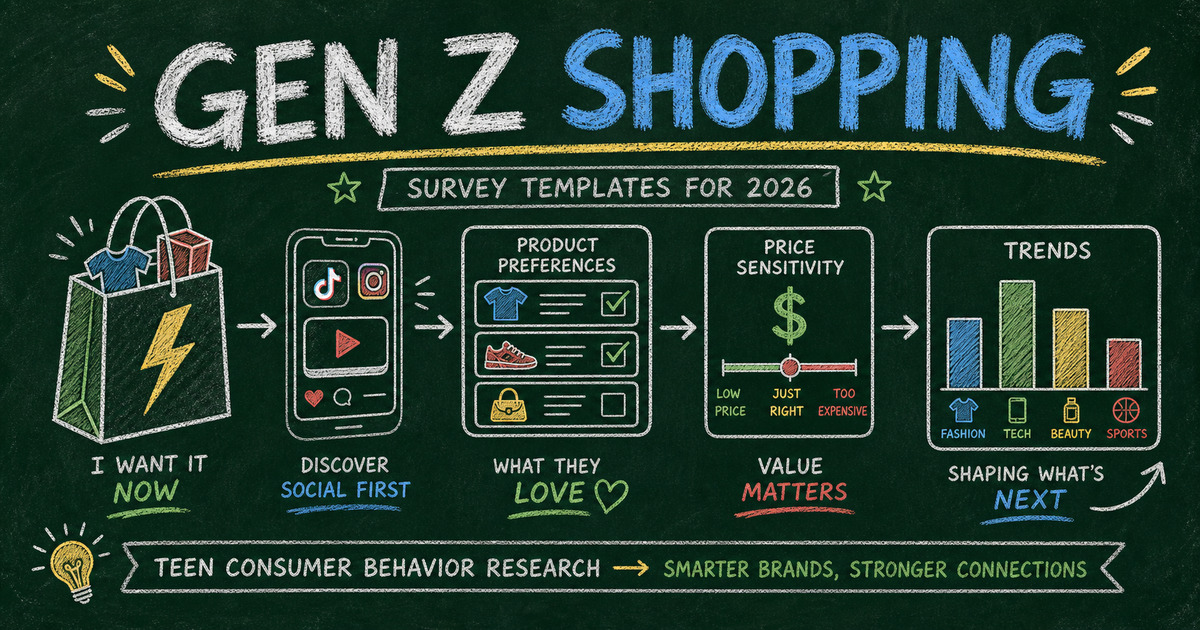
A useful Gen Z shopping habits survey needs to capture the path before purchase: discovery channel, social influence, price sensitivity, category interest, brand trust, creator impact, and what makes a product feel worth sharing. That is the difference between a shopping checklist and a consumer behavior study.
This guide gives market researchers a practical question framework for studying teen and Gen Z purchasing habits in 2026, plus a customizable FormHug template you can adapt instead of building from a blank page.
TL;DR - A Gen Z shopping habits survey should measure how young consumers discover products, compare options, react to price, trust brands, and decide what is worth buying or sharing.
- Track discovery before purchase - social feeds, creators, search, friends, ads, and stores all shape the buying path.
- Separate interest from spending power - teens may want a product but still depend on budget, discounts, parents, or timing.
- Measure trust signals - reviews, creator fit, brand values, return policies, and social proof often matter as much as product features.
- Works for: market researchers, youth brands, retailers, consumer startups, agencies, and product teams studying teen audiences.
- Start with the Gen Z shopping habits survey template, then customize the categories, age ranges, and channels for your research goal.
What Is a Gen Z Shopping Habits Survey?
A Gen Z shopping habits survey is a market research survey designed to understand how young consumers discover, evaluate, and purchase products. It is not just a retail preference survey. It looks at the full consumer journey: where attention starts, who influences the decision, which constraints shape the purchase, and what makes a brand feel credible.
For teen audiences, that journey is often indirect. The respondent may influence the purchase without completing the checkout. They may save a product, send it to a parent, wait for a sale, compare dupes, or ask friends before buying. A strong survey accounts for those behaviors instead of assuming every respondent has independent purchasing power.
The goal is to produce research you can segment and act on. You should be able to compare responses by age range, product category, shopping channel, budget level, and influence source. That is what turns the answers into a usable consumer behavior picture.
Gen Z Shopping Habits Survey Template
Use this structure when you need a pre-built but customizable template for teen and Gen Z consumer research:
| Section | What it measures | Example question |
|---|---|---|
| Screening | Whether the respondent fits the audience | Which age range best describes you? |
| Category interest | Which product areas matter | Which categories do you shop for or research most often? |
| Discovery | Where product awareness begins | Where do you usually first hear about products you want to buy? |
| Influence | Who or what changes the decision | Whose recommendation most affects whether you consider a product? |
| Price sensitivity | Budget and discount behavior | What usually makes a product feel too expensive? |
| Brand trust | Signals that make a brand credible | What makes you trust a brand you have not bought from before? |
| Purchase path | How interest becomes action | What do you usually do after finding a product you like? |
| Open-ended insight | The reason behind the pattern | Describe the last product you wanted to buy and what influenced your decision. |
The ready-made Gen Z shopping habits survey template gives you a starting version of this structure. The best customization depends on the product category: fashion, beauty, gaming, tech accessories, food and beverage, entertainment, school supplies, or local experiences all need slightly different answer options.
Survey Questions for Teen Consumer Behavior Research
The strongest question set combines structured answers for reporting with a few open-ended prompts for language, motivations, and examples. Market researchers should avoid writing every question as a broad opinion question. Ask about concrete behavior first, then ask why.
Audience and screening questions
Screening questions protect the research from mixed audiences. If the study is about teens, define the age range clearly and decide whether parents, college students, or young adults belong in the sample.
| Question | Answer type | Why it matters |
|---|---|---|
| Which age range best describes you? | Single choice | Separates teen, college-age, and older Gen Z segments |
| Which country or region are you in? | Single choice | Adds geographic context to shopping access and pricing |
| Which product categories do you shop for or research most often? | Multiple choice | Identifies relevant category interest |
| Do you usually make purchases yourself, ask a parent/guardian, or influence someone else’s purchase? | Single choice | Separates buyer, influencer, and dependent purchaser roles |
If your survey includes minors, keep the wording age-appropriate and review consent requirements before distribution. For many projects, the survey should be anonymous and avoid collecting names, phone numbers, or unnecessary identifying details.
Product discovery questions
Discovery is the first part of the purchase path. For Gen Z research, it is usually more useful to ask where a product is first noticed than where it is finally bought.
| Question | Answer type |
|---|---|
| Where do you usually first hear about products you want to buy? | Multiple choice |
| Which social platforms most often introduce you to new products? | Multiple choice |
| How often do creators or influencers introduce you to brands you had not heard of before? | Rating scale |
| When you see a product online, what do you usually do next? | Single choice |
| What kind of product content makes you stop scrolling? | Multiple choice |
Useful answer options include social feed, creator video, friend recommendation, search result, online ad, store display, brand email, marketplace recommendation, and community or group chat.
Price sensitivity and budget questions
Teen purchasing behavior often depends on budget timing, discounts, parents, gift cards, or whether the product feels worth saving for. A yes/no price question is too thin. Ask what changes the decision.
| Question | Answer type |
|---|---|
| What usually makes a product feel too expensive? | Multiple choice |
| How often do you wait for a sale before buying something you want? | Rating scale |
| Which discount or offer is most likely to change your mind? | Single choice |
| What price range feels reasonable for this product category? | Range or single choice |
| Have you ever chosen a lower-cost alternative after seeing a product online? | Yes/No |
Pair at least one structured price question with an open-ended follow-up: “What made the lower-cost option feel good enough?” That answer often reveals whether the decision is about price, trust, design, peer acceptance, or perceived quality.
Brand trust and social proof questions
Young consumers do not evaluate brands only through official product claims. Reviews, comments, creator fit, return policies, peer usage, and visual proof all shape trust.
| Question | Answer type |
|---|---|
| What makes you trust a brand you have not bought from before? | Multiple choice |
| Which is more persuasive: brand ads, creator reviews, customer reviews, or friend recommendations? | Ranking |
| How important are return policies when deciding whether to buy from a new brand? | Rating scale |
| What makes a product feel popular in a way that matters to you? | Multiple choice |
| What makes a brand feel fake or not worth trusting? | Open-ended |
This section is especially valuable for brands trying to understand the gap between awareness and conversion. A product can be known without being trusted.
Purchase path and post-purchase questions
The purchase path shows what happens after interest. For some teens, the next step is buying. For others, it is saving, sharing, asking, waiting, or forgetting.
| Question | Answer type |
|---|---|
| After finding a product you like, what do you usually do next? | Single choice |
| Who do you ask before buying something new? | Multiple choice |
| Where do you prefer to complete the purchase? | Single choice |
| What would make you abandon a product after considering it? | Multiple choice |
| After buying something you like, how likely are you to post, review, or recommend it? | Rating scale |
The post-purchase question matters because teen consumer behavior is often social after the sale too. Sharing, recommending, reviewing, styling, unboxing, or bringing a product into a friend group can become the next person’s discovery channel.
How Market Researchers Can Customize the Template
A pre-built survey template should save structure time, not lock the study into generic answers. Customize the template around the audience, category, and decision you need to make.
Customize by product category
Fashion and beauty research should include style inspiration, creator credibility, trend timing, returns, and dupe behavior. Tech and gaming research should include feature comparison, review sources, peer usage, specs, and platform compatibility. Food and beverage research should include price, availability, packaging, flavors, health perception, and where the product is discovered.
Do not ask every possible category question. Pick the category first, then rewrite the answer choices around the buying context.
Customize by respondent role
Teen audiences may be buyers, influencers, or requesters. If the respondent is not always the person paying, ask what role they usually play:
- I buy with my own money.
- I ask a parent or guardian to buy.
- I influence what my family buys.
- I save products for later.
- I mostly browse and compare.
That one question changes how you interpret the rest of the data. “I did not buy” can mean no interest, no budget, no permission, or no urgency.
Customize by research output
If the goal is a product launch, focus on category interest, price range, and trust signals. If the goal is brand positioning, focus on brand perception, values, creator fit, and social proof. If the goal is channel strategy, focus on discovery sources, content formats, and what happens after the first impression.
The cleanest survey starts with one sentence: “After reading the results, we will decide ___.” Then every question should support that decision.
When to Use a Pre-Built Survey Template vs Build From Scratch
Use a pre-built template when the research goal fits a known pattern: audience discovery, product preference, brand trust, price sensitivity, or purchase journey mapping. The template gives you a tested baseline so you can spend your time on audience-specific wording.
Build from scratch when the study involves a proprietary product concept, sensitive category, legal review, clinical claims, or a methodology that must match an academic or panel provider’s requirements. Even then, a template can still help you draft the first structure before expert review.
For most marketing and consumer research teams, the best workflow is hybrid: start from the Gen Z shopping habits survey template, remove questions that do not support the decision, customize answer options, then add one or two open-ended prompts for qualitative depth.
How to Build the Survey in FormHug
Step 1: Start from the template
Open the Gen Z shopping habits survey template. Review the existing sections and remove anything that does not match your category or audience.
Step 2: Add your category-specific answer choices
Replace generic product categories with the products you are actually studying. A fashion survey, snack survey, and gaming accessories survey should not share the same answer list.
Step 3: Add logic for respondent role
Use conditional follow-ups when the respondent’s role changes the path. A respondent who buys with their own money can answer price and checkout questions directly. A respondent who asks a parent or guardian may need questions about permission, timing, and purchase influence.
Step 4: Review the first responses before scaling
Read the first 20 responses before sending the survey to a larger sample. If respondents choose “Other” too often, your answer choices are missing real behavior. If open-ended responses are vague, make the prompt more specific.
Frequently Asked Questions
What should a Gen Z shopping habits survey ask?
It should ask how respondents discover products, which categories they care about, who influences them, what price signals matter, what makes brands trustworthy, and what they usually do after finding a product they like.
Is this the same as a consumer behavior survey?
It is a specialized consumer behavior survey focused on Gen Z, teen audiences, and shopping decisions. A general consumer behavior survey may cover broader demographics, while this template focuses on youth discovery, influence, trust, and purchase constraints.
Can market researchers use a pre-built template?
Yes. A pre-built template is useful when it gives you a strong baseline structure. Researchers should still customize screening questions, answer options, demographics, and methodology notes before fielding the survey.
Should teen shopping surveys be anonymous?
Often, yes. If the study does not require identity, avoid collecting names, phone numbers, or unnecessary personal details. For minors, review consent requirements and keep the survey purpose clear.
How many questions should the survey include?
For a cold audience, keep it around 8 to 12 questions. That is enough for screening, category interest, discovery, influence, price sensitivity, brand trust, and one open-ended question without making the survey feel like homework.
Can I use this template for fashion, beauty, or gaming research?
Yes. Customize the categories and answer options for the product space. Fashion and beauty surveys should emphasize style inspiration, creator influence, returns, and dupes. Gaming or tech surveys should emphasize specs, reviews, peer use, and platform fit.
Related
- 20 Best Market Research & Consumer Survey Templates for 2026 - compare broader consumer and market research templates
- Free Survey Maker - create surveys with templates, AI drafts, and conditional follow-ups
- Multiple Choice Survey Questions - write answer options that produce cleaner data
- Open-Ended Survey Questions - capture the language behind consumer decisions
Teen shopping behavior is not one decision at checkout. It is discovery, influence, budget, trust, and timing compressed into a path that moves fast. Start with the template, then customize it around the category you actually need to understand. Use the Gen Z shopping habits template ->

Written by
FormHug TeamProduct, research, and form automation team
The FormHug Team brings together product builders, workflow researchers, and form automation practitioners who study how people collect, route, and act on information online. Our guides are based on hands-on product testing, template analysis, customer workflow patterns, and deep experience with forms, surveys, quizzes, AI-assisted creation, integrations, and results sharing.