How to Turn an AI Question Bank into an Online Exam
Create the assessment
Turn this into a scored assessment
Build an assessment with scoring, result pages, feedback, and records you can review later.
A folder full of questions is not an exam. Without a plan, an AI can produce 40 plausible items that repeat the same fact, skip an important skill, or mix easy recall with advanced application as if they were interchangeable.
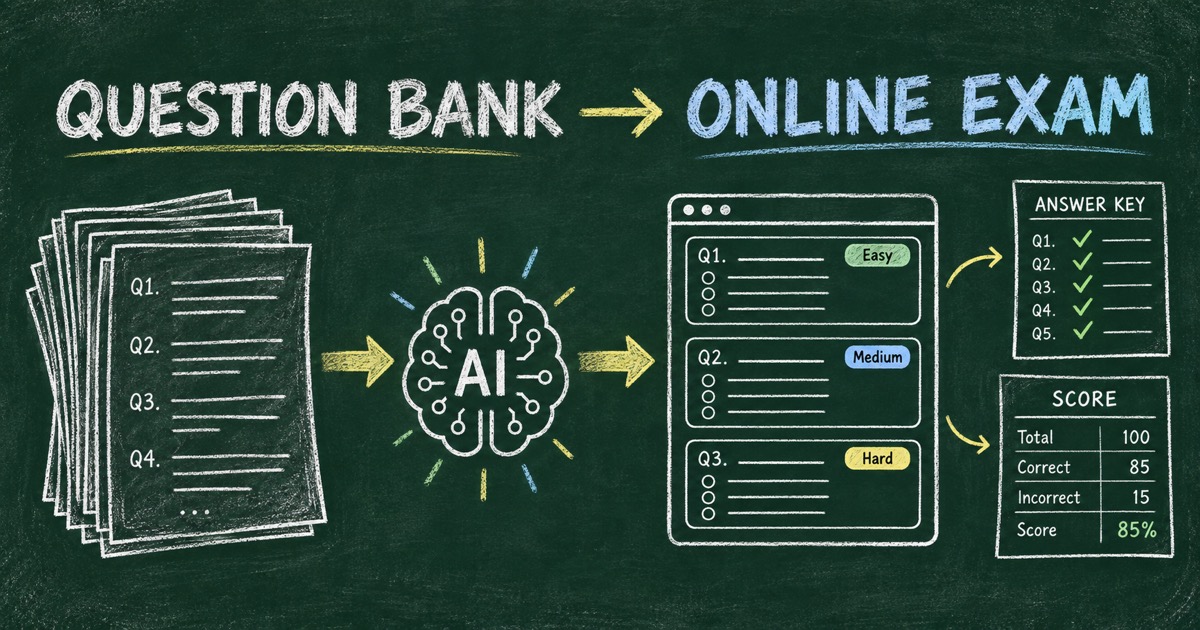
An AI question bank becomes a useful online exam when each item has a learning objective, a defensible answer key, an appropriate difficulty, and a place in a deliberate assessment blueprint. This guide shows how to make that conversion without asking learners to sit through every question you have collected.
TL;DR — An AI question bank is source material; an online exam is a selected, checked set of questions aligned to learning objectives and scoring rules.
- Map questions to objectives before choosing the final exam length.
- Check every answer key against course material or a subject-matter reviewer.
- Balance difficulty and question types so scores reflect learning, not one narrow skill.
- Works for: practice tests, course checks, onboarding, product knowledge, and training assessments.
- A larger question pool can support multiple exam versions, but it does not make a test secure by itself.
What Is an AI Question Bank for an Online Exam?
An AI question bank is a collection of draft questions—often generated from a topic, lesson, document, or existing notes—that can be reviewed and selected for one or more tests. An online exam is the published assessment learners complete, with a defined question set, answer rules, scoring method, and result experience.
The difference is selection and accountability. A bank helps an instructor reuse source material. An exam makes a particular claim about what a learner knows. That claim should be supported by questions that represent the course, answer keys that have been checked, and scoring that follows a rule learners can understand.
Start with an Exam Blueprint, Not the AI’s Question Count
Before generating or importing questions, write down what the exam must measure. A compact blueprint prevents a common failure: ending up with many questions about the easiest topic and none about the skill that matters most.
Use an Objective → Evidence → Weight map:
| Learning objective | Evidence a question should elicit | Share of exam |
|---|---|---|
| Explain a key concept | Choose or state the correct definition | 25% |
| Apply a process | Select the next step in a realistic scenario | 50% |
| Recognize a risk | Identify an error or unsafe choice | 25% |
The percentages are an example, not a universal standard. Choose weights based on the course outcomes and the consequences of getting an item wrong. If the objective is practical judgment, a test made entirely of vocabulary recall will not measure it well.
The blueprint also gives the AI useful context. Instead of asking for “a test about data privacy,” tell it the audience, the material covered, the objectives, the desired difficulty mix, and the formats that suit each objective. The AI quiz maker prompt template shows how to turn those constraints into a clearer generation brief.
Convert Source Material into Questions Learners Can Answer Fairly
When a question bank comes from an article, slide deck, policy, or training document, keep a traceable connection between each question and its source. An item should test an idea the material actually teaches—not a plausible-sounding detail the model added.
For each draft question, review four things:
- Objective: What specific knowledge or skill does it test?
- Source: Where in the approved material can a reviewer verify the answer?
- Question type: Does the response format match the skill—recall, application, calculation, or explanation?
- Difficulty: Is the challenge coming from the concept, not confusing wording?
Rewrite questions that contain two tasks at once, depend on unstated assumptions, or use “all of the above” to hide weak answer choices. For multiple-choice items, distractors should represent believable misconceptions. If one option is obviously silly, the question measures test-taking cues as much as understanding.
For a ready-made starting point, the Product Knowledge Quiz template can be adapted to a feature, onboarding module, or internal training topic. A template supplies structure; it does not verify your organization’s facts.
Build a Balanced Exam from the Bank
The final exam should be shorter and more representative than the source bank. Select questions by objective first, then inspect the mix of item types and difficulty. Avoid selecting only the items that are easiest to auto-grade if those items do not reflect the real learning goal.
An exam may combine single-answer questions for clear facts, multi-select questions when several actions are genuinely correct, and short responses when learners need to explain reasoning. Automatically scored formats give fast, consistent feedback for defined answers. Open responses often need a human rubric because multiple answers can be valid.
If you need different versions, draw questions from the same blueprint rather than randomizing the entire bank without constraints. Every version should cover comparable objectives and a similar level of challenge. Random selection is useful for variety; it is not a substitute for equivalence review.
Set Scoring Rules Before You Publish
Decide how points work before learners see the exam. Equal points are easy to explain and suit many short checks. Weighted points may be appropriate when some objectives are more consequential, but the weighting should reflect the assessment plan—not be used to disguise an arbitrary pass mark.
Write down the maximum score, whether partial credit is available, what counts as passing, and what happens after submission. A useful result can show the score and direct learners to the objectives they should review. A score alone does not explain a misunderstanding or prove that someone completed the course independently.
Keep the boundary clear: automatic scoring can apply configured keys consistently, but it cannot validate a bad answer key, confirm a learner’s identity, or certify real-world competence on its own. For employment, safety, licensure, or other consequential decisions, include qualified human review and follow the rules that apply to your organization.
Create and Review the Online Exam in Four Steps
Step 1: Write the blueprint
List the objectives, evidence you expect, and approximate weight for each. Then decide which question formats can validly test them.
Step 2: Generate or organize candidate items
Use an AI quiz maker to draft from a topic or source material, or bring together questions your team already uses. Keep the source reference next to each item during review.
Step 3: Verify answers and test the scoring
Have a subject-matter reviewer check every keyed answer. Preview the exam with known correct and incorrect response patterns to confirm the score and result message match your rules.
Step 4: Publish a learner-ready version
Use a hosted quiz or exam link to share the assessment. Check the instructions, mobile layout, result page, and completion experience before sending it to a class or team. FormHug’s AI quiz maker can turn a reviewed brief into a scored, shareable quiz that you can inspect before use.
Frequently Asked Questions
How do I turn an AI question bank into an online exam?
Map questions to learning objectives, verify each answer against the source material, balance difficulty and formats, set scoring rules, and publish only the reviewed subset that represents the course.
Can AI create an exam from a question bank or course material?
AI can draft and organize questions from a topic or source. A course owner or subject-matter reviewer should confirm that the questions reflect the approved material and that every correct answer is defensible.
How many questions should an online exam have?
Use enough questions to represent the objectives without adding repetitive items. The right length depends on the breadth of the material, the stakes, and the time learners have; a blueprint is more useful than a universal question count.
Should every question in an online exam be automatically scored?
No. Objective questions with a clear key are good candidates for automatic scoring. Explanations, essays, and other open responses may need a human rubric, especially when reasoning matters more than exact wording.
Can an AI-generated exam be used for certification?
AI can accelerate drafting, but certification exams need verified content, reviewed scoring rules, and appropriate identity and integrity controls. Automatic grading by itself does not establish competence or exam security.
Can I create a scored online exam with FormHug?
FormHug’s quiz maker supports scored quizzes, answer explanations, and shareable results. Review the generated questions and answer key before using the exam for formal decisions.
Related
- How to Create an Online Quiz — design the scoring and result experience for a hosted quiz.
- How to Create a Quiz for Employee Training — adapt a learning check to a workplace training program.
- Mini Exam Questions — write focused questions for short knowledge checks.
A large bank can still produce a weak exam if every item tests the same thing. Build from the objectives, verify the key, and publish a reviewed online exam with FormHug →

Written by
FormHug TeamProduct, research, and form automation team
The FormHug Team brings together product builders, workflow researchers, and form automation practitioners who study how people collect, route, and act on information online. Our guides are based on hands-on product testing, template analysis, customer workflow patterns, and deep experience with forms, surveys, quizzes, AI-assisted creation, integrations, and results sharing.