Anonymous Survey: How to Collect Honest Feedback Without Losing Trust
Start collecting responses
Turn this into a shareable survey
Draft the questions, publish a clean link, and keep every response organized in FormHug.
People answer differently when they think their name is attached. That is not dishonesty. It is self-protection.
Anonymous surveys work because they lower the social cost of feedback. Employees can talk about workload without worrying about managers. Students can describe confusion without feeling exposed. Customers can point out friction without starting an awkward support conversation.
But anonymity is easy to promise and easy to damage. A survey can avoid asking for names and still identify people through tiny segments, timestamps, email collection, or overly specific demographic questions. This guide explains when to use an anonymous survey, how to design one responsibly, and how to build a useful version in FormHug.
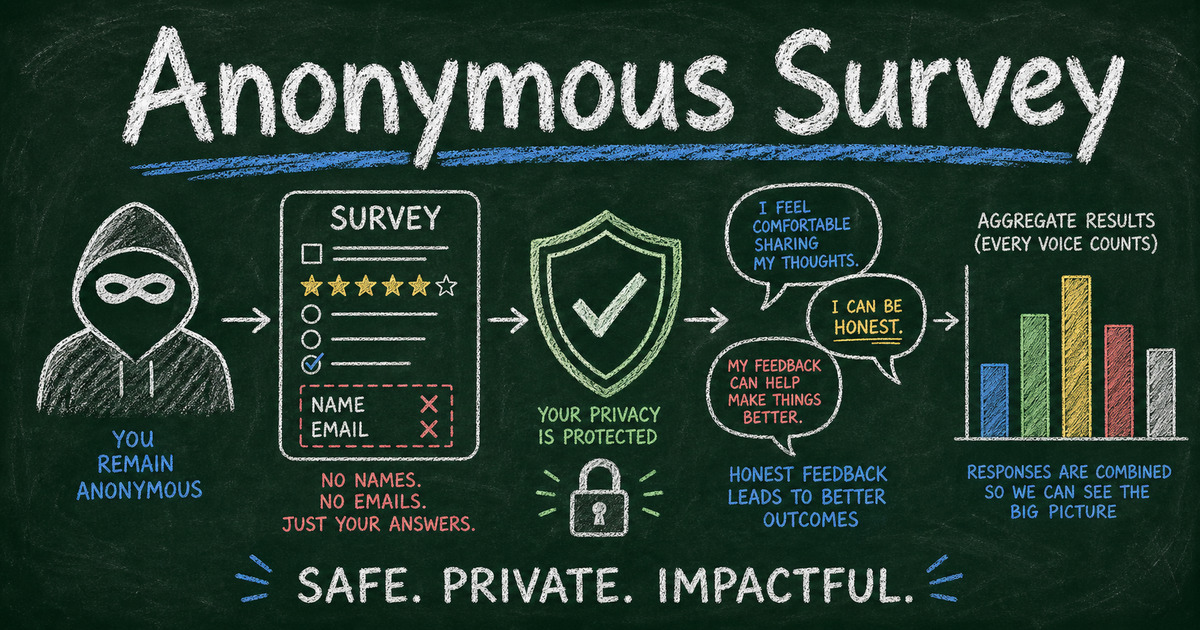
TL;DR - An anonymous survey collects feedback without names, email addresses, or other identity fields, so respondents can answer sensitive questions more honestly.
- Use anonymity for risk - workplace culture, classroom climate, leadership feedback, sensitive customer experiences, and community moderation.
- Do not over-segment - small demographic groups can reveal identity even when names are removed.
- Say exactly what is anonymous - explain what you collect, what you do not collect, and how results will be used.
- Works for: employee pulse checks, student perception surveys, customer feedback, event retrospectives, and community safety surveys.
- FormHug can create anonymous survey drafts, collect responses without identity fields, and route follow-ups based on answers.
What Is an Anonymous Survey?
An anonymous survey is a survey that does not collect information that can identify an individual respondent. That usually means no name, email, phone number, account ID, employee ID, student ID, or required login.
Anonymous does not mean “private but traceable.” It means the survey owner should not be able to connect a response to a specific person from the collected fields.
Common anonymous survey examples include:
- Employee workload and burnout checks.
- Student perception surveys.
- Classroom climate surveys.
- Leadership feedback.
- Event retrospectives.
- Customer experience surveys after sensitive service interactions.
- Community moderation or safety feedback.
The goal is not to hide everything. The goal is to remove identity pressure so the answers are more honest.
When Should a Survey Be Anonymous?
Use an anonymous survey when identity would change the answer.
Workplace feedback
Employees may soften feedback about managers, workload, compensation, burnout, return-to-office policy, or team conflict if they believe the response can be traced back to them. For broader HR examples, the employee workplace survey templates show common topics where anonymity can improve response quality.
Student and classroom feedback
Students may avoid saying they feel lost, unsupported, or uncomfortable if the instructor can identify them. Anonymous student surveys work best when questions focus on learning conditions, not personal complaints. The student perception survey guide covers classroom-specific question design.
Customer feedback
Anonymous customer feedback can surface friction that customers would not raise in a support ticket: confusing pricing, trust concerns, awkward onboarding, or embarrassment about not understanding a feature.
Community or event feedback
Communities, workshops, and events often need feedback about group dynamics, safety, inclusion, or facilitation quality. Anonymous surveys can make those answers easier to give.
Do not use anonymity when you need to follow up with a specific person, resolve an account issue, verify attendance, issue a certificate, or process a request. In those cases, use a regular form and be clear about why identity is required.
Anonymous Survey Design Rules
Remove direct identifiers
Do not ask for name, email, phone number, account ID, student ID, employee ID, or any field that directly identifies the respondent.
If follow-up is optional, separate it from the main survey. For example, use an optional final field that says: “If you want us to contact you, leave your email. This will make your response identifiable.”
Avoid small-group segmentation
Demographics can identify people indirectly. A response from “Engineering, London, manager, 10+ years” may point to one person even without a name.
Use broader categories when possible:
- Team instead of exact role.
- Region instead of office.
- Tenure range instead of start date.
- Course section instead of student name.
If a segment has fewer than 5 to 10 people, consider removing it or reporting only aggregate results.
Ask behavior-based questions
Sensitive surveys become more useful when questions focus on observable conditions.
Weak:
- Do you like your manager?
Better:
- I receive clear priorities for my work.
- I can raise concerns without negative consequences.
- Feedback helps me understand what to improve next.
Behavior-based questions are easier to answer honestly and easier to act on.
Explain how results will be used
Anonymity builds trust only if respondents believe the feedback matters.
Add a short intro:
“This survey does not ask for your name or email. Results will be reviewed in aggregate and used to improve workload planning for next quarter.”
That sentence does three jobs: it clarifies identity, sets the reporting level, and names the action.
Anonymous Survey Question Examples
Employee anonymous survey questions
- I understand what is expected of me this month.
- My current workload is sustainable.
- I have the tools and access needed to do my work.
- I can raise concerns without negative consequences.
- What is one change that would make your work easier?
Student anonymous survey questions
- The instructor explains new concepts clearly.
- I know what I am expected to learn in this course.
- I feel comfortable asking questions.
- Assignments are clear enough to begin without confusion.
- What is one thing that would help you learn better?
Customer anonymous survey questions
- The product was easy to understand.
- Pricing felt clear before purchase.
- I trusted the checkout or signup process.
- What almost stopped you from continuing?
- What should we improve first?
Event anonymous survey questions
- The session matched what was promised.
- I felt comfortable participating.
- The pace was appropriate.
- Which part of the event should we repeat?
- What should we change next time?
For answer-option patterns, pair these with multiple choice survey questions, Likert scale survey questions, and open-ended survey questions.
How to Create an Anonymous Survey in FormHug
Step 1: Decide what anonymity means for this survey
Write down what you will not collect. For example: “No name, email, phone, student ID, employee ID, or exact department.” Then write what you will collect: “Course section and broad role only.”
This prevents accidental identity fields from creeping into the form later.
Step 2: Generate a no-identity draft
Open FormHug and use a specific prompt:
“Create an anonymous employee pulse survey with no name or email fields. Use 5-point agreement scale questions about workload, clarity, manager support, and psychological safety, plus two open-ended improvement questions.”
If you need a broader tool starting point, the free survey maker guide explains how to choose a survey structure before writing the questions.
Step 3: Cut identifying segments
Review every field. Remove anything that could point to a person in a small group. If you need segmentation, use broad categories and make sensitive demographic questions optional.
For anonymous workplace or classroom surveys, shorter is safer. Ask only the fields you will actually use.
Step 4: Share the survey with a trust statement
Publish the survey and share the link with a short note:
“This survey is anonymous. It does not collect names or emails. We will review results in aggregate and share the top themes with the group.”
That note matters as much as the survey itself. People are more honest when the promise is concrete.
How FormHug Fits Anonymous Feedback
| Need | FormHug workflow |
|---|---|
| No identity fields | Build the survey without name, email, phone, or ID fields. |
| Sensitive topics | Use scales and optional open-ended follow-ups. |
| Shorter respondent path | Add conditional logic so only relevant follow-ups appear. |
| Quick launch | Generate a first draft with the AI builder, then remove identifying fields. |
| Reusable templates | Start from survey and feedback templates and adapt the wording. |
FormHug is not a substitute for legal, HR, or research governance when anonymity has formal requirements. It is a practical way to create a clean anonymous feedback survey for teams, classes, communities, and customers without adding identity fields by default.
Frequently Asked Questions
What makes a survey anonymous?
A survey is anonymous when the response cannot be connected to a specific person from the collected fields. That means no name, email, phone, ID, required login, or overly specific demographic combination.
What is the difference between anonymous and confidential?
Anonymous means the survey owner cannot identify the respondent. Confidential means identity may be known or technically available, but access is restricted. Do not call a survey anonymous if you can trace responses back to individuals.
Should employee surveys be anonymous?
Employee surveys should often be anonymous when asking about workload, management, burnout, psychological safety, return-to-office policy, or team conflict. If the survey is about a personal request or HR case, identity may be necessary.
Should student surveys be anonymous?
Student surveys should usually be anonymous when asking about teaching clarity, classroom climate, belonging, workload, or confidence. Anonymous responses help students give honest feedback without worrying about grades or relationships.
Can an anonymous survey include demographics?
Yes, but keep demographics broad and optional when possible. Small combinations of role, location, tenure, class, or department can identify people indirectly.
Can I follow up after an anonymous survey?
Only if the respondent chooses to identify themselves. If follow-up is important, add an optional contact field and clearly explain that completing it makes the response identifiable.
How do I get more honest anonymous survey responses?
Keep the survey short, remove identity fields, explain how results will be used, report findings in aggregate, and follow through visibly. Trust improves when people see that prior feedback led to action.
Is FormHug good for anonymous surveys?
Yes. FormHug can create anonymous survey drafts, publish shareable links, collect responses without identity fields, and support conditional follow-ups. The key is designing the survey so it does not ask for identifying information.
Related
- Free Survey Maker - create online surveys with AI drafts, templates, and share links
- Student Perception Survey - ask students about teaching clarity, workload, belonging, and confidence
- Best Employee Workplace Survey Templates - start from HR-ready workplace survey formats
- Open-Ended Survey Questions - collect honest context without turning the survey into an interview
An anonymous survey earns better answers only when the promise is real. Remove identity fields, avoid tiny segments, and tell people exactly how the feedback will be used. Create your survey ->

Written by
FormHug TeamProduct, research, and form automation team
The FormHug Team brings together product builders, workflow researchers, and form automation practitioners who study how people collect, route, and act on information online. Our guides are based on hands-on product testing, template analysis, customer workflow patterns, and deep experience with forms, surveys, quizzes, AI-assisted creation, integrations, and results sharing.