Likert Scale Survey Questions: Examples, Scale Types, and Best Practices
Start collecting responses
Turn this into a shareable survey
Draft the questions, publish a clean link, and keep every response organized in FormHug.
A Likert scale turns opinion into a measurable pattern. Instead of asking “Do you agree?” and forcing a binary answer, it gives people room to say how strongly they agree, how satisfied they are, how often something happens, or how confident they feel.
That extra nuance is useful only when the scale is written well. A weak Likert question mixes ideas, uses uneven labels, or gives respondents a neutral middle point that means five different things. A strong one measures one attitude at a time and uses labels that make every point clear.
This guide covers common Likert scale types, examples by survey use case, writing mistakes to avoid, and how to build a cleaner Likert survey in FormHug.
TL;DR - Likert scale survey questions measure intensity: agreement, satisfaction, confidence, frequency, importance, or likelihood.
- Use scales when intensity matters - a rating captures more nuance than a yes/no question.
- Keep labels balanced - every point should be equally spaced and easy to interpret.
- Measure one idea per question - avoid asking about two concepts in the same scale item.
- Works for: customer satisfaction, employee engagement, student feedback, product research, event feedback, and training evaluation.
- FormHug can combine Likert-style ratings with open-ended or conditional follow-ups.
What Are Likert Scale Survey Questions?
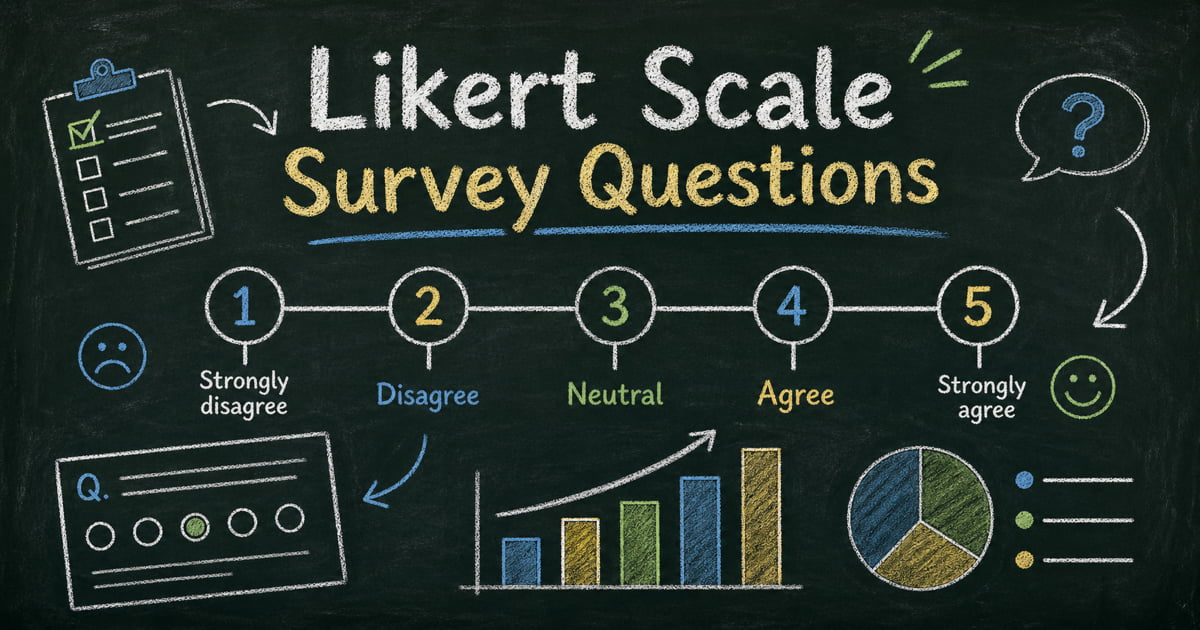
Likert scale survey questions ask respondents to choose a point on an ordered scale. The classic version measures agreement:
- Strongly disagree
- Disagree
- Neither agree nor disagree
- Agree
- Strongly agree
But the same structure can measure other concepts:
| Scale type | Example prompt |
|---|---|
| Agreement | ”The onboarding process was easy to complete.” |
| Satisfaction | ”How satisfied are you with the support experience?” |
| Frequency | ”How often do you use this feature?” |
| Confidence | ”How confident are you applying what you learned?” |
| Importance | ”How important is this feature to your workflow?” |
| Likelihood | ”How likely are you to attend again?” |
Likert scales are useful when the answer is not just Yes or No. They help you see degree, direction, and trend.
Common Likert Scale Types
5-point agreement scale
The 5-point agreement scale is the default for many surveys because it is easy to scan and includes a neutral midpoint.
Use it for statements such as:
- The instructions were clear.
- The product is easy to use.
- I understand what is expected of me.
- I feel comfortable asking for help.
Example answer labels:
| Value | Label |
|---|---|
| 1 | Strongly disagree |
| 2 | Disagree |
| 3 | Neither agree nor disagree |
| 4 | Agree |
| 5 | Strongly agree |
7-point agreement scale
A 7-point scale gives more precision, but it also asks more from respondents. Use it when the audience is comfortable with surveys or when you need subtle measurement differences.
For most customer feedback and event surveys, 5 points is enough. For academic, employee engagement, or benchmark studies, 7 points can be useful.
Satisfaction scale
Satisfaction scales work best when the respondent has just completed an experience.
- Very dissatisfied
- Dissatisfied
- Neutral
- Satisfied
- Very satisfied
Use satisfaction for support interactions, checkout, onboarding, event logistics, or training delivery. Do not use satisfaction when you really mean importance or likelihood.
Frequency scale
Frequency scales measure behavior.
- Never
- Rarely
- Sometimes
- Often
- Always
They are useful for employee pulse surveys, product usage research, and classroom feedback. Frequency questions are often more reliable than vague sentiment questions because respondents can anchor the answer to behavior.
Likert Scale Survey Question Examples
Customer satisfaction examples
- The product was easy to set up.
- The pricing was clear before purchase.
- The support response solved my issue.
- I trust this product with my data.
- The checkout process was simple.
- The product matched the description.
- I would feel confident recommending this product.
- The value is worth the price.
Product research examples
- This feature would save me time.
- This feature fits my current workflow.
- I understand what this feature does.
- I would use this feature at least once a week.
- This feature is important enough to affect my buying decision.
- I would need training before using this feature.
- The prototype felt intuitive.
- The result matched what I expected.
Employee survey examples
- I understand my top priorities this week.
- My workload is sustainable.
- I have the tools I need to do my job well.
- I receive useful feedback from my manager.
- I feel comfortable raising concerns.
- I know how my work connects to company goals.
- Meetings help me make progress.
- I see a future for myself at this company.
Student and training examples
- The lesson objective was clear.
- The examples helped me understand the topic.
- The pace of the session was appropriate.
- I feel confident applying what I learned.
- The practice questions matched the material.
- Feedback helped me improve.
- The course workload was manageable.
- I would recommend this course to another learner.
Event feedback examples
- The event agenda was clear.
- The session topics matched the event description.
- The speaker explained concepts clearly.
- The event logistics were easy to follow.
- The session length was appropriate.
- I had enough time for questions.
- I would attend another event like this.
- The event was worth the time invested.
Best Practices for Likert Scale Questions
Write statements, not compound questions
Weak: “The training was useful and well organized.”
Better:
- The training was useful.
- The training was well organized.
If one respondent agrees with one part and disagrees with the other, a compound question gives them no accurate answer.
Keep the direction consistent
Do not switch between positive and negative wording unless you are running a formal psychometric instrument. In practical business surveys, reverse-worded items often confuse respondents and make results harder to interpret.
Label every point when possible
Numbers alone are ambiguous. A 3 out of 5 can mean neutral, average, unsure, or acceptable. Labels reduce interpretation drift.
Add a follow-up for extreme scores
Likert data shows where sentiment is strong. Follow-ups explain why. Use conditional logic to ask:
- Low score: “What should we improve first?”
- High score: “What made this work well?”
That gives you quantitative trend data and qualitative context without asking everyone extra questions.
How to Build a Likert Scale Survey in FormHug
Step 1: Choose the scale concept
Decide what you are measuring: agreement, satisfaction, frequency, importance, confidence, or likelihood. Do not mix scale concepts in the same section unless the labels are clearly different.
Step 2: Draft the survey with AI
Open FormHug and describe what you need: “Create an employee pulse survey with 5-point Likert scale questions for workload, clarity, feedback, and belonging, plus one open-ended follow-up for low scores.”
Step 3: Add rating fields and labels
Use rating or single-choice fields with clear labels. For field behavior and setup options, FormHug’s rating fields documentation explains the available rating styles.
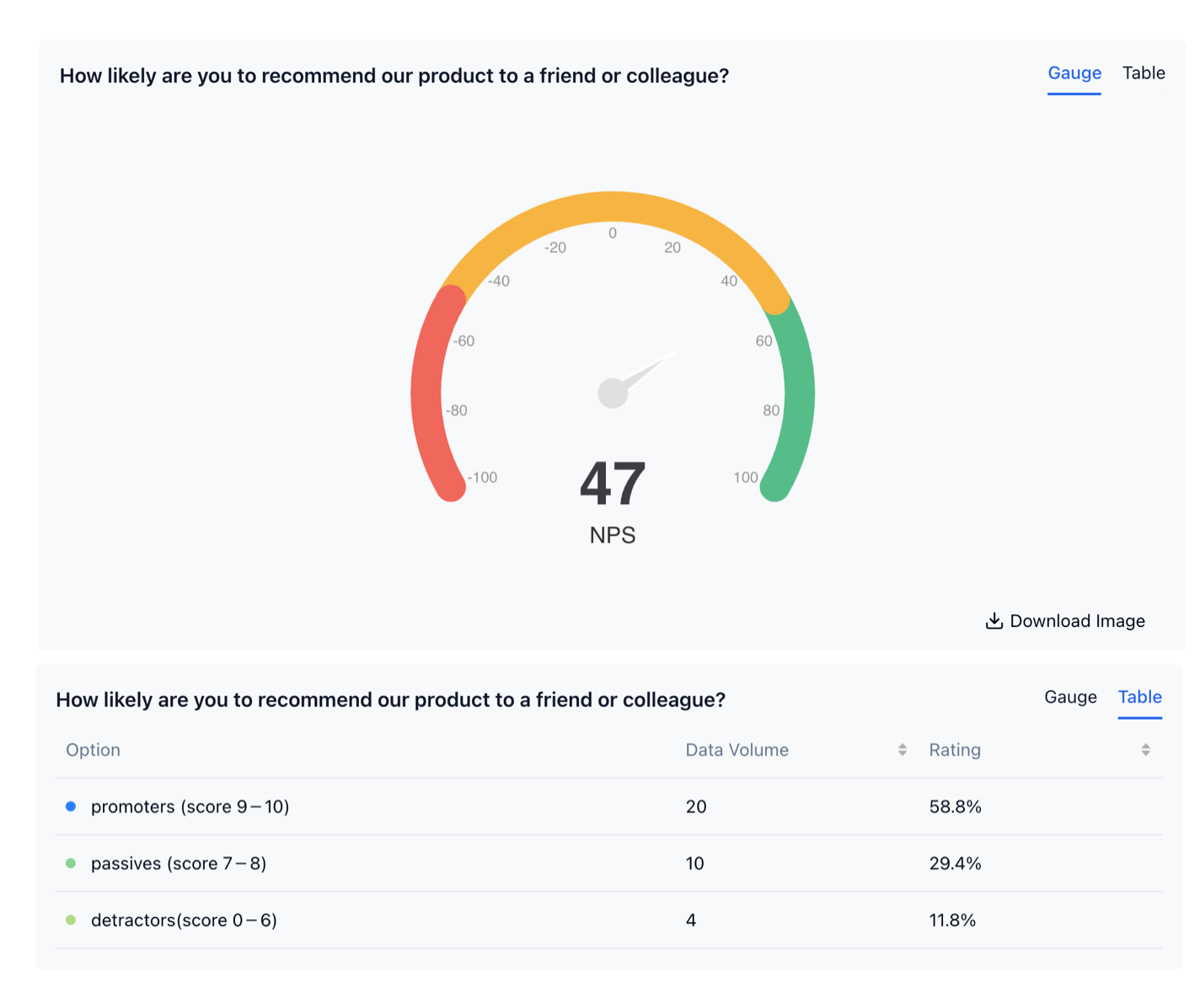
Step 4: Segment and compare results
Review average scores by segment: team, role, customer type, event session, or course module. Pair Likert scores with open-ended survey questions so you know what caused the number.
Frequently Asked Questions
What is a Likert scale question?
A Likert scale question asks respondents to choose a point on an ordered scale, usually to measure agreement, satisfaction, frequency, confidence, importance, or likelihood.
Is a 5-point or 7-point Likert scale better?
Use a 5-point scale for most practical surveys because it is easier to answer and analyze. Use a 7-point scale when you need more precision and your audience is comfortable with detailed survey instruments.
Should a Likert scale include a neutral option?
Include a neutral midpoint when neutrality is a valid answer. Remove it only when you intentionally need respondents to choose a direction, and be aware that forced-choice scales can frustrate people with genuinely mixed views.
What is the difference between a Likert scale and a rating scale?
A Likert scale is a type of rating scale with ordered response options, often used to measure agreement with statements. Rating scales are broader and can include stars, numbers, sliders, or satisfaction labels.
Can I use Likert scales for employee engagement?
Yes. Employee engagement surveys often use Likert scales because they measure sentiment over time. Keep the same questions across survey cycles so the trend line is meaningful.
Can FormHug create Likert scale surveys?
Yes. FormHug can generate Likert-style survey questions with AI, add rating fields, and show follow-up questions based on score ranges using conditional logic.
Related
- Open-Ended Survey Questions - pair scale scores with better text follow-ups
- Multiple Choice Survey Questions - use structured answer options when a scale is not the right format
- How to Create an Evaluation Form - build anchored rating forms that drive decisions
- 15 Best Employee & Workplace Survey Templates - HR survey templates that use recurring scale questions
A scale is useful only when every point means something. Label it clearly, ask one idea at a time, and use follow-ups where the score needs context. Create your survey ->

Written by
FormHug TeamProduct, research, and form automation team
The FormHug Team brings together product builders, workflow researchers, and form automation practitioners who study how people collect, route, and act on information online. Our guides are based on hands-on product testing, template analysis, customer workflow patterns, and deep experience with forms, surveys, quizzes, AI-assisted creation, integrations, and results sharing.