Employee Exit Survey Questions: What to Ask Before Someone Leaves
Start collecting responses
Turn this into a shareable survey
Draft the questions, publish a clean link, and keep every response organized in FormHug.
By the time someone resigns, the most honest feedback window is already closing. They may want to help, but they also want to leave cleanly, protect relationships, and avoid a long final-week interrogation.
That is why exit surveys should be short, specific, and safe. The goal is not to ask every question HR has ever wanted answered. The goal is to capture the few signals that help the organization improve retention, manager support, workload, compensation clarity, and team culture.
This guide gives employee exit survey questions you can adapt, explains what not to ask, and shows how to build a respectful exit survey workflow in FormHug.
TL;DR - An employee exit survey is a short, structured survey sent near an employee’s departure to understand why they are leaving and what the organization can improve.
- Ask about reasons, not blame - separate compensation, growth, manager support, workload, culture, and role fit.
- Protect trust - explain who will see the answers and whether responses are confidential.
- Keep it brief - 8 to 12 questions is enough for most small teams.
- Works for: HR teams, founders, managers, nonprofits, agencies, schools, and growing teams.
- FormHug can create exit survey drafts, collect structured responses, and help teams review patterns over time.
What Is an Employee Exit Survey?
An employee exit survey is a questionnaire completed by an employee who is leaving an organization. It asks why they are leaving, what worked well, what made the role harder, and what the organization should improve for future employees.
An exit survey is different from an exit interview. An interview is conversational and can clarify details. A survey is easier to standardize, compare, and analyze over time. The best process often uses both: a short survey first, then an optional conversation if the employee is willing.
For broader feedback systems, pair exit surveys with recurring employee workplace survey templates and shorter pulse checks. Exit feedback tells you what broke late; pulse surveys help you catch problems earlier.
The Exit Signal Map
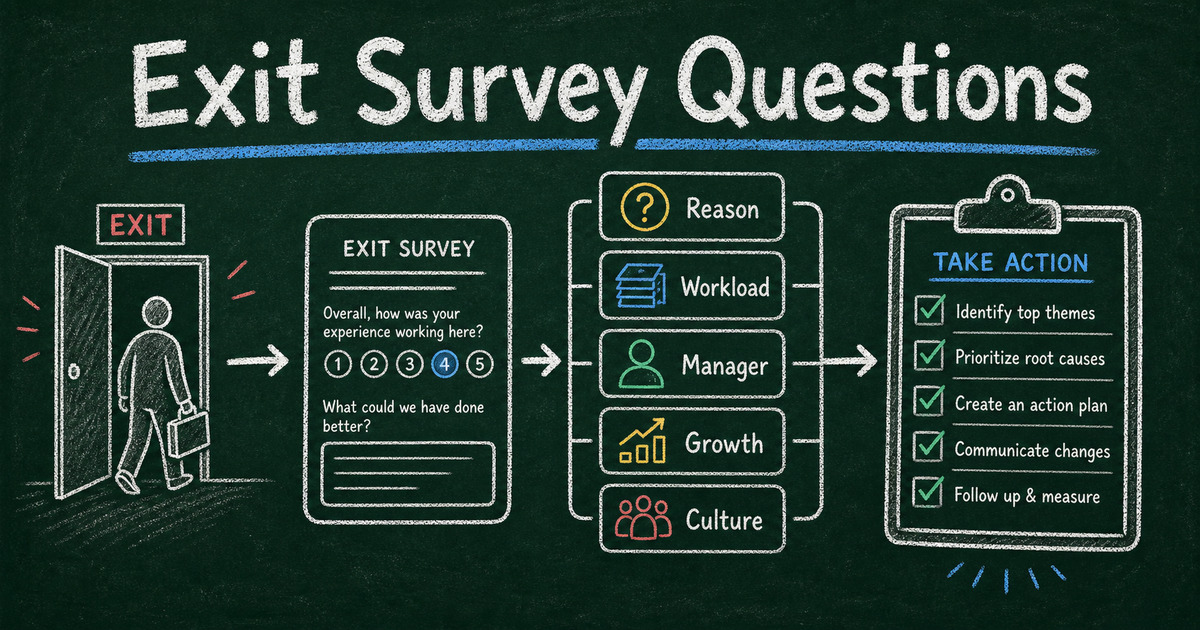
Use the Exit Signal Map to make sure the survey covers the right categories:
| Signal | What it tells you | Example question |
|---|---|---|
| Pull factor | what attracted them elsewhere | What influenced your decision to accept another opportunity? |
| Push factor | what made staying harder | Which factors made it difficult to stay? |
| Manager support | quality of direction and feedback | How supported did you feel by your manager? |
| Growth | career path and learning | Did you see a clear growth path here? |
| Workload | sustainability of expectations | How sustainable was your workload? |
| Culture | belonging and trust | Did the team environment help you do your best work? |
The map matters because “Why are you leaving?” is too broad. People often leave for a bundle of reasons. A structured survey lets you separate the job offer that pulled them away from the internal issue that made them open to leaving.
Employee Exit Survey Questions by Category
Reasons for leaving
- What is the primary reason you decided to leave?
- Which other factors influenced your decision? Select all that apply.
- Did you accept another role before resigning?
- If yes, what made the new opportunity more attractive?
- Was there anything that might have changed your decision to leave?
Role clarity and workload
- How clear were your responsibilities in this role?
- How sustainable was your workload?
- Which parts of the job created the most friction?
- Did you have the tools and information needed to do your work well?
- What should be changed about this role before hiring the next person?
Manager support
- How supported did you feel by your manager?
- How useful was the feedback you received?
- Were expectations communicated clearly?
- What could your manager or leadership team have done differently?
Growth and compensation
- Did you see a clear path for growth here?
- How fair did compensation and benefits feel for your responsibilities?
- Did you have enough learning or development opportunities?
- What growth opportunity would have made the role more compelling?
Culture and belonging
- Did you feel respected by your team?
- Did the organization live up to the values it communicated?
- Were there moments when you felt excluded, unsupported, or unable to speak honestly?
- What should leadership understand about the employee experience here?
Final recommendation
- How likely would you be to recommend this organization as a place to work?
- What is one thing we should keep doing?
- What is one thing we should change first?
You do not need all 25 questions. A strong exit survey usually uses 8 to 12. For rating design, see survey rating scales, and for open comments, use open-ended survey questions.
What Not to Ask in an Exit Survey
Avoid questions that create legal, privacy, or trust problems without producing useful action.
Do not ask:
- Questions that pressure the employee to name individual coworkers unnecessarily
- Questions that imply retaliation or blame
- Questions that ask for protected personal information
- Questions that promise anonymity if the respondent is identifiable
- Long free-text questions that make the survey feel like unpaid consulting
If you collect sensitive workplace feedback, be precise about confidentiality. “Anonymous” usually means you do not collect identity fields. “Confidential” means identity may be known but access is limited. Do not use the words interchangeably. For the deeper trust pattern, read anonymous survey.
A Short Exit Survey Template
Use this 10-question version for most small teams:
- What is the primary reason you are leaving?
- Which other factors influenced your decision?
- How clear were your role responsibilities?
- How sustainable was your workload?
- How supported did you feel by your manager?
- Did you see a clear growth path here?
- How fair did compensation and benefits feel?
- What should we improve before hiring someone into this role again?
- What should we keep doing?
- Is there anything else you want leadership to understand?
This structure combines closed-ended categories with two or three open-ended prompts. That makes the data easier to compare while still leaving room for nuance.
How to Build an Employee Exit Survey in FormHug
Step 1: Define who can see the responses
Before writing questions, decide whether HR, founders, managers, or department leads can see answers. Put that promise in the survey introduction.
Step 2: Generate the first draft
Ask FormHug AI:
Create a 10-question employee exit survey for a small company. Include reasons for leaving, workload, manager support, growth, culture, and one final open-ended question. Use respectful, neutral wording.
Step 3: Keep only decision-useful questions
Remove anything you cannot act on. In our testing, exit surveys become more honest when the first screen says the survey takes under 5 minutes.
Step 4: Review patterns, not one-off drama
One exit survey can surface an urgent issue, but trends matter more. Compare reasons over time by role, manager, location, or department only when the group size is large enough to protect privacy.
Frequently Asked Questions
What questions should I ask in an exit survey?
Ask why the employee is leaving, what other factors influenced the decision, how sustainable the workload was, whether manager support was effective, whether growth felt possible, and what should change before hiring the next person.
How many questions should an employee exit survey have?
Most exit surveys should have 8 to 12 questions. That is enough to cover reasons, workload, manager support, growth, culture, and final recommendations without making the employee do a long final assignment.
Should exit surveys be anonymous?
They can be anonymous only if you do not collect identity fields and the organization cannot infer the respondent from timing or role. In small teams, it is more honest to call the survey confidential rather than anonymous.
When should I send an exit survey?
Send it after resignation is confirmed but before the employee’s final day. Give enough time to answer thoughtfully, but do not wait until access and context are gone.
Is an exit survey better than an exit interview?
They serve different jobs. A survey standardizes the signals so you can compare patterns. An interview adds context. For important roles, use the survey first and offer a short optional conversation.
What should HR do with exit survey results?
Look for repeated themes by role, manager, workload, growth, compensation, and culture. Then share a safe summary with leaders and choose one improvement to act on.
Can FormHug create an employee exit survey?
Yes. FormHug AI can draft an exit survey from your goal, and you can edit the questions, add rating scales, include open-ended prompts, and collect responses with a shareable link.
Related
- Best Employee & Workplace Survey Templates - build a broader feedback system before people leave
- 360 Feedback Form - collect peer and manager input for development
- How to Write Survey Questions That Don’t Lead Respondents - keep sensitive workplace questions neutral
- Anonymous Survey - protect candor when identity affects honesty
An exit survey cannot save the employee who is already leaving, but it can protect the next person from the same friction. Ask fewer, better questions while trust is still available. Create your survey →

Written by
FormHug TeamProduct, research, and form automation team
The FormHug Team brings together product builders, workflow researchers, and form automation practitioners who study how people collect, route, and act on information online. Our guides are based on hands-on product testing, template analysis, customer workflow patterns, and deep experience with forms, surveys, quizzes, AI-assisted creation, integrations, and results sharing.