Survey Rating Scales: 1-5, 1-10, Stars, Smiley Faces, and NPS
Start collecting responses
Turn this into a shareable survey
Draft the questions, publish a clean link, and keep every response organized in FormHug.
Rating scales feel easy until the results come back. A 4 out of 5 can mean “pretty good,” “barely acceptable,” or “I did not want to be rude.” A 7 out of 10 can look positive until every competitor gets an 8. Stars work beautifully for quick product feedback and poorly for complex employee engagement.
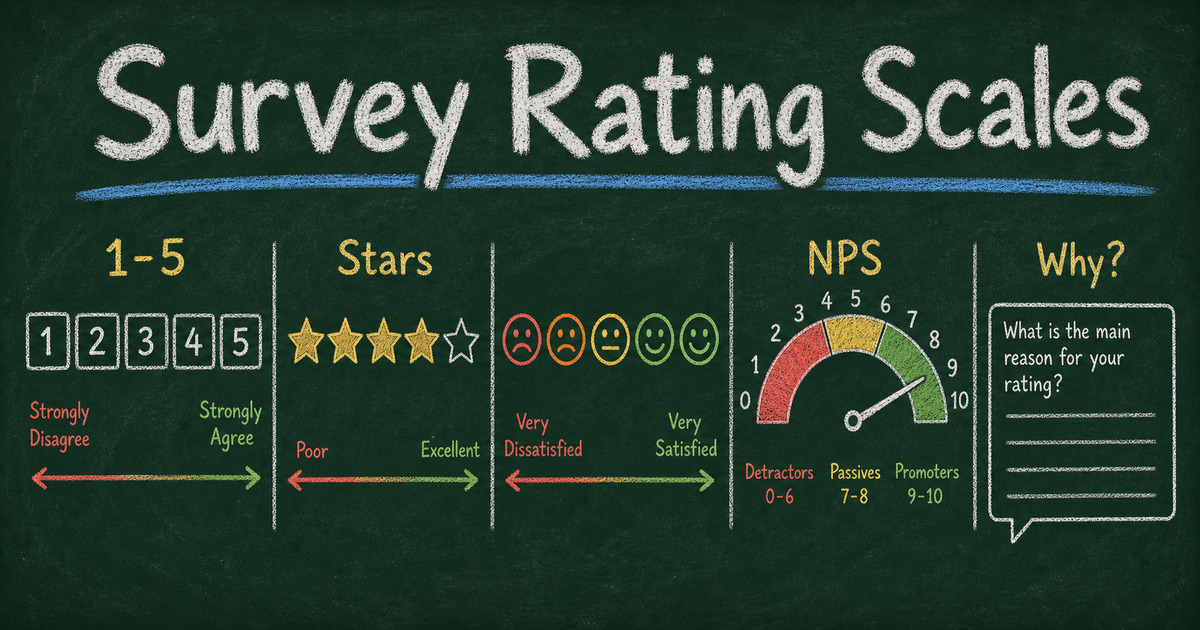
The scale you choose shapes the answer. It affects completion rate, bias, analysis, and whether the result tells you what to do next. Once the responses come in, survey result analysis helps you avoid treating one average score as the whole story.
This guide explains the most common survey rating scales, when to use each one, and how to combine ratings with follow-up questions so the score becomes useful.
TL;DR - A survey rating scale lets respondents express intensity: satisfaction, agreement, likelihood, quality, effort, frequency, or importance.
- Use 1-5 scales for simple feedback - they are fast, mobile-friendly, and easy to analyze.
- Use 1-10 or NPS for stronger differentiation - they create more spread but need clearer labels.
- Use stars or smileys for quick sentiment - they work best when precision is less important than ease.
- Works for: customer satisfaction, product feedback, employee surveys, event feedback, training, service quality, and market research.
- Always pair an important rating with one follow-up: “What is the main reason for your score?”
What Is a Survey Rating Scale?
A survey rating scale is a question format that asks respondents to choose a point on an ordered scale. The answer measures intensity rather than category.
Examples:
- How satisfied are you with your experience? 1 = Very dissatisfied, 5 = Very satisfied
- How likely are you to recommend us? 0 = Not at all likely, 10 = Extremely likely
- How easy was it to complete your task? Very difficult -> Very easy
- How would you rate this product? 1 star -> 5 stars
Rating scales are useful when “yes” or “no” is too flat. If you ask, “Were you satisfied?” you learn whether someone crossed a threshold. If you ask, “How satisfied were you?” you learn the degree.
For binary decisions, use dichotomous survey questions or the narrower yes or no survey questions. For ranking priorities, use ranking survey questions. For agreement statements, use Likert scale survey questions.
Quick Comparison: Common Survey Rating Scales
| Scale type | Best for | Strength | Weak spot |
|---|---|---|---|
| 1-5 rating scale | Satisfaction, quality, effort, confidence | Simple and mobile-friendly | Less nuance |
| 1-10 rating scale | Likelihood, performance, detailed scoring | More spread for analysis | Can feel arbitrary without labels |
| NPS 0-10 | Loyalty and recommendation | Standard benchmark | Not a full satisfaction survey |
| Star rating | Product, service, or experience reviews | Familiar and fast | Often lacks explanation |
| Smiley face scale | Quick sentiment, younger audiences, kiosks | Low reading burden | Less precise |
| Likert scale | Agreement with statements | Good for attitudes and beliefs | Can become repetitive |
| Poor-to-excellent scale | Service quality and performance | Clear verbal anchors | Needs consistent labels |
| Frequency scale | Behavior and habit questions | Captures how often something happens | Respondents interpret words differently |
1-5 Rating Scale
A 1-5 rating scale is the safest default for most surveys. It is short, familiar, and easy to answer on mobile.
Use it for:
- Customer satisfaction
- Product quality
- Support experience
- Event feedback
- Training usefulness
- Confidence after onboarding
- Ease of use
Example:
| Question | Scale |
|---|---|
| How satisfied are you with today’s workshop? | 1 = Very dissatisfied, 5 = Very satisfied |
| How easy was it to complete checkout? | 1 = Very difficult, 5 = Very easy |
| How useful was this training? | 1 = Not useful, 5 = Very useful |
The main advantage is completion. People understand 1-5 without thinking. The main weakness is compression: many answers cluster around 4, especially when people want to be polite.
Use a follow-up to make the score actionable:
What is the main reason for your rating?
1-10 Rating Scale
A 1-10 rating scale gives more room for nuance. It can work well when you need to compare groups, track change over time, or distinguish strong satisfaction from mild satisfaction.
Use it for:
- Product experience scores
- Training confidence
- Event quality
- Service performance
- Internal team pulse surveys
- Research studies where spread matters
The weakness is interpretation. One person’s 7 is another person’s 9. If you use 1-10, define the endpoints clearly and consider grouping results into ranges.
Example ranges:
| Score | Interpretation |
|---|---|
| 1-3 | Negative or blocked experience |
| 4-6 | Mixed or uncertain experience |
| 7-8 | Positive but improvable |
| 9-10 | Strong satisfaction |
For customer loyalty, use NPS instead of inventing your own 1-10 recommendation scale.
NPS Rating Scale
NPS, or Net Promoter Score, asks:
How likely are you to recommend us to a friend or colleague?
The scale runs from 0 to 10:
- 0-6: Detractors
- 7-8: Passives
- 9-10: Promoters
NPS is useful because it is standardized. Teams can track the score over time and compare segments. But NPS is not enough by itself. It tells you loyalty direction, not the reason.
Always add:
What is the main reason for your score?
For a full workflow, use NPS survey best practices or start from an NPS survey template.
Star Rating Scale
Star ratings are familiar because people see them in product reviews, app stores, hotels, restaurants, marketplaces, and service directories.
Use stars when the question is quick and experiential:
- How would you rate this product?
- How would you rate your visit?
- How would you rate the session?
- How would you rate this resource?
Stars are strong for simple public-facing feedback. They are weaker for research because respondents may interpret the same star count differently. A 3-star review could mean average, disappointing, or acceptable depending on the context.
If the rating matters, add a comment box:
What would have made this a 5-star experience?
Smiley Face Rating Scale
Smiley face scales reduce reading effort. They work well for fast sentiment collection, on-site feedback, simple kiosks, child-friendly surveys, and post-interaction feedback where the respondent should answer in seconds.
Use smileys for:
- Quick event feedback
- Service counter feedback
- Classroom pulse checks
- Simple satisfaction prompts
- Mobile-first feedback
Avoid smileys when you need precise analysis, formal research, or professional evaluation. The scale is expressive, but it can feel too casual for serious contexts.
Likert Scale
A Likert scale asks respondents how much they agree or disagree with a statement.
Example:
“The onboarding process made it clear what to do next.”
Scale:
- Strongly disagree
- Disagree
- Neither agree nor disagree
- Agree
- Strongly agree
Use Likert scales for beliefs, attitudes, perceptions, and agreement. They are stronger than a generic rating when you want to test a specific statement.
Good use:
- “The session materials were easy to follow.”
- “I understand how to apply this process in my work.”
- “The product feels worth the price.”
Weak use:
- “Rate our product.” That is not an agreement statement; use a rating scale instead.
For examples, see Likert scale survey questions.
Rating Scale Examples by Use Case
Customer satisfaction
- How satisfied are you with your overall experience? 1 = Very dissatisfied, 5 = Very satisfied
- How easy was it to get the help you needed? 1 = Very difficult, 5 = Very easy
- How likely are you to use us again? 1 = Very unlikely, 5 = Very likely
- What is the main reason for your rating?
For a full question set, use customer satisfaction survey questions.
Product feedback
- How would you rate the quality of this feature?
- How easy was it to complete your task?
- How valuable is this feature to your workflow?
- What should we improve first?
Event feedback
- How would you rate the event overall?
- How useful was the session content?
- How clear was the communication before the event?
- How likely are you to attend another event like this?
If your event starts with signups, pair this with event registration software or RSVP form setup.
Employee feedback
- How manageable is your current workload?
- How clear are your priorities this week?
- How supported do you feel by your manager?
- How confident are you in the team’s direction?
For more employee-oriented structures, see employee workplace survey templates.
Training and education
- How confident are you applying this concept?
- How useful was the training for your role?
- How clear were the examples?
- How likely are you to recommend this training to a teammate?
If the goal is to test knowledge rather than collect perception, use a training quiz or mini exam.
Copy-Ready Rating Scale Templates
Use these as starting points when you want a rating question that already has clear labels and a useful follow-up.
| Use case | Rating question | Scale labels | Follow-up |
|---|---|---|---|
| CSAT | How satisfied are you with your experience? | 1 = Very dissatisfied, 5 = Very satisfied | What is the main reason for your rating? |
| Event feedback | How would you rate the event overall? | 1 = Poor, 5 = Excellent | What should we change before the next event? |
| Training confidence | How confident do you feel applying what you learned? | 1 = Not confident, 5 = Very confident | What topic still feels unclear? |
| Product quality | How would you rate the quality of this feature? | 1 = Very poor, 5 = Excellent | What would make this feature more useful? |
| Employee pulse | How manageable is your current workload? | 1 = Not manageable, 5 = Very manageable | What would help most this week? |
| NPS | How likely are you to recommend us? | 0 = Not at all likely, 10 = Extremely likely | What is the main reason for your score? |
The pattern is the same across all six: ask for one score, define the endpoints, then ask for the reason. If you are building a broader feedback program, start from FormHug’s survey maker or the surveys and feedback templates.
Best Practices for Survey Rating Scales
Label the endpoints clearly
Do not assume people know what 1 and 5 mean. Always define the endpoints:
- 1 = Very dissatisfied
- 5 = Very satisfied
For important surveys, label every point or use verbal options.
Keep the direction consistent
Do not make one question run negative-to-positive and the next run positive-to-negative. It creates errors and makes the survey feel like a trap.
Use neutral options deliberately
A 5-point scale usually includes a neutral middle. That is useful when neutrality is real. If you need a forced choice, use an even-numbered scale, but know that it may frustrate people who genuinely feel neutral.
Ask one thing at a time
Weak:
How satisfied are you with the price and support?
Better:
How satisfied are you with the price? How satisfied are you with the support?
Double-barreled rating questions produce scores you cannot interpret.
Add one open-ended follow-up
A score without a reason is a signal, not an insight. Add one follow-up after important ratings:
- What is the main reason for your score?
- What would have made this better?
- What should we improve first?
- What worked especially well?
For richer qualitative input, use open-ended survey questions.
How to Build a Rating Scale Survey in FormHug
Step 1: Choose the decision
Start with the decision the survey should support. Are you improving onboarding, measuring event quality, prioritizing product work, or tracking customer loyalty?
The decision determines the scale. Satisfaction, effort, confidence, recommendation, and frequency are different measurements.
Step 2: Pick the scale type
Use 1-5 for most feedback. Use NPS for recommendation. Use Likert for agreement. Use stars or smileys when speed matters more than research precision.
In FormHug, you can create the survey with AI, start from a survey template, or build manually with rating, NPS, multiple choice, and text fields. If you are starting from a blank idea, the AI form builder can draft the first version from a prompt such as “Create a post-event feedback survey with a 1-5 satisfaction rating, an NPS question, and conditional follow-up questions.”
Step 3: Add conditional follow-ups
Use conditional logic to keep the survey short:
- If rating is low, ask “What went wrong?”
- If rating is high, ask “What worked well?”
- If NPS is 0-6, ask what would need to change.
- If NPS is 9-10, ask what they would recommend to others.
This makes the survey feel more relevant than asking everyone the same long set of questions.
Step 4: Review results by segment
Do not only look at the average. Compare ratings by audience, product, event, plan, location, or role. A 4.2 average may hide one segment at 2.8 and another at 4.9.
For broader survey setup, read how to create an online survey for free and the free survey maker guide.
Frequently Asked Questions
What is the best rating scale for a survey?
For most surveys, a 1-5 rating scale is the best default because it is simple, familiar, and easy to answer on mobile. Use NPS for recommendation, Likert scales for agreement, and stars or smileys for quick sentiment.
Is a 1-5 or 1-10 scale better?
Use 1-5 when you want simplicity and high completion. Use 1-10 when you need more spread, benchmarking, or detailed segmentation. A 1-10 scale needs clearer labels because respondents interpret numbers differently.
What is the difference between a rating scale and a Likert scale?
A rating scale is any ordered scale used to measure intensity. A Likert scale is a specific rating scale used to measure agreement with a statement.
Should rating scales include a neutral option?
Include a neutral option when neutrality is a valid answer. Remove it only when you need a forced choice and are comfortable making undecided respondents choose a side.
How many rating scale questions should a survey include?
For quick feedback, use one to three rating questions plus one open-ended follow-up. For deeper research, use more, but group related ratings and avoid repeating the same scale too many times.
Can rating scales measure customer satisfaction?
Yes. Rating scales are commonly used for CSAT, NPS, customer effort, product quality, support quality, and post-purchase feedback.
What should I ask after a low rating?
Ask for the reason and the most useful next action: “What is the main reason for your score?” and “What should we improve first?” Keep the follow-up short.
Related
- Likert Scale Survey Questions - write agreement scales for attitudes and perceptions
- Customer Satisfaction Survey Questions - combine CSAT ratings with reason and action questions
- NPS Survey Best Practices - use the 0-10 recommendation scale correctly
- Open-Ended Survey Questions - add qualitative follow-ups that explain the score
A rating scale is only useful when the number leads somewhere. Pick the scale that matches your decision, ask one reason behind the score, and keep the survey short enough for people to finish. Create your rating scale survey ->

Written by
FormHug TeamProduct, research, and form automation team
The FormHug Team brings together product builders, workflow researchers, and form automation practitioners who study how people collect, route, and act on information online. Our guides are based on hands-on product testing, template analysis, customer workflow patterns, and deep experience with forms, surveys, quizzes, AI-assisted creation, integrations, and results sharing.